Home / About
About Diamond Consulate
We did not build
another jewelry store.
We built the place we wished already existed.
We built the place we wished already existed.
Fine jewelry has spent a very long time perfecting the sale.
We wanted to improve the decision.
Most jewelry stores are organized around inventory.
Cases first.
Questions second.
Speed somewhere close behind.
That structure works for many purchases. It works less well when someone is choosing an engagement ring, comparing natural and laboratory-grown diamonds, redesigning inherited jewelry, or trying to explain a custom piece that does not exist yet.
Diamond Consulate was built around those decisions instead.
Before the diamond, there is a person.
Before the setting, there is a life the jewelry has to fit.
Before the custom design, there is usually a reason: a proposal, an anniversary, a family stone, a new chapter, or something that has been imagined for years.
That is why the consultation comes first.
You sit down. We listen. We ask better questions than, “What carat size were you thinking?”
The jewelry comes after we understand what it needs to do.
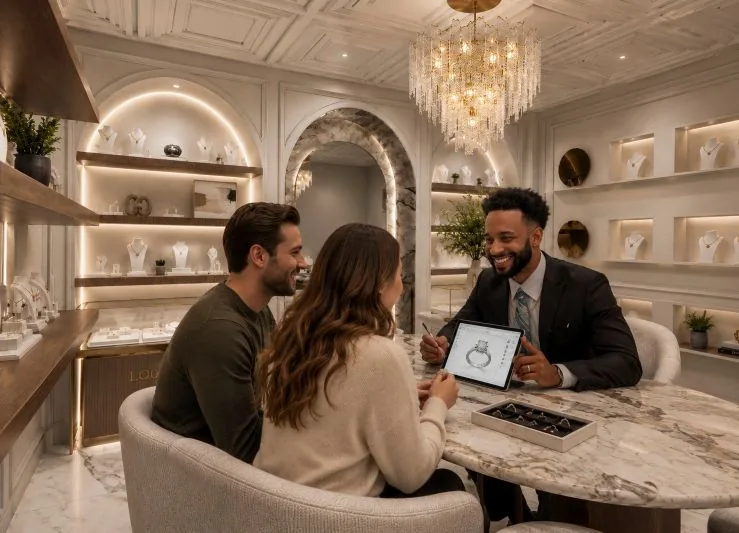
Budgets are easier to discuss without an audience.
So are proposal plans.
So is the question, “Is this family diamond actually worth using?”
The studio is reserved so the conversation can be honest, uninterrupted, and prepared in advance.
That preparation may include loose diamonds, gemstones, design references, an existing ring, or notes about an heirloom piece.
It is a quieter way to buy jewelry.
Quiet tends to improve expensive decisions.
Explore the ConsultationThe consultation is not where we sell jewelry. It is where people stop guessing.
See how it works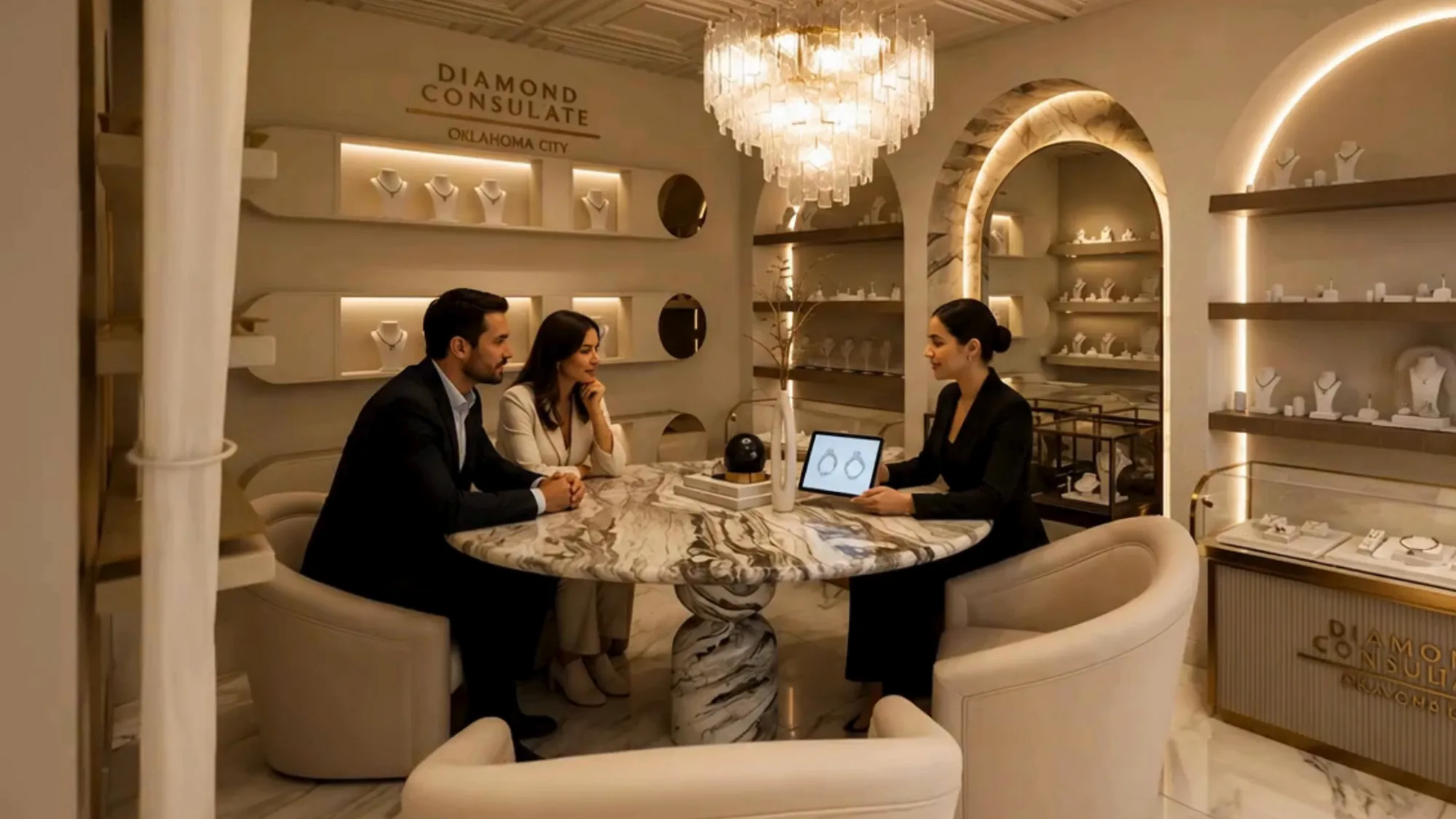
Western Avenue already understands the difference between an errand and an evening.
Restaurants. Independent businesses. Established neighborhoods. A part of Oklahoma City people choose to spend time in, not simply pass through.
That made sense for Diamond Consulate.
Have dinner first. Come to the studio afterward. Compare diamonds. Watch a design take shape. Ask the questions you would not ask standing at a crowded counter.
Nobody accidentally spends ninety minutes designing an engagement ring between buying shoes and finding the food court.
Visit the Oklahoma City StudioThe better question is: what matters to you?
A natural diamond formed over geological time, carries scarcity, and may feel more appropriate for clients who place value on origin, rarity, and long-term emotional symbolism.
A laboratory-grown diamond can provide more visible size or higher specifications within the same budget. For many clients, that is the more sensible decision.
Sometimes the recommendation is natural.
Sometimes it is laboratory-grown.
Sometimes it is a smaller diamond with a better cut.
The right answer is the one that fits the person, the budget, and the reason for buying.
Compare Natural and Lab-Grown DiamondsPeople understand diamonds more quickly when they can compare them side by side.
Different cuts.
Different proportions.
Natural and laboratory-grown.
Different price points.
A grading report explains measurements. The Diamond Table shows what those measurements actually look like.
It is where people stop buying numbers and start choosing the diamond.
Traditional custom design often involves explaining the idea, waiting for a rendering, emailing changes, and waiting again.
Here, the screen turns toward you.
The ring appears in three dimensions. Band width, setting height, contour, side stones, prongs, halos, and proportion can be adjusted while you watch.
You do not have to imagine what “slightly lower” means.
You can see it.
Explore Live CAD DesignInspiration is useful.
Imitation is less interesting.
A photograph can show the proportion you like, the kind of detail you notice, or the part you would change. That is usually where the real design begins.
The finished piece should suit the wearer, the stones, the hand, the lifestyle, and the years ahead.
A beautiful ring that catches on everything, sits too high, cannot be worn with a wedding band, or feels wrong after six months is not a successful design.
Custom should mean more considered.
Not merely less available.
Explore Custom JewelryChris has spent nearly four decades in fine jewelry and at the bench.
He approaches design from the perspective of the person who eventually has to make the piece work in metal, hold the stones securely, survive daily wear, and still look refined from every angle.
That matters because a rendering can be beautiful and still be poorly engineered.
Chris has operated in fine jewelry since 2003 and helped shape Diamond Consulate around the parts of the business clients rarely see: structure, craftsmanship, stone setting, repairability, and what happens to jewelry after the first photograph.
Donovan guides clients from the first conversation through design direction and final approval.
His work includes custom engagement rings, wedding bands, statement pieces, gemstone jewelry, and heirloom redesign.
He holds the Accredited Jewelry Professional diploma from the Gemological Institute of America, with training in diamond fundamentals, colored stones, and jewelry product knowledge.
He is likely to ask how the jewelry will be worn before asking which trend you have saved most often.
The first question usually produces the better ring.
Diamond Consulate was not built to see as many clients as possible.
There are two consultation studios.
That limits how many conversations can happen at once.
Good.
The limit protects the reason the studio exists: one-on-one attention, preparation, discretion, and enough time to reach the right decision without turning the experience into a showroom floor.
What appears in the cases is there to begin a conversation.
Not end one.
Good jewelry should not require pressure.
Questions are part of the process.
Smaller can be better.
Larger can also be better, when that is actually the goal.
Laboratory-grown is not “less.”
Natural is not automatically “more.”
The grading report is not the diamond.
A custom piece should fit the life it is entering.
The proposal matters.
The next forty years matter more.
Diamond Consulate is a consultation-led jewelry studio in Oklahoma City specializing in custom engagement rings, natural and laboratory-grown diamonds, wedding bands, wedding rings, custom jewelry, heirloom redesign, The Diamond Table, and Live Collaborative CAD Design.
Diamond Consulate is located at 5701 N Western Avenue, Suite B, Oklahoma City, OK 73118, near Classen Curve and a few minutes from Nichols Hills.
The experience is built around one-on-one consultations rather than open retail traffic. The room, designer, and relevant diamonds or gemstones are prepared before the client arrives.
Diamond Consulate was founded by the ownership behind a fine jewelry business operating since 2003, including master jeweler Chris Uptain.
Custom jewelry design is led in the studio by Chris Uptain and Donovan Smith, with the client participating in design decisions through conversation and Live Collaborative CAD Design.
The Diamond Table is the in-person diamond comparison experience at Diamond Consulate, where natural and laboratory-grown diamonds, different cuts, proportions, and price points can be evaluated side by side.
Live Collaborative CAD Design allows clients to see a custom ring or jewelry model develop on screen and participate in changes to proportion, setting height, band width, stone placement, and detail before production.
Yes. Diamond Consulate offers both natural and laboratory-grown diamonds and explains the differences in origin, price, rarity, resale, appearance, and value without assuming one option is right for every client.
Yes. Custom engagement rings can begin with diamond selection at The Diamond Table and continue through Live Collaborative CAD Design.
Yes. Inherited diamonds, gemstones, rings, brooches, pendants, and other family pieces can be evaluated for redesign, resetting, restoration, or preservation.
Yes. Services include fitted and contoured wedding bands, wedding rings, eternity bands, men’s wedding bands, engraving, and coordinating custom designs.
Reservations allow the studio, designer, time, and relevant diamonds, gemstones, or design references to be prepared around each client and project.
No. Many consultations begin with a screenshot, an inherited stone, an existing ring, or only a general idea. Clarifying the direction is part of the process.
Yes. Inspiration images can help identify proportion, style, detail, and what the client would change. The goal is to create an original, wearable design suited to the person and project.
Bring the questions.
Bring the ring.
Bring the family diamond.
The conversation starts there. Reserve Your ConsultationOpening November 2026 · Reservations available now · (405) 805-1050
“Chris put the diamonds side by side and let our eyes make the first decision. The comparison made the grading reports far easier to understand.”
“Donovan explained where the certificate mattered and where the visible difference was minimal. That clarity helped us spend on what we could actually appreciate.”
“We expected a sales presentation and received an education instead. We left confident about the diamond because we had compared it in real life.”