That makes choosing it worth a little more thought than five minutes at a display case.
Stay with you.
Through work.
Travel.
Weekends.
Children.
Weight changes.
Forty summers in Oklahoma.
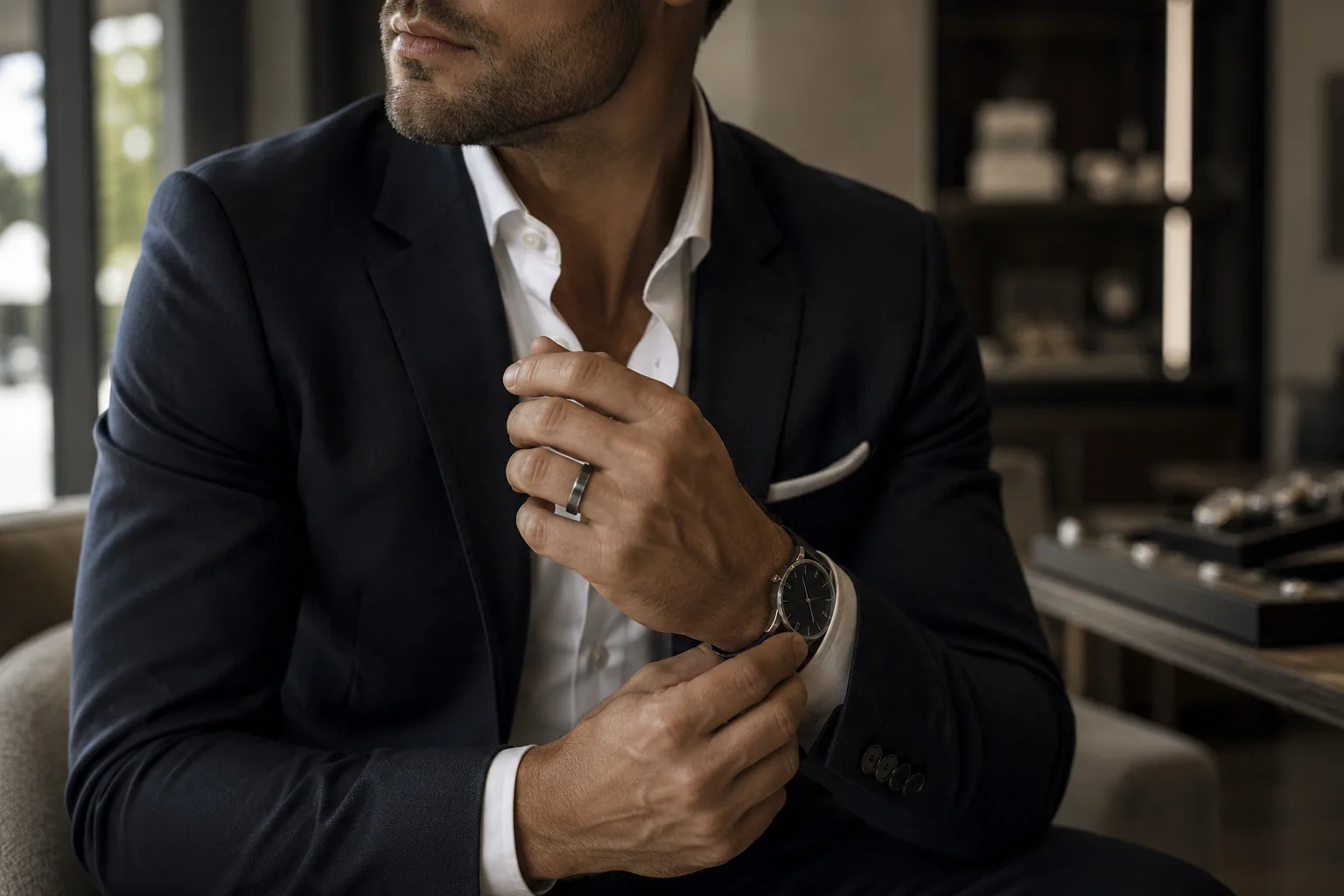
A men’s wedding band is not chosen for one photograph. It is chosen for decades of ordinary days.
That is why comfort, repairability, sizing, width, and metal matter more than whichever finish looked best under showroom lighting.
The band should work now.
It should also be capable of changing later.
Gold and platinum can generally be resized, refinished, repaired, and rebuilt by a skilled jeweler. That flexibility matters because fingers, jobs, habits, and hands rarely remain identical for four decades.
Alternative metals such as tungsten, titanium, cobalt, and ceramic offer real advantages, including affordability, distinctive weight, and scratch resistance. They also come with limitations involving resizing and repair.
Scratch resistance sounds impressive until the ring no longer fits.
Neither choice is automatically wrong. The tradeoffs simply deserve to be understood before the engraving is added.
| Metal | How it feels | Long-term reality | Often chosen by |
|---|---|---|---|
| Platinum | Dense, substantial, naturally white, and noticeably heavier than gold. | Can generally be resized and repaired. Develops a soft patina rather than staying mirror-bright forever. | Someone who likes weight, understated luxury, and a naturally white metal. |
| 14k Yellow Gold | Warm, traditional, durable, and lighter than platinum. | Can generally be resized, refinished, and repaired. A practical choice for everyday wear. | Someone who wants a classic band without making the decision complicated. |
| 14k White Gold | Bright white appearance with a lighter feel than platinum. | Usually rhodium-plated, so periodic replating may be needed as the surface wears. | Someone who wants a white-metal look at a lower initial price than platinum. |
| 18k Gold | Richer color and a slightly softer, more substantial luxury feel. | Can generally be resized and repaired. It may show wear sooner than 14k because of its higher gold content. | Someone who values richer color and does not mind visible signs of wear. |
| Rose Gold | Warm with a subtle copper tone that can feel both modern and traditional. | Can generally be resized and repaired, subject to the design. | Someone who wants warmth without choosing conventional yellow gold. |
| Tungsten | Heavy, hard, and highly resistant to surface scratching. | Usually cannot be resized or conventionally repaired and can fracture under a severe impact. | Someone prioritizing scratch resistance, weight, and lower cost. |
| Titanium | Very light, modern, and comfortable for someone who dislikes heavy jewelry. | Often difficult or impossible to resize, depending on construction. | Someone who wants to barely feel the ring on the hand. |
| Cobalt | Bright, white, substantial, and generally harder than precious metals. | Resizing and repair options are limited and depend on the manufacturer and design. | Someone seeking a bright alternative-metal appearance. |
| Ceramic | Light, smooth, and available in distinctive colors, especially black. | Highly scratch-resistant but brittle compared with metal and generally not resizable. | Someone prioritizing a modern appearance and lower maintenance. |
There is no universal best metal.
There is only the best metal for the person, the work, the budget, and how important future resizing or repair may be.
Most men spend more time researching a lawn mower than the ring they intend to wear every day.
Give the ring thirty minutes
Width. Most men begin somewhere between 5mm and 7mm, but hand shape, finger length, ring size, and personal taste matter more than a standard recommendation.
Thickness. A ring can look restrained from the top and still feel bulky between the fingers. Profile matters.
Comfort fit. A rounded interior often moves over the knuckle more easily and feels less constricting during the day.
Edges. Flat, rounded, beveled, stepped, and knife-edge profiles all meet the neighboring fingers differently.
Weight. Some men want to feel the ring. Others want to forget it is there. Neither group is being unreasonable.
A ring that feels heavy after fifteen minutes does not usually become lighter after fifteen years.
Photographs are useful for style.
They are nearly useless for width.
A 5mm band can look substantial on one hand and almost delicate on another. A 7mm band can feel confident on the screen and intrusive between the fingers.
The fastest answer is to try several widths, profiles, and weights on the same finger.
Most men know within thirty seconds.
They simply need the bands in front of them.
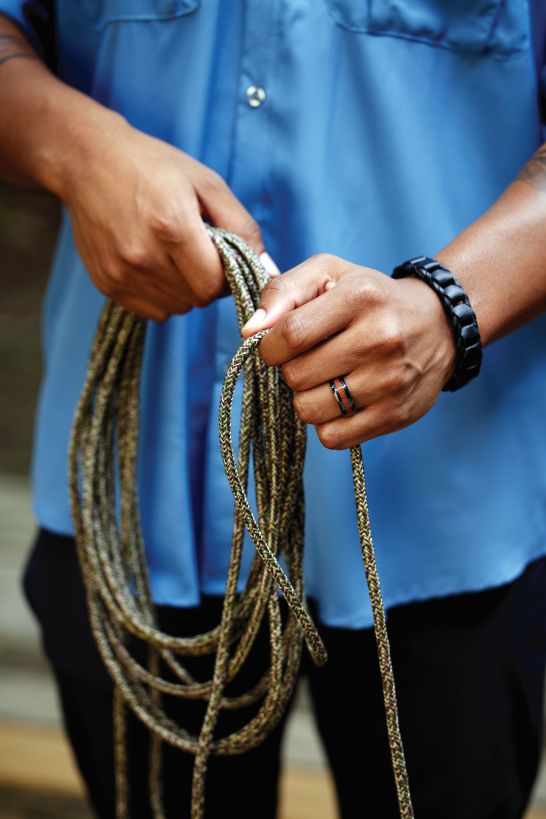
Low profiles, durable precious metals, restrained edges, and finishes that age gracefully often make more sense than high-polish surfaces or raised stone settings. Safety policies may also require the ring to be removed during some work.
Gloves, handwashing, swelling, equipment, and workplace protocols all influence width, profile, stone placement, and whether a separate silicone work band is practical.
Comfort, appearance, and personal style can lead the decision because the ring is less likely to meet heavy equipment or repeated impact.
Comfort across changing climates and swelling, understated design, and the ability to service the ring over time may matter more than elaborate surface detail.
No wedding band should be worn through every activity simply to prove commitment. A secure place to store the ring and a silicone alternative may be the smartest design feature of all.
Texture, mixed finishes, engraving, unusual profiles, blackened details, stones, and custom CAD design can create something personal without becoming theatrical.
The best men’s wedding band is not the toughest ring on the internet.
It is the one that makes sense for the life wearing it.
Polished. Bright and formal. It shows scratches readily, particularly in the first few weeks when every mark feels personal.
Brushed or satin. Soft, directional texture that tends to blend daily wear more easily.
Matte. Quiet, modern, and understated, though the surface can burnish over time.
Hammered. Irregular texture that gives the ring character and makes new marks less obvious.
Sandblasted. Fine texture with a softer visual presence; it may need refreshing as high points polish through wear.
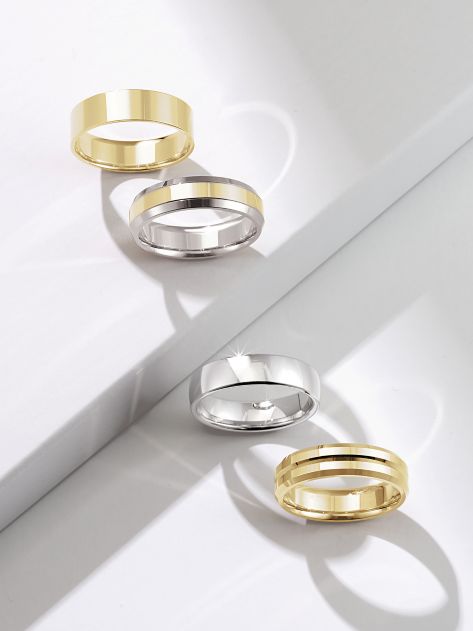
Mixed finish. Polished edges with a brushed center, or the reverse. Useful when one finish alone feels too plain.
Classic dome. Traditional, rounded, and visually softer.
Flat. Clean and architectural, with a more modern presence.
Beveled edge. Adds definition without requiring ornament.
Step edge. Creates contrast between levels and works particularly well with mixed finishes.
Knife edge. More directional and distinctive, though not every hand finds it comfortable.
Custom contour. Developed through Live Collaborative CAD Design when the standard profiles all feel almost right.
Men’s and women’s wedding rings do not need to be identical.
They do not even need to be the same width, finish, or exact design.
Couples often connect the rings through one detail:
The same metal.
A shared engraving.
A matching edge.
A stone from the same source.
A finish repeated in different proportions.
They should look like they belong to the same marriage.
They are not required to look like they came in the same box.
Explore Wedding BandsA men’s diamond wedding band does not have to look ornamental.
A single flush-set diamond.
A row of channel-set stones.
Black diamonds in a darkened recess.
A hidden birthstone or diamond set inside the band.
Stone setting should suit the work, the profile, and the maintenance the wearer is willing to accept.
The quieter version is often the more interesting one.
A custom men’s band may involve only a few decisions.
The exact width.
A particular weight.
A beveled edge.
A finish that continues through the side profile.
A hidden engraving no one else sees.
That may not sound dramatic.
It is still the difference between a ring selected from a tray and a ring designed around the wearer.
Custom men’s wedding bands can be developed through Live Collaborative CAD Design.
Make the bevel narrower.
Reduce the thickness.
Compare a 6mm band with a 7mm version.
Move the diamond.
Add the engraving.
You do not have to interpret a technical description.
You can see the ring before it becomes metal.
Explore Live CAD DesignMost men who have never worn jewelry choose a slightly narrower band than they first imagined.
Comfort fit helps more than most decorative details.
Brushed and matte finishes often feel less precious during the first year because daily marks blend more naturally.
Platinum is excellent for someone who enjoys weight and patina.
14k gold is excellent for someone who wants durability, serviceability, and fewer complications.
Alternative metals can be excellent when their limitations are acceptable.
The right width becomes obvious faster on the hand than on a screen.
And no ring should be worn around machinery simply because it is a wedding ring.
There is no universal best metal. Platinum offers weight, a naturally white color, repairability, and a soft patina. Fourteen-karat gold offers durability, repairability, several colors, and a lighter feel. Alternative metals may offer greater scratch resistance or lower cost but often have limited resizing and repair options.
Durability depends on what kind of damage matters. Tungsten resists surface scratching but can fracture and usually cannot be resized. Gold and platinum scratch more easily but can generally be serviced, resized, refinished, and repaired. Long-term durability is not the same as scratch resistance.
Not necessarily. These materials can be attractive, affordable, light or highly scratch-resistant. The important tradeoff is that resizing and repair options may be limited or unavailable. Choose them when those limitations are acceptable rather than because the limitations were never mentioned.
Many men choose between 5mm and 7mm, but the right width depends on ring size, finger length, hand shape, comfort, and personal style. Trying several widths on the same hand is more reliable than choosing from photographs.
Six millimeters is a common middle width because it feels substantial without being unusually wide. It is a useful starting point, not a rule.
Comfort fit refers to a rounded interior profile that can slide over the knuckle more easily and reduce the feeling of pressure at the edges. Sizing may differ from a flat-fit band, so the finished profile should be considered during measurement.
Brushed, satin, matte, hammered, and textured finishes often blend everyday marks more naturally than a mirror polish. Work involving machinery, electrical equipment, climbing, or heavy impact may require the ring to be removed regardless of metal or finish.
Every wearable material changes with use. Gold and platinum will scratch and develop wear. Tungsten and ceramic resist surface scratching more strongly but can chip or fracture. Finishes can also burnish or change over time.
Many gold and platinum bands can be resized, but the amount depends on the design, metal, width, engraving, stones, patterning, and construction. Full-eternity stones, continuous patterns, and some inlays may limit future sizing.
Most tungsten bands cannot be resized. Many titanium bands also cannot be resized conventionally, although some manufacturers offer replacement programs. Confirm the policy before purchasing.
It should feel secure without causing pain or persistent pressure. It should move over the knuckle with some resistance and sit comfortably once in place. Finger size changes with temperature, activity, hydration, and time of day, so measurement should not rely on one rushed fitting.
That is very common. Begin by trying several widths, weights, and interior profiles. Men who have never worn jewelry often prefer a narrower, lower-profile, comfort-fit band once they compare the options on the hand.
No. The rings can be connected through metal color, engraving, finish, edge detail, or symbolism without being identical. They should suit the individuals wearing them.
Yes. Options include flush-set diamonds, channel-set stones, black diamonds, a single exterior accent, or a hidden diamond or birthstone inside the band. The setting style should reflect the wearer’s work and maintenance preferences.
Yes. Custom bands can be designed around the exact width, thickness, profile, finish, stones, engraving, and weight the wearer prefers. Live Collaborative CAD Design allows the proportions to be reviewed before production.
Yes. Engraving can include dates, initials, handwriting, coordinates, short messages, symbols, patterns, or hidden interior details, subject to the band width and design.
Pricing depends on metal, width, thickness, ring size, weight, construction, finish, engraving, stones, and whether the ring is custom. A precise quote is provided after the design and material choices are established.
Allow at least six to eight weeks for many custom projects, with additional time before the wedding for final fitting or adjustment. More complex designs may require longer. Bring the wedding date to the consultation so the production plan can be realistic.
Remove the ring for activities involving heavy weights, machinery, climbing, electrical work, impact, or any situation where the ring could catch, compress, or place the finger at risk. A silicone band may be useful when workplace rules permit one.
Diamond Consulate offers one-on-one men’s wedding band consultations at 5701 N Western Avenue, Suite B, Oklahoma City. Clients can compare widths, weights, metals, profiles, finishes, and custom options in person.
Try the widths.
Feel the weight.
Compare the edges.
Then choose the ring you can imagine forgetting you are wearing.
Reserve a Men’s Wedding Band ConsultationOpening November 2026 · Reservations available now · (405) 805-1050