Home  /  CAD Design
CAD Design

Watch your ring
appear on the screen.

Everywhere else, you describe what you want and wait days for an email. Here, the designer turns the monitor toward you and builds it while you sit there.

The Difference

This is not how
jewelry design normally works.

The standard process in this industry goes like this. You sit with a salesperson and describe what you want. They write it down. The notes go to a designer somewhere else, often in another state, sometimes overseas, who has never met you and never will. Two to four days later a rendering arrives in your inbox.

It isn't right. It never is the first time. So you write back describing the change, and wait again. Three rounds of that is two or three weeks, and somewhere in the middle most people stop asking for changes, not because the ring is right, but because they are tired of the loop.

That is how the majority of custom rings in America actually get designed, and it is why so many of them end up being the third-closest thing the buyer was willing to settle for.

What Happens Instead

The monitor turns
toward you.

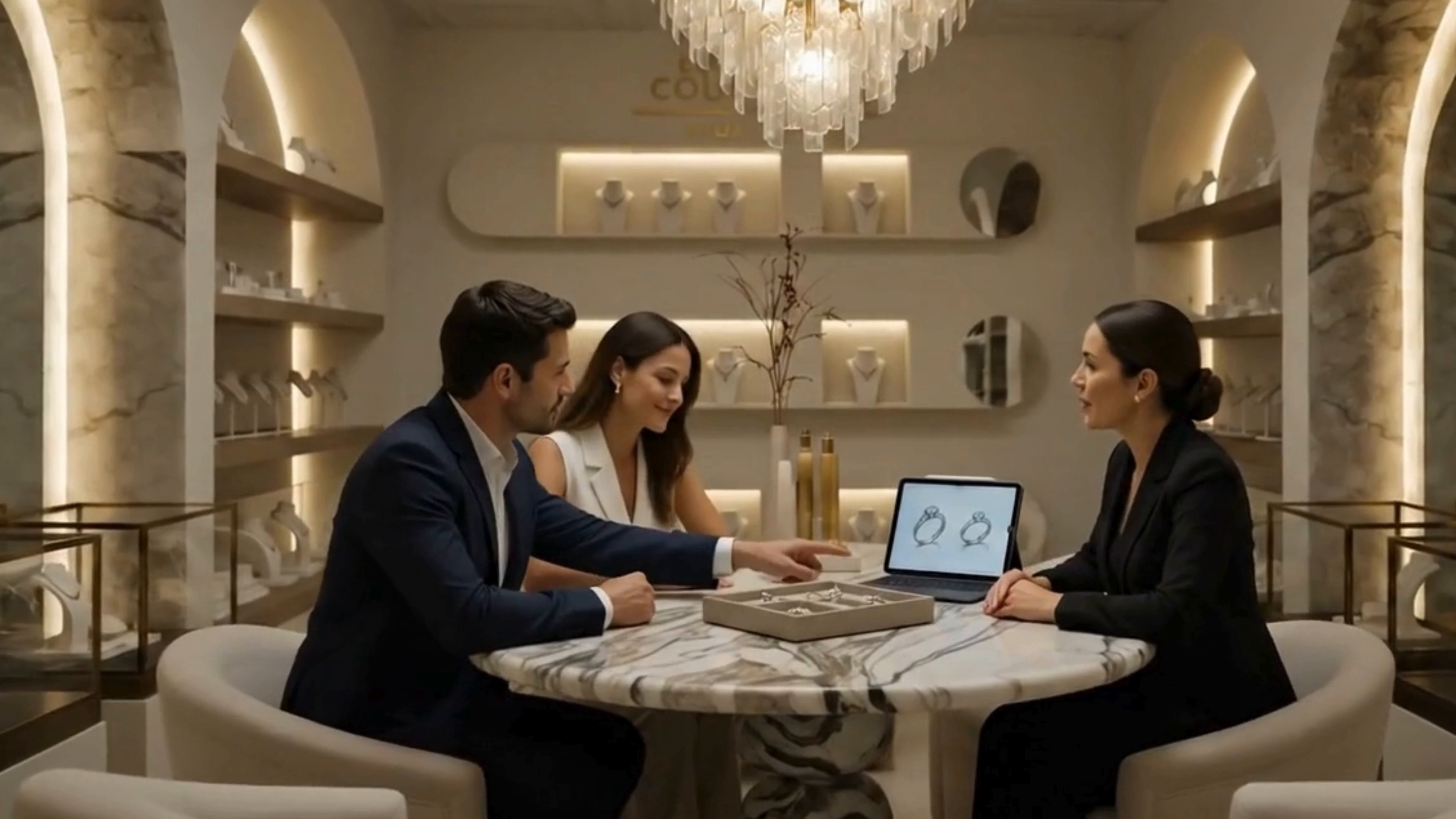
You sit down. The designer opens a blank file, and over the next hour your ring appears on a screen angled so you can see it — rotating, in three dimensions, at actual scale.

You say the band looks heavy. He thins it, and you watch it thin. You ask what it looks like with the stone set lower. It sits lower, in about fifteen seconds. You wonder whether the hidden halo will actually read from the side. He rotates the model to a side view and you see the answer for yourself instead of being told.

By the end of the appointment there is a finished design that you watched take shape, changed a dozen times, and approved with your own eyes, rather than a PDF you were left to interpret alone.

People find it absorbing. Two hours regularly go by without anyone noticing, which is part of why we hold appointments until ten on a Friday.

Side By Side

How custom design usually goes,
and how it goes here.

Nearly everywhere elseDiamond Consulate
Who models itAn off-site designer you never meetThe master jeweler sitting next to you
When you first see it2–4 days later, by emailDuring your appointment, live on screen
Making one changeEmail, wait, receive, repeatSay it and watch it happen, in seconds
Revision rounds2–3, spread over 2–3 weeksAs many as you want, in one sitting
Answering "what if"Costs a full cycle, so most people stop askingCosts nothing, so people keep asking
What you finally approveA render you interpreted on your ownA design you watched take shape
BuildabilitySometimes modeled by someone who has never set a stoneModeled by the person who has to make it work

We are not aware of another jeweler in the Oklahoma City metro doing custom CAD design live, in front of the client, during the appointment. If you find one, we would like to know, and either way, this is worth asking any jeweler you are considering.

Definition

In-person CAD design means the three-dimensional model of your ring is created in front of you, in real time, by the person who will build it, so revisions happen in the same appointment rather than across a week of emails.

The technology itself is not unusual. Nearly all custom jewelry made today starts as a CAD file, gets 3D-printed in resin, and is cast from that pattern. What's unusual is who operates it and where.

The conventional arrangement is that a salesperson takes your description, sends it to an off-site designer, and returns a rendering days later. Every correction costs another cycle. Two or three rounds becomes two or three weeks, and the ring quietly drifts toward whatever is easiest to model rather than what you asked for.

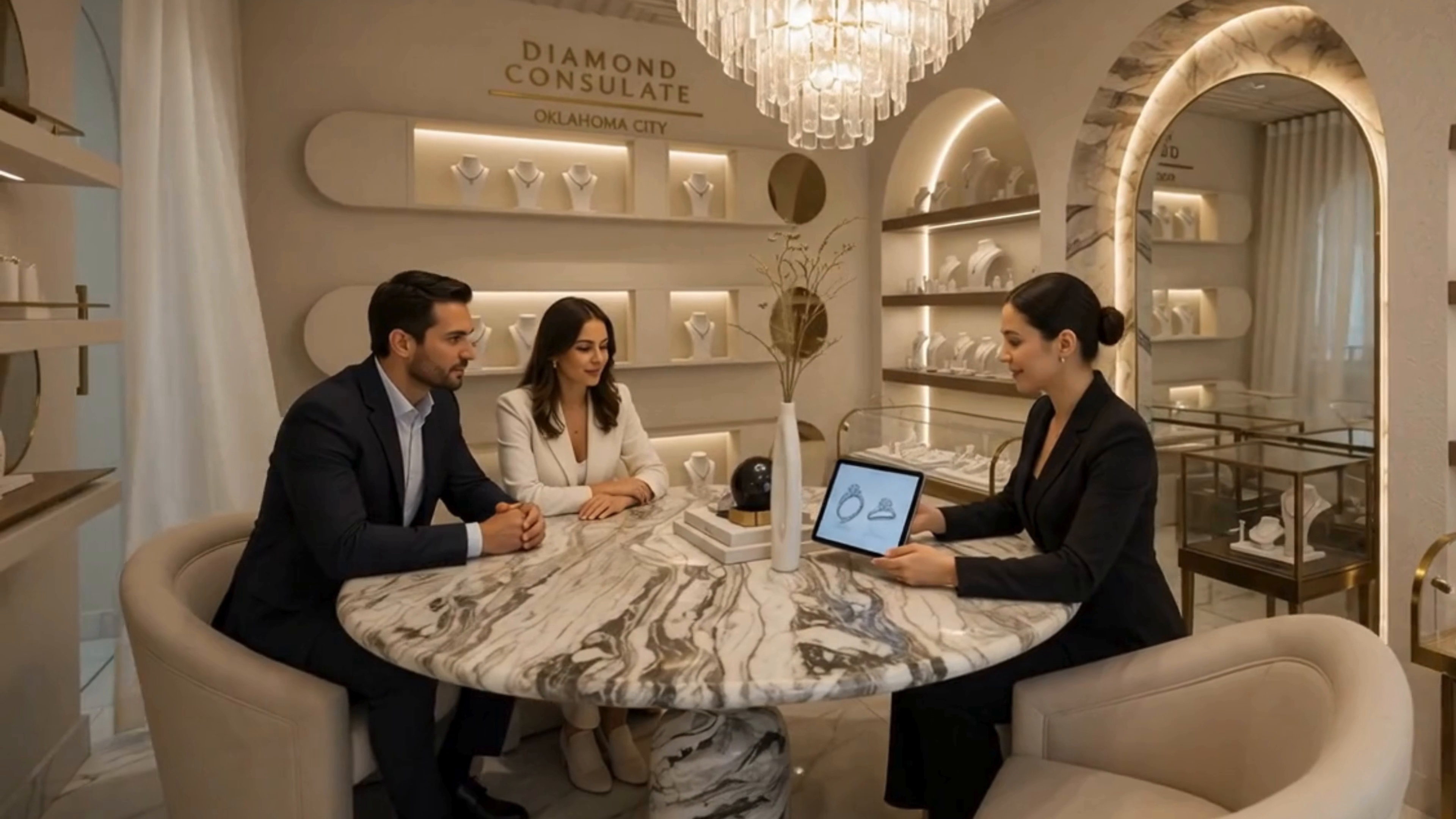
In-house CAD design at Diamond Consulate, Oklahoma City.
In the Room

Changes take
seconds, not days.

Sit beside the designer and the questions become concrete. Should the prongs be lower so it sits under a glove? Is the band too thick for her hand? Does the hidden halo read from the side at this height?

Each of those is a thirty-second adjustment on screen and a visible answer immediately. The ring you approve is the ring you actually wanted, rather than the third-closest thing you were willing to stop iterating on.

For complicated pieces we'll 3D-print the resin model so you can try the shape on a finger before a gram of gold is cut.

Bring a photo of something close. We’ll model the differences while you sit there.

Book a design session
Who Runs It

The designer is also the maker.

Chris Uptain has spent thirty years at the bench. That matters at the CAD stage more than anywhere else, because a designer who has never set a stone will happily model a ring that cannot actually be built. Prongsprongs.

When the person modeling it is the person who has to make it work, those problems get designed out before you ever see them.

Meet the team
From File to Finger

What happens after
you approve it.

The CAD model is not the ring. It's the instruction set for making one, and the process from there is a mix of very modern technology and technique that hasn't changed much in a hundred years.

  1. I

    Resin pattern

    The approved file is 3D-printed in castable resin at extremely fine resolution. Aa.

  2. II

    Investment and burnout

    The pattern is surrounded in plaster investment and heated until the resin burns out entirely, leaving a perfect void in the shape of the ring.

  3. III

    Casting

    Molten gold or platinum is drawn into the cavity under vacuum or centrifugal force. The plaster is broken away and the rough casting emerges.

  4. IV

    Finishing by hand

    Filed, sanded through progressive grits, and polished. This stage is entirely manual and it's where the difference between adequate and excellent gets decided.

  5. V

    Setting

    Stones set under magnification, prongs formed and burnished over each one. Then a final polish and, if the design calls for it, hand engraving or milgrain applied with a wheel.

People sometimes assume 3D printing means the ring is printed. It isn't. The pattern is printed, and printing replaced the hand-carving of wax models. Everything after that is the same craft it has always been.

CAD Questions
What is CAD in jewelry design?

CAD stands for computer-aided design. A jeweler builds a precise three-dimensional model of your ring on a computer, which is then used to 3D-print a resin pattern, cast the metal, and set the stones. It's how nearly all custom jewelry is manufactured today.

Why does doing CAD in person matter?

Because revision cycles collapse from days to minutes. In the standard model you describe what you want, wait two to four days for a rendering, email a correction, and wait again. Sitting beside the designer, a change to prong height or band width happens while you watch.

Do I get to see the ring before it's made?

Yes. You'll see photorealistic renders from every angle, and for complex pieces we can 3D-print a resin model you can physically try on before we cast anything in metal.

Is there a design fee?

Design time is included in the price of the piece. If you decide not to proceed, there's no charge for the appointment or the CAD work.

Can you work from a photo?

Yes. Aa. Most projects start from a picture of something close but not quite right, and the design work is in identifying what to change.

What happens after the CAD is approved?

The file is used to 3D-print a pattern in castable resin, which is then invested in plaster and burned out, leaving a cavity that molten metal is cast into. The rough casting is filed, sanded and polished by hand, then the stones are set. It's a mix of very modern and very old technique.

Can I keep the CAD file?

The design is yours. Ask and we'll provide the renders, which are what most people actually want, for insurance records, or to have.

How many revisions do I get?

As many as it takes. There's no charge for changing your mind before casting, which is exactly why we do it in front of you rather than across email.

Can you copy a ring I've seen elsewhere?

We can work from an image as a starting point, and we'll usually suggest changes — proportions that suit her hand, a band width that works better, a profile that sits under a glove. Direct copies of another designer's distinctive protected work we won't do, but that situation is rare.

Is 3D-printed jewelry lower quality?

No, and the question reflects a misunderstanding of the process. What's printed is a wax or resin pattern, not the ring. The ring itself is cast in gold or platinum and finished by hand exactly as it has been for a century. Printing replaced hand-carving the pattern.

Do you design pieces other than rings?

Yes — pendants, earrings, bracelets, men's pieces, and heirloom redesigns of all kinds. The CAD process is identical regardless of what's being made.

Can I see a physical model before you cast it?

For complex pieces, yes. We can 3D-print the design in resin so you can try the shape and size on a finger. It costs nothing and it settles arguments about band width faster than any render.

Do other jewelers do CAD design in person?

Very few anywhere, and we are not aware of another in the Oklahoma City metro. Nearly every jeweler uses CAD, it is how custom jewelry is made, but the modeling is almost always done off-site by a designer the client never meets, with renderings emailed back over several days. Ask any jeweler you are considering whether you will watch your design being built, and who is building it.

Why don't more jewelers design in front of the client?

Because it requires the person operating the software to also be a jeweler, to be fast enough to work in real time, and to be in the building during appointments. Most shops separate those roles, a salesperson in front, a designer somewhere else, which is more efficient for the shop and worse for the client.

Do I have to know CAD or design software?

Not at all. You describe what you want in plain English, thinner, lower, wider, softer, and the designer translates. Most people find it easier than describing a ring in words, because you are reacting to something visible rather than imagining it.

How long does a live CAD session take?

Most rings are substantially designed within an hour, inside a ninety-minute or two-hour appointment. Complex pieces sometimes carry into a second appointment, which costs nothing.
The Next Step

Design it in the studio.

Bring a photo of something close. We'll model the differences while you sit there.

Book an Appointment

Or call (405) 805-1050  ·  By appointment, seven days