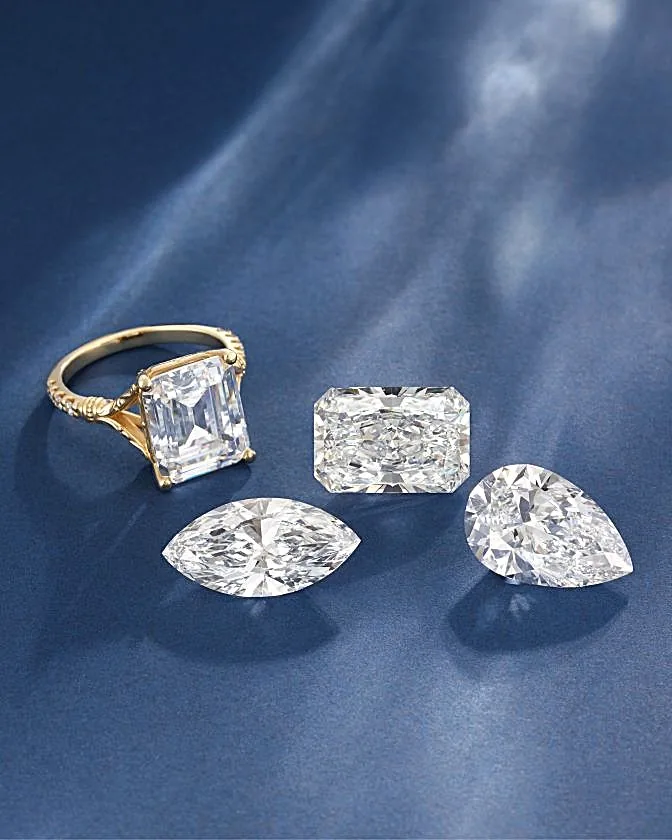
Nobody can read “1.00” from across a dinner table.
Compare the visual result just below the threshold before paying for the round number.
Why round numbers cost more
Diamond pricing is not perfectly linear. Popular weights—often called magic sizes—attract additional demand. GIA consumer education identifies thresholds such as 0.50, 0.75 and 1.00 carat, with one carat especially significant.
The result: a diamond just over a threshold may carry a higher price per carat than a visually similar diamond just below it.
A deeper guide to diamond price breakpoints
In brief: Diamond Price Breakpoints is best evaluated by looking at carat thresholds, visible dimensions, quality tradeoffs and total budget. The right choice depends on the wearer, the finished result and the total budget, not on one label alone.
The short answer
A strong decision starts by separating what can be verified from what is simply a preference. For diamond price breakpoints, the useful variables are carat thresholds, visible dimensions, quality tradeoffs and total budget. There is no single specification that makes every choice better. The goal is to understand which differences are visible, which affect durability or process, and which primarily affect price.
For diamond price breakpoints, document the reason behind each important choice. That creates a cleaner comparison and helps prevent specifications from becoming goals by themselves. A well-informed purchase should be explainable in a few sentences: what you chose, why it fits the wearer, and which tradeoffs you intentionally accepted.
What matters most
Start with the outcome you want rather than the most impressive label. In jewelry, several variables interact at once. A choice that looks ideal on paper can be less compelling in person, while a technically modest option can be the better fit when proportions, lifestyle and budget are considered together. Ask the jeweler to explain the tradeoff in plain language and, whenever possible, show the difference side by side.
For diamond price breakpoints, document the reason behind each important choice. That creates a cleaner comparison and helps prevent specifications from becoming goals by themselves. A well-informed purchase should be explainable in a few sentences: what you chose, why it fits the wearer, and which tradeoffs you intentionally accepted.
What buyers often misunderstand
One common mistake is treating a category name, grade or process as a complete quality judgment. It rarely is. Reports and specifications are valuable evidence, but they do not replace visual comparison, construction quality or an understanding of how the finished piece will be worn. Another mistake is paying for a difference that cannot be seen or that does not advance the wearer’s priorities.
For diamond price breakpoints, document the reason behind each important choice. That creates a cleaner comparison and helps prevent specifications from becoming goals by themselves. A well-informed purchase should be explainable in a few sentences: what you chose, why it fits the wearer, and which tradeoffs you intentionally accepted.
How to compare options intelligently
Compare a focused group under consistent conditions. Keep the total project budget in view and change one meaningful variable at a time. For diamonds, look at face-up appearance as well as the report. For custom jewelry, review proportion, profile, stone protection and how a wedding band or adjacent jewelry will interact. Write down the reason you prefer one option so the decision remains connected to a real benefit.
For diamond price breakpoints, document the reason behind each important choice. That creates a cleaner comparison and helps prevent specifications from becoming goals by themselves. A well-informed purchase should be explainable in a few sentences: what you chose, why it fits the wearer, and which tradeoffs you intentionally accepted.
Questions to ask your jeweler
Ask what is included, what can change the price, which details are visible without magnification, what affects long-term wear, what the realistic timeline is and what happens after approval. If a gemstone is involved, ask which independent report accompanies it and how the jeweler evaluates characteristics the report does not fully describe. Clear answers are more useful than broad claims such as best, premium or investment grade.
For diamond price breakpoints, document the reason behind each important choice. That creates a cleaner comparison and helps prevent specifications from becoming goals by themselves. A well-informed purchase should be explainable in a few sentences: what you chose, why it fits the wearer, and which tradeoffs you intentionally accepted.
Oklahoma City buying context
For an Oklahoma City buyer, local access is useful when the decision benefits from physical comparison or collaborative design. Diamond Consulate uses private appointments so clients can compare relevant options, discuss natural and lab-grown diamonds, plan custom jewelry and review design details without relying only on online specifications. The appointment model is intended to make the decision easier to understand, not to rush it.
For diamond price breakpoints, document the reason behind each important choice. That creates a cleaner comparison and helps prevent specifications from becoming goals by themselves. A well-informed purchase should be explainable in a few sentences: what you chose, why it fits the wearer, and which tradeoffs you intentionally accepted.
A practical decision framework
First define the wearer, purpose, timeline and total budget. Second identify the two or three variables that matter most. Third eliminate options with visible, structural or process problems. Fourth compare the remaining choices in person when possible. Finally, confirm the documentation, specifications, service expectations and final price before approving the purchase or design.
For diamond price breakpoints, document the reason behind each important choice. That creates a cleaner comparison and helps prevent specifications from becoming goals by themselves. A well-informed purchase should be explainable in a few sentences: what you chose, why it fits the wearer, and which tradeoffs you intentionally accepted.
When expert guidance adds the most value
Guidance is most valuable when two options look similar on paper but differ materially in person, when an heirloom stone must be protected, when a custom design has interacting structural details, or when budget can be allocated several different ways. The advisor should help expose tradeoffs rather than simply steer you toward the highest specification or price.
For diamond price breakpoints, document the reason behind each important choice. That creates a cleaner comparison and helps prevent specifications from becoming goals by themselves. A well-informed purchase should be explainable in a few sentences: what you chose, why it fits the wearer, and which tradeoffs you intentionally accepted.
Continue with related Diamond Consulate resources
| Compare | Why it can be useful | What to verify |
|---|---|---|
| 0.45 vs. 0.50 ct | Tests whether the half-carat milestone adds visible value | Millimeter spread, shape and setting scale |
| 0.70 vs. 0.75 ct | May reduce threshold premium with modest visual change | Actual dimensions and cut quality |
| 0.90–0.99 vs. 1.00 ct | Classic opportunity to compare appearance against symbolic weight | Face-up diameter or length and width |
| 1.35–1.49 vs. 1.50 ct | Can preserve substantial budget in some markets | Shape-specific spread and current pricing |
| 1.80–1.99 vs. 2.00 ct | Tests a major price and demand milestone | Depth, dimensions and whether the visual difference is meaningful |
Carat is weight, not diameter
A one-carat diamond weighs 200 milligrams. That measurement does not state how the weight is distributed. Two equal-weight diamonds can have different face-up dimensions.
Why “just under” is not automatically better
A poorly proportioned 0.95-carat diamond may look smaller or perform worse than a well-selected 1.00-carat diamond. The strategy works only when the actual stones remain attractive and comparable.
Natural and lab-grown price behavior
Both markets recognize popular sizes, but the price curves are not identical. Natural diamond pricing reflects rarity and established trade demand. Lab-grown pricing is more heavily influenced by production capacity and rapid market change. Always request current comparisons.
Pay for the size you can see—not merely the milestone you can say.
Editorial basis: official GIA carat-weight and “magic size” education reviewed August 2026.
What is a diamond magic size?
It is a popular carat-weight threshold where demand can cause the price per carat to increase, such as 0.50, 0.75, 1.00, 1.50 or 2.00 carats.
Is a 0.90-carat diamond much smaller than a 1.00-carat diamond?
Often the visible difference is modest, but dimensions and cut proportions matter. Compare millimeter measurements rather than weight alone.
Why can a 2-carat diamond cost more than twice a 1-carat diamond?
Larger diamonds are rarer, and price per carat generally rises with size and quality. Popular thresholds can add further demand.
Should I always buy just below a threshold?
No. It is a useful comparison strategy, not a rule. Shape, dimensions, quality and actual price still matter.
Do lab-grown diamonds have the same breakpoints?
Consumer preferences still cluster around round-number sizes, but pricing behavior differs because lab-grown supply and production economics are different.