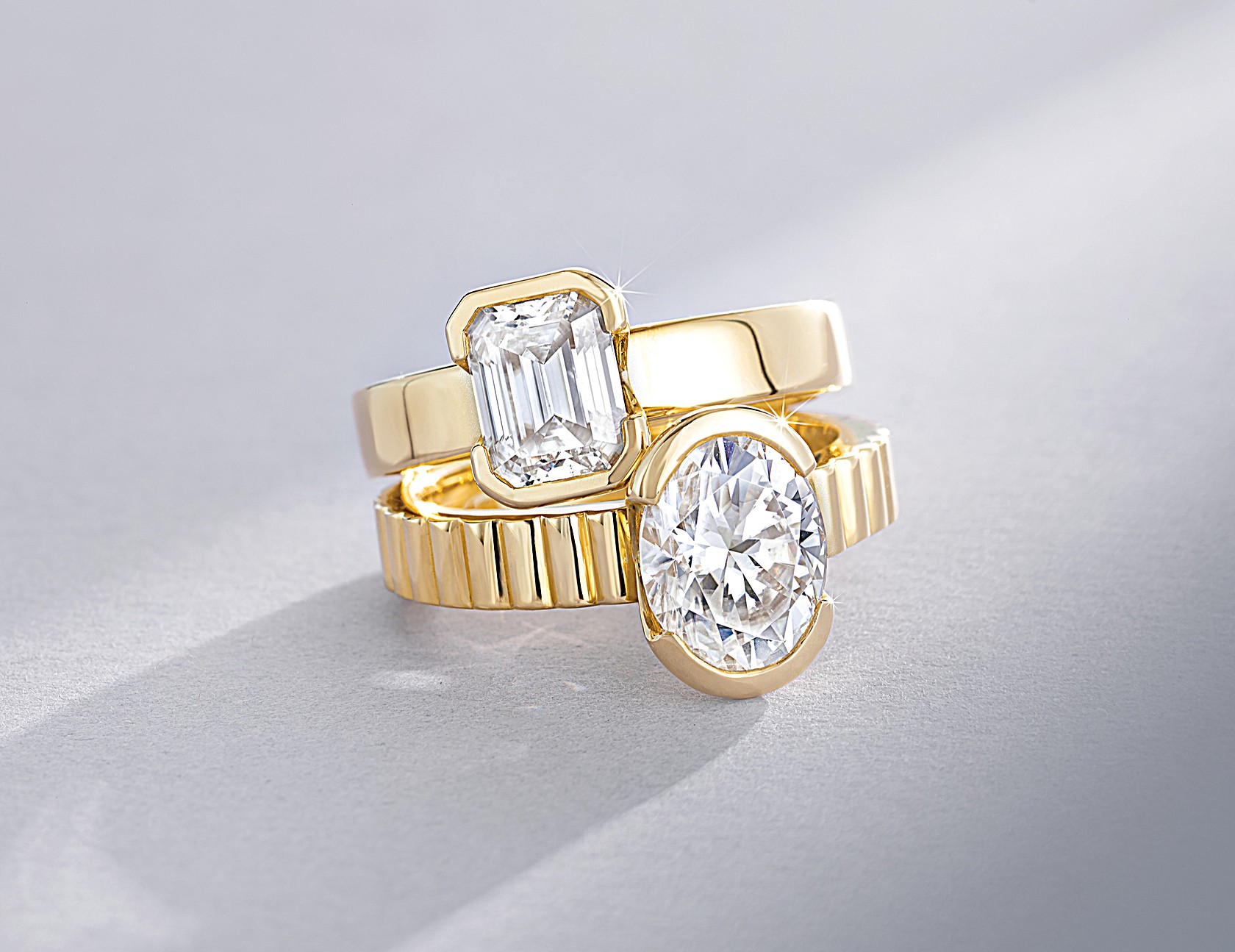

A setting should do three things at once: present the diamond beautifully, protect the vulnerable parts and make sense for the person wearing it.
The 30-second answer
Choose prongs if you want an open, traditional setting that reveals more of the diamond and uses less visible metal. Choose a bezel if you want a smoother outline, greater edge protection and fewer exposed catching points. Neither setting is automatically more beautiful, secure or brilliant in every design—the result depends on proportion, workmanship, diamond shape and lifestyle.
A prong setting creates the familiar appearance of a diamond held at a few precise points. A bezel surrounds all or part of the stone with a rim of metal. Prongs usually feel lighter and more open. Bezels usually feel cleaner, lower-profile and more architectural.
The decision should not be made from a generic pros-and-cons list alone. A fine bezel around an oval diamond can look completely different from a thick bezel around a round stone. Four delicate prongs can produce a different visual result from six heavy prongs. The center stone, ring profile, metal color, wedding band and daily habits all matter.
If you only remember ten things
- A bezel protects more of the diamond’s edge.
- Prongs leave more of the diamond visible from the side.
- A well-cut diamond does not rely on side light for most visible sparkle.
- A bezel does not automatically make a diamond dull.
- A heavy bezel can visually reduce a small diamond; a fine bezel can define or enlarge the outline.
- Prongs require regular inspection because they can wear, bend or loosen.
- Bezels have fewer exposed catching points but still require skilled setting and inspection.
- Four prongs expose more of the stone; six prongs create a different balance of coverage and redundancy.
- Pointed shapes need thoughtful tip protection regardless of setting style.
- Future wedding-band fit should be considered before the center setting is finalized.
What is a prong setting?
A prong setting uses small metal supports to hold the diamond at selected points. The prongs rise from the basket, head or ring structure and are shaped over the stone’s crown or girdle. Most solitaire engagement rings use four or six prongs, although specialty designs may use more or fewer.
Prongs can be rounded, claw-shaped, tabbed, split, double or integrated into decorative details. Their visual impact depends on thickness, height, metal color and finishing. Fine prongs can appear almost invisible from the top, while larger prongs create a stronger traditional outline.
Advantages of prong settings
- Open, familiar engagement-ring appearance
- More of the diamond remains visible
- Usually easier cleaning access around the sides and underside
- Can make the diamond appear visually light or floating
- Works with nearly every diamond shape
- Allows flexible four-prong, six-prong and decorative variations
Limitations of prong settings
- Prongs can catch on fabric, hair or gloves
- They can wear, bend or shift over time
- Exposed diamond edges receive less continuous protection
- Higher settings may feel less practical for active wearers
- Small prongs require routine professional inspection
What is a bezel setting?
A bezel setting surrounds all or part of the diamond with a rim of metal. A full bezel encircles the entire perimeter. A partial or half bezel leaves sections of the edge visible while securing the stone at selected sides.
Bezels can be extremely fine and delicate or intentionally bold. They can sit low against the finger, rise into a sculptural frame or integrate into a cathedral, halo or three-stone design. The thickness and height of the rim determine whether the setting feels minimal, vintage, contemporary or substantial.
Advantages of bezel settings
- Protects more of the diamond’s girdle and edge
- Creates a smooth, clean outline
- Has fewer exposed points that can catch
- Can be designed with a lower profile
- Works well for active lifestyles when properly built
- Can visually define unusual diamond shapes
Limitations of bezel settings
- Uses more visible metal around the diamond
- A thick bezel may dominate a small stone
- Cleaning access can be more limited in closed designs
- Requires precise, skilled setting
- Can be more difficult to alter or replace than a standard prong head
Bezel vs. prong comparison
| Factor | Bezel | Prongs |
|---|---|---|
| Visual style | Clean, framed, modern or architectural | Open, traditional, airy or floating |
| Edge protection | More continuous protection | More exposed edge between prongs |
| Catching | Fewer exposed points | More potential catching points |
| Visible metal | More metal around the stone | Less metal from the top |
| Cleaning access | Depends on how open the underside is | Often easier side and underside access |
| Maintenance | Inspect bezel edge and stone security | Inspect prongs for wear, bending and movement |
| Profile | Can be very low | Can be low or high depending on basket |
| Best fit | Protection, smoothness and defined outline | Openness, visibility and traditional presentation |
Does a bezel make a diamond look smaller?
It can, but it does not have to. The visual effect depends on the bezel’s thickness, color, height and relationship to the diamond.
A thick, dark or high bezel can create a strong metal border that visually competes with a small stone. A fine, bright bezel closely following the diamond’s outline can make the total silhouette feel larger and more intentional. A bezel in yellow or rose gold creates stronger contrast around a colorless diamond, while platinum or white gold may blend more quietly.
Face-up dimensions matter as much as carat weight. A diamond with generous spread can remain visually prominent in a bezel, while a deep diamond with smaller face-up measurements may feel more contained.
Does a bezel reduce sparkle?
Not automatically. Most visible light performance in a well-cut diamond is driven by light entering and returning through the top. Diamonds do not need open sides to sparkle.
Cut quality, transparency, cleanliness and viewing conditions usually matter more than whether the edge is surrounded by metal. However, a very heavy or closed design can affect how easily the diamond is cleaned, and buildup beneath the stone can reduce brilliance.
A bezel may change the character of the sparkle because the metal creates a stronger boundary. Prongs may make the stone feel more visually open. The best comparison is to view the actual diamond in representative designs or through accurate CAD proportions.
Which setting is more secure?
A bezel protects more of the diamond’s edge and removes many exposed prong tips, which can be advantageous for active wear. However, security depends on workmanship and condition.
A poorly executed bezel can fail to hold the stone evenly. A well-built prong setting can remain secure for decades when inspected and maintained. Prongs also offer a form of visible redundancy: if one prong is damaged, the others may continue to hold the stone temporarily, depending on the design.
No setting should be assumed maintenance-free. A ring should be inspected after a significant impact, snag or visible change.
Four prongs vs. six prongs
Four-prong settings expose more of the diamond and can preserve a square or compass-like visual orientation. They are common for many shapes and can make a round diamond appear slightly more open.
Six-prong settings create additional points of contact and often emphasize a rounder outline. They may provide more redundancy, but the prongs must still be correctly proportioned and maintained. Six heavy prongs can make a smaller diamond feel crowded; six fine prongs can remain elegant.
| Feature | Four prongs | Six prongs |
|---|---|---|
| Visibility | More open | Slightly more metal |
| Outline | Can emphasize corners or compass points | Often reinforces a round appearance |
| Redundancy | Four contact points | Six contact points |
| Cleaning | Generally open | Generally open |
| Best fit | Minimal visual interruption | Traditional round-stone security aesthetic |
Full bezel vs. partial bezel
A full bezel surrounds the entire diamond. It provides the most continuous edge protection and creates the clearest framed outline.
A partial bezel secures selected sides while leaving other areas open. This can preserve more visibility and side light while protecting vulnerable areas. Partial bezels are especially effective in east-west designs, geometric settings and elongated shapes.
Partial bezels must be engineered carefully. The open sections should not expose delicate corners or create a pathway for the stone to shift.
Basket, cathedral and low-profile settings
Bezel and prong describe how the diamond is held. Basket and cathedral describe supporting structure. A prong-set diamond can sit in a low basket or a high cathedral. A bezel can be integrated into either style.
Basket settings
A basket supports the stone with horizontal rails or gallery structure. It can sit low and provide a stable, practical profile. The basket’s shape determines whether a straight wedding band can sit flush.
Cathedral settings
Cathedral shoulders rise toward the center setting. They create height and visual transition from the shank to the stone. Cathedral designs can use prongs or bezels.
Low-profile settings
Low-profile rings reduce height and snagging but may limit flush wedding-band fit. A low basket can block a straight band, requiring a contour, open band or intentional gap.
Best setting for a round diamond
Round diamonds work well in nearly every setting. Four or six prongs preserve an open solitaire look. A fine bezel creates a crisp circular frame and can make the total outline feel larger.
For a classic appearance, six prongs are often favored. For maximum openness, four prongs may be preferred. For a modern low-profile ring, a full or partial bezel can be highly effective.
Best setting for an oval diamond
Oval diamonds are especially sensitive to proportion and orientation. Four prongs at the corners can keep the outline open, while six prongs may add tip protection. A fine bezel emphasizes the elongated silhouette and reduces exposed edges.
The bezel should follow the oval closely. Excess metal at the ends can make the diamond appear shorter or heavier. An east-west oval can work beautifully in a partial bezel.
Best setting for an emerald-cut diamond
Emerald cuts have clipped corners that require careful protection. Four double or tab prongs can preserve the geometric outline. A fine bezel reinforces the rectangular shape and protects the corners.
Because step cuts reveal clarity and structure rather than intense scintillation, a bezel can complement their architectural character without meaningfully changing the essential visual style.
Best setting for a radiant-cut diamond
Radiant cuts combine brilliant faceting with clipped corners. Prongs should protect each corner without covering too much of the outline. Bezels can strengthen the geometric silhouette and create a contemporary look.
Elongated radiants often work well in partial bezels that secure the shorter sides while leaving the long edges visible.
Best setting for a cushion-cut diamond
Cushion cuts vary from square to elongated and from softly rounded to more defined corners. Four prongs create a traditional look. Double prongs can add vintage detail. A bezel can emphasize the pillow-like perimeter but should not become visually heavy.
Best setting for a pear-shaped diamond
Pear shapes have one vulnerable point. A V-prong, protective tip or precisely fitted bezel is important. A full bezel can offer strong point protection, while a prong setting should secure both the rounded end and the tip.
Best setting for a marquise diamond
Marquise diamonds have two vulnerable points. Each tip should be protected with a V-prong, tab or bezel. A partial bezel can secure the tips while leaving the sides open, creating a sleek elongated appearance.
Best setting for a princess-cut diamond
Princess cuts have sharp corners that require protection. V-prongs or a full bezel can protect all four corners. Standard rounded prongs placed incorrectly can leave the tips exposed.
Best setting for an Asscher-cut diamond
Asscher cuts have clipped corners and a strong geometric pattern. Four double prongs can reinforce a vintage look. A bezel creates an architectural frame that complements the step-cut pattern.
Best setting for a heart-shaped diamond
Heart shapes require protection at the point and careful preservation of the cleft. Prongs can leave the outline open, but placement must not obscure the shape. A custom bezel must follow the curves precisely and preserve the top indentation.
Prongs and diamond shape distortion
Prong placement can subtly change how a diamond’s outline is perceived. Heavy prongs at the ends of an oval can make it appear shorter. Large corner prongs can square off a cushion. Six prongs can make a round diamond feel more circular, while four compass prongs can create a slightly square visual effect.
CAD should show prong placement at realistic scale. Enlarged renderings often make prongs appear larger than they will after setting and finishing, but exact dimensions should still be confirmed.
Bezel thickness and proportion
The bezel should be proportioned to the diamond and ring. A tiny diamond may require a very fine rim to avoid visual dominance. A large stone can support a more substantial frame.
The metal color also matters. A yellow-gold bezel around a colorless diamond creates contrast and visibly expands the total perimeter. A platinum bezel blends more closely with the diamond’s white light return.
Which setting is best for an active lifestyle?
A low, smooth bezel is often a strong option for active wearers because it has fewer catching points and protects the diamond’s edge. However, no rigid engagement ring should be worn during weightlifting, contact sports, climbing or work around machinery.
A low prong setting can also work when the prongs are well shaped and the wearer follows appropriate removal habits. Lifestyle recommendations should focus on realistic behavior—not the promise that any setting is indestructible.
Recommendations by profession
| Profession or routine | Considerations | Possible direction |
|---|---|---|
| Healthcare | Gloves, sanitation, snagging | Low bezel or refined low prongs |
| Office work | Keyboard contact and comfort | Either style can work |
| Education or childcare | Frequent hand use and catching | Smoother profile may help |
| Creative professions | Style and hand visibility | Choose by visual preference |
| Construction or mechanics | Impact, tools and machinery | Remove ring during work |
| Fitness professional | Weights and pressure | Remove before training |
Cleaning and maintenance
Prong settings often allow easier access beneath the diamond, but buildup can still collect in the basket. Bezels can trap residue where the metal meets the stone, especially in closed-back or low-access designs.
Clean either setting with methods appropriate for the diamond, metal and any accent stones. Periodic professional cleaning and inspection remain important.
Prong maintenance
- Check for bent, lifted, worn or missing prongs.
- Listen for movement or rattling.
- Inspect after a snag or impact.
- Avoid waiting until the stone visibly shifts.
Bezel maintenance
- Inspect the entire rim for lifting or separation.
- Check for trapped debris and cleaning access.
- Inspect after impact to the edge.
- Confirm that the stone remains evenly seated.
Wedding-band fit
The setting profile determines whether a straight wedding band can sit flush. A high prong basket may allow a straight band beneath it. A low bezel may block the band and require a contour or intentional gap.
Neither result is automatically better. Some clients prioritize low profile and accept a fitted band. Others want a straight wedding band and raise the center setting slightly. The wedding band should be visualized during the engagement-ring design process.
Can a bezel be changed to prongs later?
Sometimes, but not always. Converting a bezel to prongs may require rebuilding the head or entire setting. The original stone measurements, ring structure and metal condition determine what is possible.
Changing prongs to a bezel can also require a new head or custom redesign. Choose the setting with long-term preference in mind rather than assuming an easy future conversion.
Cost comparison
A bezel often requires more metal and more setting labor than a basic prong head. However, price varies by design, metal, diamond shape and whether the setting is custom.
Complex claw prongs, hand-fabricated baskets and specialty double-prong designs can also add cost. Compare the complete ring rather than assuming one category is always less expensive.
Common myths
- Bezels always make diamonds look smaller
- Bezels block all the light
- Prongs are always less secure
- Six prongs are always safer than four
- Bezels never need maintenance
- Prong settings always sit higher
- Proportion controls the visual effect
- Most light performance comes through the top
- Workmanship and condition determine security
- Prong size and placement matter
- Every setting requires inspection
- Either style can be engineered low or high
A practical decision tree
Do you want the diamond to look open and traditional? If yes, begin with prongs.
Do you want a smooth, framed outline? If yes, begin with a bezel.
Is edge protection a major priority? If yes, a full or strategically placed partial bezel may be best.
Do you dislike catching on gloves or clothing? If yes, compare low bezels and low refined prongs.
Do you want minimal visible metal? If yes, choose fine prongs or a very fine white-metal bezel.
Is the diamond pointed? If yes, require protected tips regardless of style.
Must a straight wedding band sit flush? If yes, review basket height before approval.
Do you want easy side access for cleaning? If yes, an open prong basket may be preferable.
Buyer checklist
- View the selected diamond in both setting styles.
- Confirm the exact bezel thickness or prong dimensions.
- Review the setting from top, side and underside.
- Ask how the design protects corners, tips and the girdle.
- Confirm the center height and overall profile.
- Review cleaning access.
- Discuss inspection and maintenance.
- Consider gloves, clothing and daily activities.
- Confirm future wedding-band fit.
- Ask whether the setting can be repaired or replaced.
- Approve the actual diamond orientation.
- Choose based on the whole ring, not a generic claim.
Do you want to notice the diamond first—or the relationship between the diamond and its frame?
Frequently asked questions
Is a bezel setting better than prongs?
Not universally. Bezels offer more edge protection and a smoother profile. Prongs offer a more open, traditional appearance. The better choice depends on style, shape, lifestyle and maintenance preferences.
Does a bezel make a diamond look smaller?
A heavy bezel can, while a fine bezel may define or enlarge the total outline. Proportion, metal color and diamond spread determine the result.
Does a bezel reduce sparkle?
Not automatically. Most visible light performance comes through the top of a well-cut diamond. Cleanliness and cut matter more than side exposure.
Are bezel settings more secure?
They protect more of the edge and have fewer exposed prong tips, but security still depends on workmanship, fit and maintenance.
Are prong settings safe?
Yes, when properly designed, set and maintained. Prongs should be inspected periodically for wear, bending or movement.
Which catches less, bezel or prongs?
A smooth bezel generally has fewer catching points. Low, refined prongs can also minimize snagging.
Are four or six prongs better?
Four prongs expose more of the stone. Six prongs add contact points and often create a rounder outline. Prong thickness and workmanship matter more than number alone.
What is a partial bezel?
A partial bezel secures selected sides of the diamond while leaving other edges visible. It can balance protection with openness.
Which setting is best for an oval diamond?
Both can work. Prongs preserve openness, while a fine bezel defines the elongated outline and protects more of the edge.
Which setting is best for a pear or marquise?
Both require strong tip protection. V-prongs, tabs, full bezels or strategically designed partial bezels can protect the points.
Which setting is best for an active lifestyle?
A low bezel is often practical because it is smooth and protective, but all rigid rings should be removed during hazardous activities.
Can a bezel setting sit low?
Yes. Bezels can be engineered very low, though lower settings may affect flush wedding-band fit.
Can prongs sit low?
Yes. A low basket can keep a prong-set diamond close to the finger, depending on stone depth and design.
Can a wedding band sit flush with a bezel?
Sometimes. It depends on basket height, gallery shape and how far the bezel extends below the diamond.
Are bezels harder to clean?
They can provide less side access, especially in closed designs. An open underside and regular cleaning help maintain brightness.
Can bezel settings be repaired?
Often yes, but the method depends on damage, metal and stone. Major repairs may require rebuilding the bezel.
Can prongs be replaced?
Often yes. Worn prongs can sometimes be retipped or rebuilt, though severe damage may require a new head.
Is a bezel more expensive?
Often, because it uses more metal and skilled setting labor, but complex prong designs can also be costly.
Does metal color matter?
Yes. White metal blends with a colorless diamond, while yellow or rose gold creates a visible frame and warmer contrast.
How do I choose between bezel and prongs?
Compare the actual diamond in realistic proportions and decide whether you prefer an open presentation or a defined protective frame.
See both settings before production
During a private Diamond Consulate consultation, the selected center stone can be shown in different bezel and prong proportions through Live Collaborative CAD Design. That makes height, edge protection, metal visibility and future wedding-band fit visible before the ring is made.