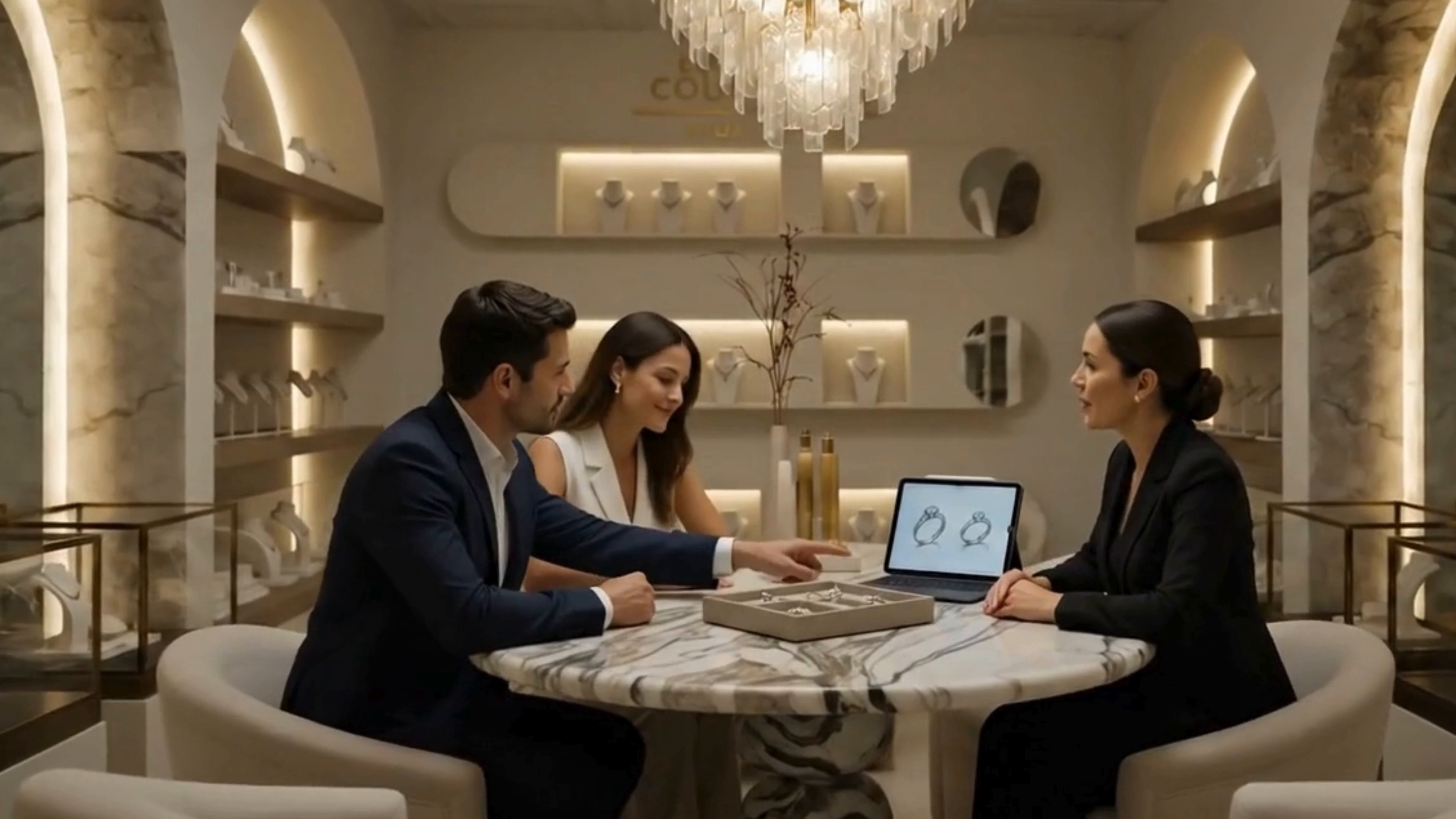
A good diamond decision is not made by memorizing more rules. It is made by asking better questions in the right order—and comparing what you can actually see.
The short answer: what should you know before buying a diamond?
Before buying a diamond, establish the total ring budget, decide whether you prefer a natural diamond, a laboratory-grown diamond or an open comparison, confirm the diamond’s grading report and origin, compare several stones side by side, and evaluate visible beauty before paying for higher grades you may not appreciate.
A diamond report is important, but it does not choose the diamond for you. Two diamonds with similar grades can look noticeably different because of proportions, facet pattern, transparency, dimensions and the way each stone handles light. The most useful buying process combines documentation with direct visual comparison.
- Set the complete ring budget before shopping for the center stone.
- Compare natural and lab-grown options based on your priorities, not assumptions.
- Prioritize visible performance and attractive proportions over impressive labels alone.
- Verify the grading report, origin disclosure and exact measurements.
- Choose the diamond and setting as one coordinated design.
- You have seen the diamond in more than one lighting environment.
- You understand what each price premium buys visually.
- You have reviewed return, exchange, upgrade and production terms.
- You know how the setting will protect the stone.
- You would still choose the diamond with the report turned face down.
The complete diamond buying checklist at a glance
| Stage | What to confirm | Why it matters |
|---|---|---|
| Budget | Total ring budget, not only center-stone budget | The setting, design work, taxes and insurance also affect the final cost. |
| Origin | Natural, laboratory-grown or open comparison | Origin changes price, rarity, long-term expectations and buying priorities. |
| Shape | Preferred outline and facet personality | Shape affects appearance, face-up size, setting options and how the ring feels stylistically. |
| Performance | Brightness, contrast, sparkle and movement | These are the visible reasons most people love a diamond. |
| Dimensions | Length, width, depth and ratio | Carat weight alone does not tell you how large a diamond looks. |
| Color | Visible warmth in the intended metal | A grade difference may be difficult to see once the diamond is mounted. |
| Clarity | Eye cleanliness, transparency and inclusion position | Pay for a clean-looking, structurally appropriate diamond—not invisible rarity unless that matters to you. |
| Documentation | Report number, laboratory, origin and treatment disclosure | Documentation helps confirm identity and what is being represented. |
| Setting | Protection, profile, metal, wedding-band fit and maintenance | The setting can improve appearance, security and daily comfort. |
| Policies | Return, exchange, warranty, trade-in and upgrade terms | These terms affect flexibility after the sale. |
| Final approval | Finished-ring inspection, documents, appraisal and insurance | The purchase is not complete until the ring and records are correct. |
Step 1: establish the total ring budget
The best budget is one that leaves you comfortable after the purchase. There is no universal salary formula that determines what an engagement ring should cost. Begin with the total amount you want to spend on the completed ring, then allocate that budget among the center diamond, setting, design complexity, accent stones, taxes and any immediate insurance cost.
A center-stone-only budget can create an unnecessary compromise later. A buyer may select the largest diamond possible and then discover that the intended platinum setting, custom gallery, hidden halo or flush-fitting wedding band pushes the complete ring beyond the target. Designing the purchase as a whole helps prevent this problem.
Questions to answer before the appointment
- What is the comfortable total budget for the finished ring?
- Is there a firm ceiling that should not be exceeded?
- Which matters more: visible size, natural rarity, design detail, metal choice or long-term flexibility?
- Will the ring be purchased all at once, financed or built in stages?
- Does the budget need to include an appraisal, insurance or a matching wedding band?
Instead of asking, “How large a diamond can I afford?” ask, “Which complete ring gives me the most visible beauty and meaning within the amount I want to spend?”
Step 2: decide how you feel about natural and laboratory-grown diamonds
Natural and laboratory-grown diamonds are both crystalline carbon and can share the same optical and physical characteristics. Their origin, market pricing, rarity and long-term value expectations are different. The right decision depends on what the buyer wants the purchase to represent.
| Priority | Natural diamond may fit | Laboratory-grown diamond may fit |
|---|---|---|
| Origin and rarity | You value a diamond formed in the earth and its natural scarcity. | You are comfortable with a manufactured origin. |
| Visible size for budget | You accept a smaller or more selectively graded stone to preserve natural origin. | You want substantially more size or higher paper grades for the same initial spend. |
| Long-term market expectations | You prefer the category with greater established secondary-market history, while understanding jewelry is not a guaranteed investment. | You prioritize current appearance and initial value over future resale expectations. |
| Emotional preference | The geological story matters to you. | The visual result matters more than natural rarity. |
| Open comparison | Many buyers benefit from seeing both categories without labels first, then discussing price and origin after establishing visual preferences. | |
Neither choice should be framed as universally superior. The important point is that origin should be disclosed clearly and documented in writing. A buyer should also understand that a grading report evaluates the diamond presented to the laboratory; it does not promise future resale value or guarantee that the stone is the most attractive choice within a budget.
Step 3: choose shape before chasing grades
Shape is one of the most visible and personal choices in a diamond. Round brilliant, oval, radiant, cushion, emerald, pear, marquise, princess, Asscher and other shapes each create a different visual personality. Shape affects apparent size, sparkle pattern, length-to-width ratio, setting design and how the ring looks on the hand.
Do not assume the shape that looks best in a photograph will be the one you prefer in person. Try several outlines on the hand. An elongated oval may look elegant and lengthening, a radiant may feel crisp and energetic, an emerald cut may look architectural and calm, and a cushion may feel soft and romantic.
- Round, oval, radiant, pear, marquise and many cushions
- Typically emphasize sparkle and scintillation
- Facet patterns can vary substantially within the same shape
- May display bow ties, crushed-ice areas or uneven brightness
- Emerald and Asscher cuts
- Emphasize broad flashes, symmetry and transparency
- Inclusions may be easier to see
- Proportion, outline and clarity deserve careful visual review
Step 4: understand the 4Cs without allowing them to control the purchase
The 4Cs—cut, color, clarity and carat weight—create a useful shared language for describing diamonds. They are not a complete beauty score. The grading report summarizes characteristics under standardized conditions, while the buyer experiences the diamond as a moving object in changing light, viewed from normal distance and eventually mounted in a ring.
Cut: evaluate what the diamond does with light
For round brilliant diamonds, laboratory cut grades can help narrow the field. Even then, diamonds within the same broad grade may not look identical. For fancy shapes, there is often no single overall cut grade that predicts beauty. Examine brightness, contrast, symmetry of the visible pattern, liveliness and whether dark areas remain distracting as the diamond moves.
A well-performing diamond should not appear bright only under jewelry-store spotlights. Compare it near a window, in diffused indoor light and under ordinary room lighting. The goal is not constant maximum sparkle; every diamond changes with its environment. The goal is a pattern you find attractive across realistic conditions.
Color: buy what you can see in the chosen setting
Diamond color grades describe the degree of body color observed under controlled conditions. In everyday wear, perceived color is influenced by shape, size, lighting, fluorescence, surrounding metal and the viewer’s sensitivity. A near-colorless diamond can appear beautifully white once mounted, especially when its cut and transparency are strong.
Yellow or rose gold can make a slightly warmer diamond feel harmonious. White metal can emphasize contrast for color-sensitive buyers. Larger diamonds and some elongated shapes may reveal warmth more readily than smaller round diamonds. Compare the actual stones in or beside the intended metal rather than assuming a specific letter grade is mandatory.
Clarity: seek eye cleanliness, transparency and structural suitability
Clarity grades describe the size, number, position, nature and relief of inclusions and surface characteristics under magnification. Most people do not wear a ring under a microscope. The practical question is whether the diamond looks clean to the unaided eye at normal viewing distance and whether its inclusions affect transparency, durability or setting decisions.
Inclusion placement matters. A small inclusion hidden near the edge may be less noticeable than a dark inclusion under the table. Feathers near vulnerable corners or girdle areas deserve attention in shapes with points. A jeweler should explain not only the grade, but also what creates the grade and whether it matters in daily wear.
Carat weight: measure weight, then look at dimensions
Carat is a unit of weight, not a visual size grade. Two diamonds of equal carat weight can face up differently because of depth, outline and proportions. A stone that carries excessive weight below the girdle may look smaller from the top than another diamond of the same weight.
Review millimeter measurements and compare face-up spread. Also avoid buying only for maximum spread. A diamond can look wide but lose desirable brightness or show a fragile girdle. The goal is an appealing balance of dimensions, performance and durability.
For a well-cut diamond, the visible difference between adjacent paper grades may be minor once the stone is set and clean. Spend where your eyes can appreciate the benefit.
Step 5: compare face-up size, proportions and facet pattern
Dimensions help explain how a diamond uses its weight. For elongated shapes, review length, width and length-to-width ratio. For round diamonds, diameter offers a practical picture of face-up size. For every shape, consider outline symmetry, shoulder shape, corner style and whether the proportions support an attractive visual pattern.
| Feature | What to look for | Potential concern |
|---|---|---|
| Face-up spread | Looks appropriately large for its weight without appearing flat or lifeless | Excess depth can hide weight; extreme shallowness can reduce performance |
| Length-to-width ratio | Matches the outline you personally prefer | A ratio is not automatically good or bad; it must suit the shape and design |
| Bow tie | Moderate contrast that moves and adds definition | A dark, static bow tie dominating the center |
| Crushed-ice pattern | Fine, lively sparkle with enough brightness and definition | Mushy, gray or disorganized appearance |
| Windowing | Consistent reflections and depth through the center | Large transparent areas that allow the viewer to see through the stone |
| Outline | Balanced shoulders, corners and symmetry | Uneven lobes, awkward bulges or an outline that feels visually unbalanced |
Step 6: evaluate fluorescence in the actual diamond
Fluorescence describes a diamond’s visible reaction to ultraviolet radiation, commonly blue. It is not automatically a benefit or defect. In some lower-color diamonds, blue fluorescence may make the stone appear less warm in certain conditions. In many diamonds, it has little visible effect during ordinary wear.
The practical approach is to inspect the diamond rather than reject or prefer it based on the fluorescence notation alone. Ask whether the stone appears hazy, oily or less transparent in daylight. Strong fluorescence does not automatically create these effects, but the specific diamond should be evaluated directly.
Step 7: verify the grading report and diamond identity
A grading report documents the laboratory’s assessment of the diamond submitted for evaluation. Confirm the laboratory name, report number, measurements, carat weight, shape, grades, fluorescence and any comments. Use the laboratory’s official report-verification system to confirm that the number and data match.
GIA and IGI are among the laboratories buyers commonly encounter. GIA is widely used for natural diamonds, while IGI is frequently seen with laboratory-grown diamonds and also grades natural stones. The laboratory name matters, but the report should still be treated as documentation—not a substitute for comparing beauty, price and suitability.
- Verify the report number through the laboratory’s official database.
- Confirm that the measurements and carat weight match the stone being offered.
- Confirm natural or laboratory-grown origin in writing.
- Review treatment disclosures and report comments.
- Ask whether the report number is laser-inscribed and, when practical, verify it under magnification.
- Keep the original report or secure digital access with your purchase records.
Step 8: compare diamonds side by side before reading the prices
Side-by-side comparison reveals tradeoffs quickly. Three to five carefully selected options are usually more useful than scrolling through hundreds of listings. Ask the jeweler to present diamonds that differ meaningfully in one or two areas—perhaps size, color, clarity, origin or facet pattern—while staying within the total budget.
Begin without studying the labels. Notice which diamond draws your eye first. Then compare the reports and prices. This sequence helps you determine whether a premium creates a visible improvement or merely a rarer paper grade.
Use more than one lighting environment
- Diffused daylight or window light for overall brightness and color.
- Ordinary indoor lighting for realistic daily appearance.
- Directional spot lighting to examine scintillation and movement.
- Shadowed or lower-light conditions to see contrast pattern and transparency.
No diamond looks the same in every environment. A useful comparison asks whether the stone remains attractive as lighting changes—not whether it produces maximum sparkle at every moment.
Step 9: choose the diamond and setting together
The setting changes how the diamond looks, wears and is protected. A low-profile bezel may emphasize security and easy wear. A classic prong setting may expose more of the diamond and allow easier cleaning. A halo can increase overall visual presence. A hidden halo adds detail from the side without changing the center outline as dramatically.
Shape-specific protection matters. Pear and marquise tips, princess corners and other vulnerable points often benefit from V-prongs, bezels or protective design elements. Very thin girdles, exposed corners and high settings deserve extra discussion for active wearers.
| Setting question | Why ask it before approving the diamond? |
|---|---|
| Will the wedding band sit flush? | Basket shape, gallery height and accent placement can create a gap. |
| How high will the center stone sit? | Height affects profile, snagging and perceived size. |
| How are corners or points protected? | Vulnerable shapes need thoughtful prong or bezel placement. |
| Will the metal affect perceived color? | White, yellow and rose metals interact differently with diamond warmth. |
| Can the ring be resized? | Design, metal and stones around the shank may limit future sizing. |
| How should it be maintained? | Pavé, halos and delicate details require periodic inspection. |
Step 10: understand price, policies and long-term expectations
Diamond prices are influenced by origin, shape, carat thresholds, grades, proportions, brand, supply and market conditions. A small difference near a popular carat milestone can create a noticeable price change even when the visual size difference is modest. Compare diamonds slightly below common thresholds such as one, one-and-a-half or two carats when appropriate.
Ask what the price includes. A lower online listing may not include inspection, design guidance, setting work, sizing, appraisal support or future service. A higher price is not automatically justified either. The value must be explained in terms of the diamond, craftsmanship, policies and support.
- Return and exchange period, including any exclusions for custom work.
- Whether the diamond has an upgrade or trade-in policy and the exact requirements.
- Whether resizing, routine inspection or cleaning is included.
- Warranty limitations and required maintenance documentation.
- Production timeline and what happens if the proposal date changes.
- Whether the appraisal is prepared by the seller or an independent appraiser.
Step 11: recognize common diamond-buying red flags
- The seller will not provide or verify the grading report.
- Origin or treatments are described vaguely rather than disclosed in writing.
- You are pressured to buy immediately because the diamond is supposedly your only opportunity.
- The explanation relies entirely on grades without showing visible differences.
- Policies are verbal, unclear or unavailable before payment.
- The setting design ignores protection for the diamond’s shape.
- Inflated “retail values” used to create artificial discounts.
- Claims that any diamond is guaranteed to appreciate.
- Advice that one color or clarity grade is mandatory for every buyer.
- Listings that omit measurements, videos or meaningful inclusion details.
- Pressure to select a larger diamond before establishing the complete ring budget.
- Comparisons made under different lighting or with dirty stones.
Step 12: online buying versus an in-person diamond consultation
Online shopping can provide broad inventory access and transparent comparison data. It can also make diamonds appear more interchangeable than they are. Videos are useful, but screen brightness, magnification, camera angle and controlled lighting can exaggerate or hide differences.
An in-person comparison allows you to see how diamonds look on the hand, in changing light and beside the chosen metal. It also makes it easier to compare natural and laboratory-grown options without relying on assumptions. The strongest process may combine online research with an in-person final comparison before approval.
We narrow the field before the appointment, then compare relevant diamonds side by side. The goal is not to overwhelm you with inventory. It is to make the meaningful differences easy to see.
Step 13: complete the finished-ring inspection
When the ring is finished, inspect the actual piece before leaving. Confirm that the center diamond matches the report, the ring size is correct, prongs are even, stones appear secure, the finish is consistent and the design matches the approved rendering or order details.
- Verify the center diamond’s report number and identifying details.
- Inspect prong alignment, stone security and symmetry.
- Confirm metal type, finish, engraving and ring size.
- Check that the wedding band relationship matches the plan.
- Receive the grading report, receipt, warranty terms and appraisal when applicable.
- Photograph the completed ring and store records securely.
Step 14: insure and maintain the ring
Arrange insurance promptly after taking possession. Coverage may be available through a homeowners or renters endorsement or a specialized jewelry policy. Review deductibles, geographic coverage, mysterious disappearance, damage, repair, replacement process and whether the policy uses replacement cost, stated value or another settlement method.
An appraisal can help document the ring, but an appraisal amount is not the same as resale value. Inflated replacement figures may increase premiums without improving the settlement. Keep the appraisal current enough to reflect meaningful changes in replacement cost and maintain photographs, receipts and grading reports.
Routine inspection and cleaning are part of ownership. Prongs wear, rings bend and small stones can loosen. Remove fine jewelry during heavy impact, weight training, construction, chemical exposure and activities where the ring can catch. Clean according to the metal, setting and stone design, and schedule professional inspection as recommended.
The master checklist to save before buying
- I have established a complete ring budget.
- I know whether natural origin, lab-grown size or an open comparison best fits my priorities.
- I have tried more than one diamond shape on the hand.
- I understand the visible tradeoffs among cut, color, clarity and carat weight.
- I have compared face-up dimensions rather than carat weight alone.
- I have viewed several relevant diamonds side by side.
- I have seen the preferred diamond in more than one lighting environment.
- I have assessed bow tie, windowing, facet pattern and transparency where relevant.
- I have verified the grading report through the laboratory’s official system.
- I have confirmed natural or laboratory-grown origin and any treatments in writing.
- I understand what the price premium buys visually.
- The setting protects the diamond and supports my daily lifestyle.
- I know whether the future wedding band will sit flush.
- I have reviewed return, exchange, upgrade, warranty and maintenance terms.
- I have the production schedule and proposal timeline in writing.
- I know what documentation will be provided with the finished ring.
- I have planned for insurance and ongoing inspection.
- I would still choose this diamond if the grading report were turned face down.
If the report were turned face down and the prices temporarily hidden, would this still be the diamond you prefer?
Before buying a diamond, decide what you are actually optimizing for: visible size, cut quality, color, clarity, shape, rarity, natural origin or lab-grown value. A grading report provides important data, but it cannot tell you whether a particular diamond is visually appealing.
Use the grading report as a filter
Certification helps compare measurable characteristics and confirms important identification details. It should narrow the field, not make the final decision. Proportions, facet pattern, transparency and visual performance still need to be evaluated.
Compare diamonds in the order that matters to you
Start with shape and budget, then identify the characteristics you can see and care about most. This prevents paying for grades that do not materially improve the appearance while overlooking cut or proportion differences that do.
These details can be compared during a private Oklahoma City consultation. Reserve a consultation or continue through the education library.
What should I know before buying a diamond?
Know the complete ring budget, preferred diamond origin, shape priorities, visible tradeoffs among the 4Cs, grading-report details, setting requirements, seller policies and insurance plan. Compare multiple diamonds in person whenever possible.
Which of the 4Cs is most important?
Visible light performance is usually the most important consideration, but no single grade determines beauty. Cut quality, proportions, transparency and facet pattern should be assessed together with color, clarity and carat weight.
Should I buy the highest diamond grade I can afford?
Not necessarily. Higher grades can represent rarity that is difficult to see once the diamond is mounted. Buy the level at which further upgrades no longer create a visible benefit that matters to you.
Is a natural diamond better than a lab-grown diamond?
Neither is universally better. Natural diamonds offer geological origin and greater natural rarity. Laboratory-grown diamonds typically offer more size or higher paper grades for the same initial budget. The right choice depends on the buyer’s priorities.
How can I tell whether a diamond is too deep?
Compare its face-up dimensions with similar diamonds of the same shape and weight. A diamond carrying excessive weight below the girdle may appear smaller from the top, although overall proportions and performance must be evaluated together.
What does eye-clean mean?
Eye-clean generally means inclusions are not noticeable to the unaided eye under normal viewing conditions. Because distance, eyesight and inclusion placement vary, ask to inspect the actual diamond rather than relying on the term alone.
Is fluorescence bad in a diamond?
No. Fluorescence is not automatically good or bad. Inspect the individual diamond for transparency, color and appearance in daylight. Many fluorescent diamonds show no undesirable effect during ordinary wear.
What diamond grading report should I look for?
Look for a report from a recognized laboratory and verify it through that laboratory’s official system. GIA is common for natural diamonds, while IGI is frequently used for laboratory-grown diamonds and also grades natural stones.
How many diamonds should I compare?
Three to five carefully selected diamonds are often enough to reveal meaningful tradeoffs without creating unnecessary decision fatigue.
What is a bow tie in an oval, pear or marquise diamond?
A bow tie is a darker contrast pattern across the center of some elongated brilliant shapes. A moderate bow tie can add definition, while a very dark, static bow tie may distract from the diamond’s overall brightness.
What is windowing in a diamond?
Windowing occurs when an area allows the viewer to see through the diamond rather than returning an attractive reflection pattern. It is especially relevant when evaluating step cuts and some shallow fancy shapes.
Should I buy just below a popular carat weight?
It can be a useful value strategy. A diamond slightly below a major threshold may cost less while looking nearly the same size, but dimensions and visual performance should still guide the choice.
Can I trust diamond videos online?
Videos are helpful screening tools, but magnification, lighting, camera exposure and screen settings affect appearance. Use them to narrow options, then verify the final choice in person when possible.
What documents should come with a diamond ring?
Depending on the purchase, documents may include the grading report, receipt, origin and treatment disclosures, warranty terms, appraisal and care instructions. Keep report numbers, photographs and insurance records together.
Should I insure an engagement ring immediately?
Yes. Arrange coverage promptly after taking possession and review the deductible, covered causes of loss, replacement process and valuation method.
Does an appraisal show what my diamond is worth for resale?
No. An appraisal usually estimates replacement value for a stated purpose, often insurance. It is not the same as current cash resale value and should not be treated as a guaranteed market price.
What return or upgrade questions should I ask?
Ask about the return window, custom-order exclusions, exchange terms, upgrade requirements, minimum spend, original-document requirements and whether the policy applies differently to natural and laboratory-grown diamonds.
What is the final question before buying a diamond?
Ask whether you would still choose the diamond if the grading report were turned face down and the price were temporarily hidden. Your answer reveals whether you are buying visible beauty or only a label.
What should I compare before deciding?
Compare appearance, proportions, durability, maintenance, budget and how the jewelry will be worn in real life.
Can these details be customized?
Yes. Dimensions, materials, finishes and design details can often be adjusted together to suit the wearer.
Can I compare options in person?
Yes. Diamond Consulate offers private, appointment-led consultations in Oklahoma City for side-by-side comparison and design guidance.