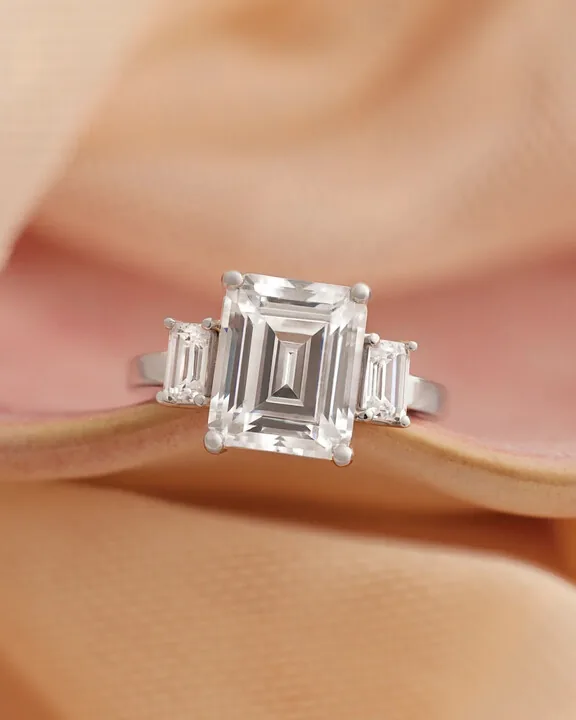
Emerald Cut vs. Asscher Cut: The Quick Answer
Choose an emerald cut if you want an elongated shape, a larger face-up appearance and a sleek, elegant look. Choose an Asscher cut if you prefer a square, symmetrical diamond with a deeper, more architectural pattern and stronger Art Deco character. Both reward careful selection because their broad, open facets reveal clarity, color and cutting precision more readily than many brilliant-cut shapes.
Emerald Cut vs. Asscher Cut at a Glance
| Feature | Emerald Cut | Asscher Cut |
|---|---|---|
| Overall shape | Rectangular and elongated with clipped corners | Square or nearly square with deeply clipped corners |
| Facet style | Step cut with long, linear facets | Step cut with concentric, geometric facets |
| Visual effect | Broad flashes and a long “hall of mirrors” appearance | Centered, kaleidoscopic pattern with strong depth |
| Face-up size | Usually appears larger at the same carat weight | Often appears smaller because more weight is held in depth |
| Typical style | Elegant, refined, minimalist and modern | Architectural, vintage-inspired and Art Deco |
| Clarity sensitivity | High; the open table can reveal inclusions | High; the centered pattern can draw attention to inclusions |
| Color sensitivity | Can show warmth along the body and corners | Can concentrate warmth through the deeper pattern |
| Popular settings | Solitaire, three-stone, tapered baguettes, bezel, halo | Geometric halo, bezel, split shank, three-stone, solitaire |
What Do Emerald and Asscher Cuts Have in Common?
Emerald and Asscher cut diamonds belong to the step-cut family. Rather than using many small triangular facets to create rapid sparkle, step cuts use long, parallel rows of facets that resemble a staircase when viewed from the side. The result is a calmer, more deliberate pattern of broad flashes, alternating light and dark areas, and a strong sense of transparency.
This optical style is often described as a “hall of mirrors.” The phrase fits emerald cuts especially well, but both shapes depend on crisp facet alignment and balanced contrast. When a step cut is well proportioned, the pattern appears structured and lively. When it is poorly proportioned, the center may look dull, glassy or overly dark.
Do not judge either shape by a grading report alone. Step cuts must be evaluated visually because two diamonds with similar laboratory grades can perform very differently.
Shape and Outline: Elongated vs. Square
Emerald cut shape
An emerald cut is rectangular with clipped corners. Its elongated outline can visually lengthen the finger and often looks larger than its carat weight suggests. The effect can be classic and understated in a solitaire or dramatically architectural in an east-west setting.
Most buyers prefer a clearly elongated emerald cut, although the ideal length-to-width ratio is personal. A lower ratio produces a broader, almost square look. A higher ratio creates a long, narrow silhouette. Neither is automatically better; the goal is balance, visual appeal and an outline that complements the ring design.
Asscher cut shape
An Asscher cut is square or nearly square, with deeply clipped corners that can make it look octagonal when set. Its geometry feels more compact and symmetrical than an emerald cut. The concentric step pattern pulls the eye inward, creating a sense of depth that is especially striking in well-cut stones.
The Asscher cut is closely associated with early twentieth-century design and works naturally with Art Deco-inspired settings. It can also look highly contemporary when paired with a minimalist bezel or clean solitaire.
Which Sparkles More?
Neither shape produces the splintery brilliance of a round brilliant, oval or radiant cut. That is not a weakness; it is the defining aesthetic of a step cut. Both emerald and Asscher cuts create larger, slower flashes of light that feel elegant rather than glittery.
Emerald cut optics
Long facets create broad linear flashes that travel across the stone. The pattern emphasizes length, transparency and clean lines.
Asscher cut optics
Concentric facets create a more centralized, kaleidoscopic effect. The pattern often feels deeper and more dramatic.
An Asscher cut may appear more visually intense in the center, while an emerald cut may look brighter across a larger horizontal area. The better choice depends on whether you prefer elongated flashes or centered geometry.
Which Looks Larger at the Same Carat Weight?
Emerald cuts usually look larger than Asscher cuts of equal carat weight. Carat measures weight, not visible size. Because emerald cuts spread more of their weight across an elongated surface, they often have a larger face-up area. Asscher cuts are generally deeper and carry more weight below the girdle, which can make them look smaller from the top.
This difference becomes important when comparing budgets. A well-proportioned emerald cut may provide more visual coverage without increasing carat weight. An Asscher cut may require a slightly higher carat weight to achieve the same apparent presence, but buyers who value its geometry often consider that tradeoff worthwhile.
Length-to-Width Ratio and Proportion Guidelines
Ratios are useful starting points, not rigid rules. The most attractive diamond is the one with a balanced outline and strong optical performance.
What to inspect beyond ratio
- Balanced corner clipping
- A centered, symmetrical facet pattern
- No persistent dark band across the center
- No watery or glassy “window” effect
- Even brightness as the diamond moves
- A pleasing outline without excessive bulging or narrowness
Clarity: Which Cut Shows Inclusions More?
Both emerald and Asscher cuts can reveal inclusions more readily than brilliant cuts. Their broad open tables and large step facets offer fewer places for inclusions to hide. This does not mean you must automatically purchase a very high clarity grade. It means the location and visibility of the inclusion matter.
A common starting point is VS2, followed by careful visual evaluation. Some SI1 diamonds are completely eye-clean, while some diamonds with higher clarity grades may have a noticeable inclusion near the center. In Asscher cuts, the facet pattern draws the eye inward, so centrally located inclusions deserve particular attention. In emerald cuts, elongated inclusions or dark crystals beneath the table can be easier to notice.
Clarity buying checklist
- Inspect the diamond face-up at normal viewing distance.
- Review enlarged imagery, but do not judge only by magnification.
- Prioritize an eye-clean appearance over a specific grade.
- Check whether inclusions are dark, reflective or centrally located.
- Ask whether prongs can safely and naturally cover a minor corner inclusion.
Color: Which Shape Shows More Warmth?
Step cuts tend to reveal body color more than many brilliant cuts because they return light differently. Emerald cuts may show warmth through their elongated body and near the corners. Asscher cuts can concentrate color within their deeper central pattern.
The best color grade depends on the metal, setting and your own sensitivity to warmth. White metals may make color differences more noticeable. Yellow or rose gold can make a slightly warmer diamond appear intentional and harmonious. A diamond does not need the highest color grade to look beautiful; it needs to look right in the completed ring.
Emerald Cut vs. Asscher Cut Price
There is no universal rule that one shape always costs more. Price depends on carat weight, color, clarity, cut quality, supply and demand. Emerald cuts are widely sought after and available in a broad range of sizes. Asscher cuts are less common, and exceptionally well-proportioned examples may be harder to source.
Both shapes can offer value compared with round brilliant diamonds because cutting them may retain more of the original rough. However, selecting a step cut solely by price can be costly if the diamond looks dull, dark or transparent in the wrong way. Optical quality should remain the priority.
Durability and Everyday Wear
Both shapes have clipped corners, which are less vulnerable than the sharp points of a princess or marquise cut. Even so, the corners and girdle should be protected by a well-made setting. Four-prong and double-claw designs can work well when engineered correctly. Bezels provide additional edge protection and create a modern profile.
Step cuts also tend to reveal fingerprints, dust and lotion more quickly because of their open facets. Regular cleaning helps preserve their crisp pattern. This is a maintenance consideration, not a durability defect.
Best Engagement-Ring Settings
Best settings for emerald cut diamonds
- Classic solitaire: keeps the elongated silhouette prominent.
- Tapered baguette three-stone: reinforces the clean, linear facet pattern.
- Bezel setting: adds protection and a sleek contemporary edge.
- Halo: increases visible size and can soften or amplify the geometry.
- East-west setting: creates a wider, fashion-forward look.
Best settings for Asscher cut diamonds
- Art Deco halo: echoes the clipped corners and geometric symmetry.
- Minimal solitaire: allows the centered facet pattern to lead.
- Geometric three-stone: pairs well with trapezoids, bullets or baguettes.
- Bezel setting: emphasizes the octagonal outline.
- Split shank: balances the square center with added width and structure.
Which Style Fits You Best?
Choose emerald cut if you want:
An elongated silhouette, a larger face-up appearance, refined minimalism, elegant linear flashes and a shape that can visually lengthen the finger.
Choose Asscher cut if you want:
A square geometric outline, strong symmetry, a centered optical pattern, vintage or Art Deco character and a more architectural presence.
Neither option is universally better. The decision is emotional as much as technical. Some buyers immediately respond to the clean length of an emerald cut. Others are drawn to the visual depth and symmetry of an Asscher cut.
How Each Shape Looks on the Hand
Emerald cuts tend to create a lengthening effect, especially when set north-south. They can look graceful on nearly any hand because the ratio can be adjusted from broad to highly elongated. Asscher cuts create more width and visual balance. Their compact symmetry can feel bold without appearing flashy.
Finger shape should not be treated as a rule that limits your options. Ring scale, band width, setting height and side-stone design often influence the final look as much as the center-stone shape.
Natural vs. Lab-Grown Emerald and Asscher Cuts
Both shapes are available as natural and lab-grown diamonds. The same evaluation standards apply: face-up pattern, clarity placement, color, proportions and overall beauty. A laboratory origin does not guarantee better cutting, and a natural origin does not guarantee stronger optics.
Lab-grown diamonds can make higher carat weights or clarity grades accessible within a given budget. Natural diamonds may appeal to buyers who value geological rarity. The best choice depends on your priorities, not on a single universal definition of value.
Common Buying Mistakes to Avoid
- Buying by certificate alone. Step-cut beauty cannot be reduced to a few numbers.
- Choosing the highest clarity grade automatically. Eye cleanliness matters more than paying for rarity you cannot see.
- Ignoring face-up dimensions. Two diamonds of equal carat weight may look noticeably different in size.
- Overlooking persistent darkness. Contrast is normal, but a dead or overly dark center is not desirable.
- Using ratio as the only cut standard. Ratio describes outline, not optical performance.
- Choosing a setting before evaluating the stone. The setting should enhance the specific diamond's proportions and corners.
Simple Decision Guide
| Your priority | Better starting point |
|---|---|
| Largest visual size for the carat weight | Emerald cut |
| Square, symmetrical outline | Asscher cut |
| Elongated finger coverage | Emerald cut |
| Art Deco or vintage geometry | Asscher cut |
| Minimalist modern ring | Either; emerald feels sleek, Asscher feels architectural |
| East-west setting | Emerald cut |
| Deep, centered optical pattern | Asscher cut |
Compare Both Shapes in a Private Consultation
Diamond Consulate offers appointment-only diamond and engagement-ring consultations in Oklahoma City. Compare emerald and Asscher cuts side by side, review natural and lab-grown options, and design a setting around the diamond you genuinely prefer.
Reserve a ConsultationFrequently Asked Questions
What is the main difference between an emerald cut and an Asscher cut diamond?
An emerald cut is rectangular and elongated, while an Asscher cut is square or nearly square with deeply clipped corners. Both are step cuts, but an emerald cut creates a long hall-of-mirrors effect and an Asscher cut produces a more centered, geometric pattern.
Which looks larger, an emerald cut or an Asscher cut?
At the same carat weight, an emerald cut usually looks larger from the top because its elongated outline spreads weight across a larger visible surface. Asscher cuts tend to carry more weight in their depth.
Which sparkles more?
Neither is designed for the rapid sparkle of a brilliant cut. Both create broad flashes. Asscher cuts often show a concentrated kaleidoscopic pattern, while emerald cuts produce longer linear flashes.
Do step-cut diamonds show inclusions?
Yes. Their large open tables and step facets can make inclusions easier to see, so eye-clean clarity is especially important.
What clarity is best for an emerald cut?
VS2 is a common starting point, but the individual diamond matters more than the grade. Some SI1 diamonds are eye-clean, while some higher-graded stones have visible central inclusions.
What clarity is best for an Asscher cut?
VS2 or better is a practical starting range. Pay close attention to inclusions near the center because the facet pattern naturally draws the eye inward.
Which shape shows more color?
Both can reveal warmth more readily than brilliant cuts. Emerald cuts may show color along their body and corners; Asscher cuts may concentrate it through the deeper central pattern.
Are Asscher cuts more expensive than emerald cuts?
Not always. Price depends on the individual diamond, market availability and quality factors. Exceptional Asscher cuts can be harder to source, while emerald cuts may carry stronger demand.
What is the best setting for an emerald cut?
Solitaire, tapered baguette three-stone, bezel, halo and east-west settings all work well. The setting should protect the clipped corners and preserve the elongated outline.
What is the best setting for an Asscher cut?
Geometric halos, bezels, split shanks, three-stone settings and clean solitaires all complement the square step-cut pattern.
Is an emerald cut flattering on the hand?
Yes. Its elongated outline can visually lengthen the finger, particularly in a north-south setting.
Is an Asscher cut good for a vintage ring?
Yes. The clipped corners, symmetry and concentric step facets pair naturally with Art Deco and vintage-inspired design.
Can emerald and Asscher cuts be lab-grown?
Yes. Both shapes are available as natural and lab-grown diamonds. Cutting quality, clarity placement and overall visual performance still need careful evaluation.
Which is better for a minimalist ring?
Both work well. Emerald cuts feel elongated and sleek; Asscher cuts feel balanced and architectural.
Should I choose an emerald cut or an Asscher cut?
Choose emerald for elongation, visual size and linear elegance. Choose Asscher for square symmetry, depth and Art Deco character. The best answer comes from comparing well-cut examples side by side.
Continue Your Diamond Research
This educational guide is intended to help you compare design and quality factors. Every diamond should be evaluated individually.