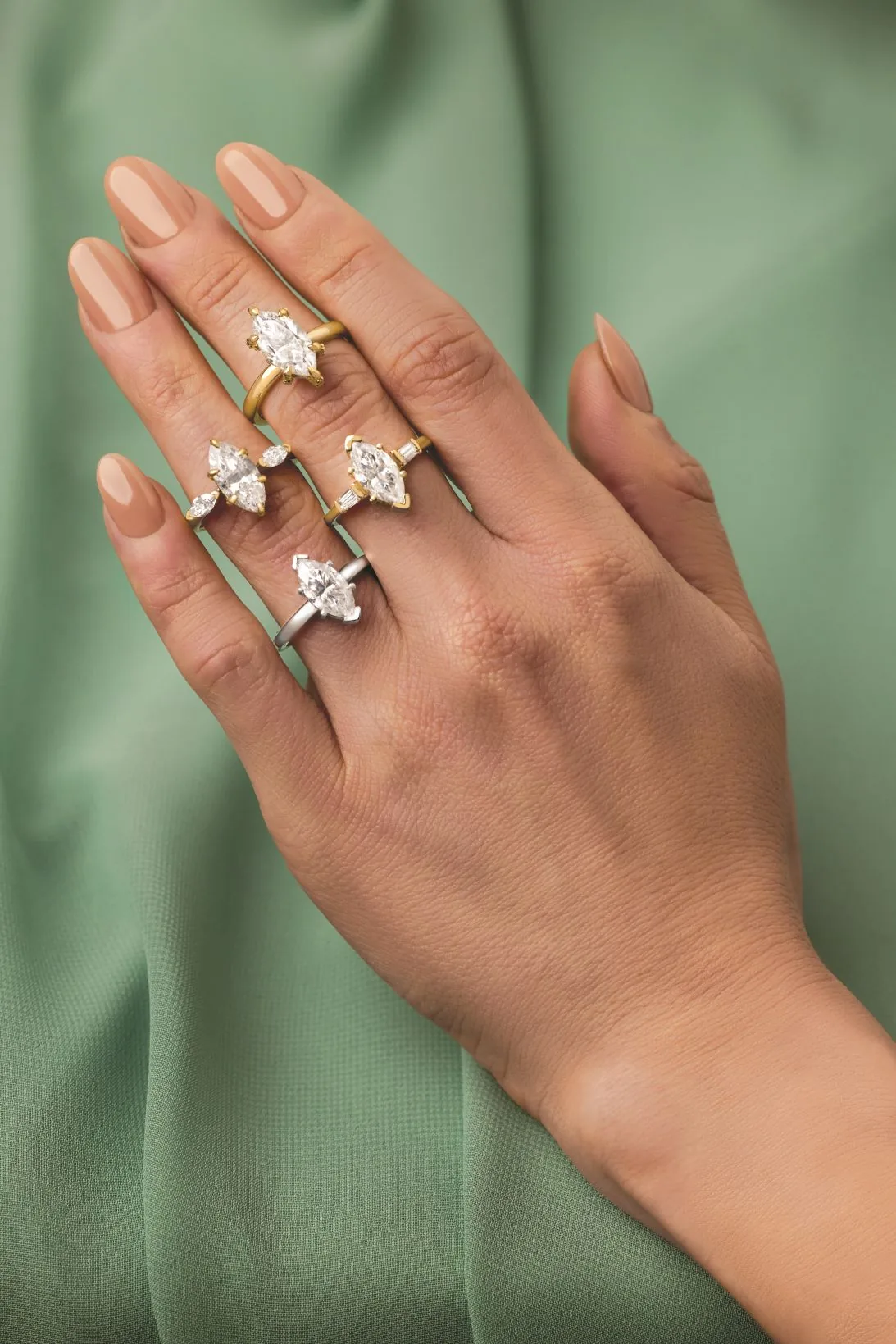
A three-stone engagement ring uses one center stone and two side stones to create a wider composition across the finger. The design can symbolize past, present and future, represent two people and a shared life, or simply provide more presence than a solitaire. The strongest three-stone rings are not defined by total carat weight alone. They depend on relationships: center-to-side scale, shape compatibility, facet pattern, color, clarity, angle, height, shoulder transition and wedding-band clearance.
- The fast answer
- Meaning and symbolism
- The proportion system
- How large should side stones be?
- Popular center and side-stone pairings
- Pear-shaped side stones
- Trapezoid and tapered baguette sides
- Round and half-moon side stones
- Color, clarity and facet matching
- Finger coverage and visible spread
- Prongs, baskets and setting styles
- Setting height and profile
- Wedding-band fit
- Lifestyle and maintenance
- Natural and lab-grown combinations
- Heirloom and sentimental stones
- Why custom CAD helps
- Cost and budget planning
- Common design mistakes
- Frequently asked questions
What makes a three-stone engagement ring look balanced?
A balanced three-stone ring keeps the center visually dominant while allowing the side stones to extend and support the composition. The side stones should be chosen by millimeter dimensions, outline and facet character—not only by carat weight. Their width, length, angle and height determine whether the ring feels graceful, crowded, flat or disconnected.
For many designs, each side stone may appear somewhere around one-third to one-half the visual scale of the center, but there is no universal ratio. Pears taper differently from trapezoids. Half-moons create more continuous width. Rounds add sparkle but can feel more separate. The correct relationship depends on the actual center shape, finger width and desired style.
The side stones should complete the center stone's outline—not compete to become two additional centers.
What does a three-stone engagement ring symbolize?
The traditional interpretation is past, present and future. The center often represents the present, with the side stones representing the relationship's history and what comes next. Some couples assign different meaning: friendship, love and commitment; two people and the life they create together; or family members represented through specific stones.
The symbolism is optional. A three-stone ring can be chosen simply because it provides more finger coverage, a stronger side profile or an architectural composition that a solitaire cannot create.
Meaning is strongest when it influences the design naturally. A birthstone may be used as a hidden detail rather than forcing two colored side stones into a composition that does not suit the wearer. An heirloom diamond may become one side of an asymmetrical design. The ring should remain visually coherent even when the story is personal.
Treat the three stones as one proportion system
The center and side stones should be selected together whenever possible. The side stones affect the apparent width of the ring, the center's dominance, the shoulder transition and the wedding-band relationship. A center diamond that looks ideal by itself may feel undersized once broad side stones are added.
| Design element | Visual role | Practical role |
|---|---|---|
| Center stone | Primary focus and vertical anchor | Determines the core basket and setting height |
| Side-stone width | Controls how strongly sides compete | Affects total finger coverage |
| Side-stone length | Creates taper or broad continuity | Influences shoulder and prong placement |
| Stone angle | Directs the eye toward or away from center | Changes comfort and wedding-band clearance |
| Facet pattern | Creates harmony or intentional contrast | Affects visible matching under movement |
| Gallery and bridge | Defines side profile | Controls support and band fit |
How large should the side stones be?
The correct side-stone size is usually judged by visible dimensions rather than carat weight. A 0.30-carat pear and a 0.30-carat trapezoid may cover different amounts of space. Depth can hide weight below the setting, while length and width create the face-up relationship.
Smaller side stones keep the center clearly dominant and create a tapered transition into the band. Larger sides create a bolder, more continuous statement and may make the ring read almost like a five-stone composition. Neither is wrong, but the intended hierarchy should be clear.
| Side-stone impression | Visual result | Best suited to |
|---|---|---|
| Subtle | Center remains strongly dominant; sides act as accents | Classic or refined designs |
| Balanced | Sides add width while supporting the center | Most traditional three-stone compositions |
| Bold | Sides approach the center in visual importance | High-coverage or statement rings |
Why percentage rules can mislead
Some buyers search for a fixed percentage of center carat weight. That can be a useful starting point, but shape and spread matter more. Pears narrow toward the tips. Tapered baguettes can look long with modest weight. Half-moons create broad arcs. Compare stones in millimeters and view them beside the actual center.
Popular center and side-stone pairings
| Center shape | Popular side stones | Design effect |
|---|---|---|
| Round | Pears, rounds, tapered baguettes, half-moons | Classic sparkle or a tapered romantic outline |
| Oval | Pears, half-moons, rounds, tapered baguettes | Extended finger coverage with soft curves |
| Emerald | Trapezoids, tapered baguettes, bullets, half-moons | Architectural and Art Deco |
| Radiant | Trapezoids, pears, half-moons, tapered baguettes | Structured outline with brilliant sparkle |
| Cushion | Pears, half-moons, rounds, trapezoids | Soft, broad and romantic |
| Asscher | Trapezoids, baguettes, shields | Geometric and compact |
| Pear | Rounds, tapered baguettes, custom curved sides | Asymmetrical center with structured support |
| Marquise | Pears, rounds, tapered baguettes | Long dramatic center with tapered width |
These are common pairings, not rules. A ring may deliberately combine brilliant and step-cut optics. The goal is to create intentional contrast rather than accidental mismatch.
Pear-shaped side stones
Pear sides create one of the most recognizable three-stone silhouettes. Their rounded ends sit beside the center while their points taper toward the band, creating a graceful transition. They can complement round, oval, cushion and radiant centers.
The pear's orientation matters. The broad end can face the center and the point extend outward, which is most common. Reversing the pears creates a different architectural effect. Their shoulders, points and bow-ties should match each other closely.
Pears that are too large can compete with the center or make the ring feel crowded. Pears that are too small may look like detached accents rather than part of the composition. Their angle should follow the finger and center outline rather than lie flat without connection.
What to inspect in matched pear sides
- Similar length-to-width ratio
- Matching shoulder fullness
- Aligned points
- Comparable bow-tie visibility
- Consistent color and brightness
- Symmetrical placement beside the center
Trapezoids and tapered baguette side stones
Trapezoids and tapered baguettes work especially well with emerald, radiant and Asscher centers. Their straight lines and clipped geometry create an architectural frame. They can widen the ring without adding the rounded softness of pears.
Step-cut trapezoids create broad flashes and a calm optical rhythm beside emerald and Asscher centers. Brilliant trapezoids can add more scintillation beside radiants. The facet relationship should be selected intentionally.
Tapered baguettes are narrower and more linear. They can create an elegant transition into the shank without approaching the center in visual dominance. They are often effective when the buyer wants a three-stone ring that still feels restrained.
Round, half-moon and other side-stone shapes
Round side stones add familiar brilliant sparkle. They are easy to source in matched pairs and can create a traditional composition. Because they do not taper naturally into the band, the shoulders and prong placement must manage the transition carefully.
Half-moons create broad curved coverage and can sit closely beside oval, cushion, emerald or radiant centers. Their inner edge may be straight or slightly curved depending on the cut. They can produce a nearly continuous face-up silhouette.
Shields, bullets, kites and custom-cut sides create more distinctive geometry. These shapes can solve unusual center outlines but may require specialized sourcing and a longer timeline.
Rounds
Classic, brilliant and easy to understand. They create separate points of sparkle rather than a continuous tapered line.
Half-moons
Broad and fluid. They provide strong coverage and can closely follow curved centers.
Shields and bullets
Architectural and distinctive. They may require careful sourcing and custom baskets.
Custom-cut sides
Useful for unusual heirloom centers or exact outlines, but they add cost and production time.
How should side stones match the center?
Matching does not always mean identical grades. The stones should look harmonious in the finished ring. Color differences become more noticeable when stones sit close together, especially in white metal. Step cuts may show color differently from brilliant cuts, and larger side stones make mismatches easier to see.
Clarity should be selected by visible appearance and inclusion placement. Small brilliant sides can often appear clean at lower grades because their facet patterns conceal inclusions. Open step-cut sides may reveal inclusions more easily.
Facet pattern is as important as grade. Two radiants may both be bright but show different textures. Two pears may have different bow-ties. Side stones should respond similarly as the ring moves.
Match these characteristics visually
- Color appearance in the intended metal
- Brightness and transparency
- Facet pattern
- Bow-tie or contrast behavior
- Outline and symmetry
- Depth and apparent size
The side stones do not need to repeat every line of the center's grading report. They need to look intentionally selected beside it.
Three-stone rings and finger coverage
Three-stone rings can provide significantly more horizontal coverage than a solitaire. This can make the ring feel substantial without placing the entire budget into one larger center stone. The side stones extend the design across the finger and create more visible presence from normal viewing angles.
More coverage is not always more flattering. A composition that extends too far can press into adjacent fingers, feel rigid or appear crowded. The outer stones should follow the hand rather than create a straight bar wider than the comfortable top of the finger.
Finger size and shape should be considered during CAD. The same three stones can feel elegant on one hand and oversized on another. Tilting the side stones and adjusting the shoulders can help the composition wrap naturally.
Prongs, baskets and setting styles
Each stone requires secure support, but the metal should not divide the ring into three unrelated settings. Shared prongs can reduce visible metal between stones, while individual baskets can provide more separation and flexibility. The correct choice depends on shapes, spacing and maintenance needs.
Prongs should protect vulnerable points and corners. Pear tips, marquise points and clipped corners need shape-specific placement. Extremely small shared prongs may look delicate but provide less material for future maintenance.
| Setting approach | Visual effect | Practical consideration |
|---|---|---|
| Individual baskets | Each stone remains clearly defined | May create more metal and greater separation |
| Shared prongs | More continuous stone-to-stone appearance | Requires precise engineering and inspection |
| Bezel or partial bezel | Modern, framed and protective | Adds visible metal and may broaden the composition |
| Cathedral shoulders | Connects the shank to the outer stones | Can add support and affect band fit |
Setting height and side-stone angle
The three stones may sit on one level, step down gradually or angle toward the finger. A flat arrangement can feel broad and formal. Lower, angled sides create a wrapped appearance and may improve comfort.
The center should remain visually elevated enough to lead the composition, but an extreme height difference can make the side stones look attached rather than integrated. The baskets and shoulders should connect smoothly.
Lowering the entire design can improve protection but complicate wedding-band clearance. Raising the center may allow a straight band to fit while making the ring more prominent from the side. The correct profile depends on lifestyle and the desired stack.
How should a wedding band fit with a three-stone ring?
Three-stone galleries often extend farther across the finger than solitaire baskets. The outer stones, baskets and shoulders can block a straight band from sitting flush. The future wedding band should be considered before the engagement ring is finalized.
A contoured band can curve around the outer baskets. A straight band may work when the setting is raised and the bridge provides enough clearance. An intentional gap can also create a layered look and reduce direct rubbing.
| Band preference | Three-stone design implication |
|---|---|
| Straight flush band | Requires careful bridge, height and outer-basket clearance |
| Contoured band | Allows a lower or broader three-stone setting |
| Intentional gap | Provides flexibility and separates the rings visually |
| Stack of multiple bands | Requires planning for total width and outer-stone contact |
When a matched band is desired, it can be designed in CAD with the engagement ring. Even when the band will be purchased later, the relationship should be documented.
Lifestyle, comfort and maintenance
A three-stone ring contains more settings, prongs and exposed edges than a simple solitaire. This can increase maintenance and create more opportunities for contact. Side stones that extend widely may rub adjacent fingers or catch during hands-on work.
For active wearers, a lower profile, protected tips, sufficient band width and controlled side-stone spread can improve practicality. The ring should still be professionally inspected because each stone and prong must remain secure.
Daily-wear questions to answer
- Will the wearer use gloves regularly?
- Do the side stones contact adjacent fingers?
- Will the ring be removed for work or exercise?
- How much professional maintenance is acceptable?
- Are vulnerable points protected?
- Can the underside be cleaned effectively?
- Will the wedding band rub against side baskets or prongs?
Natural and laboratory-grown center and side stones
Natural centers are commonly paired with natural side stones, and laboratory-grown centers with laboratory-grown sides. This creates consistency in disclosure and project logic. Mixed-origin designs can be created, but the combination should be intentional, clearly disclosed and documented.
Origin does not determine whether the stones look harmonious. Shape, cut character, color and dimensions still control the appearance. A well-matched pair of side stones is important regardless of category.
The decision should reflect the couple's preferences and value priorities. It should not be based on the assumption that side-stone origin is too small to matter. Clear documentation protects future understanding of the ring.
Using heirloom stones in a three-stone ring
Three-stone designs can incorporate family diamonds or gemstones while preserving a new center stone. Two matched heirloom stones may become the sides. One heirloom stone may inspire an asymmetrical composition. A center diamond may be flanked by family stones representing two families or generations.
Older stones should be examined for wear, chips, unusual dimensions and cutting style. Matching a second heirloom stone may be difficult if the outlines or color differ. Custom design can use spacing, metal and orientation to make differences feel intentional.
Sentimental importance does not remove structural risk. A worn or chipped stone may need protective prongs, a bezel or a different placement within the ring.
Why custom CAD is especially valuable for three-stone rings
Three-stone rings depend on exact relationships that are difficult to judge from separate stone listings. CAD allows the actual center and side-stone measurements to be arranged together. The stones can be scaled, angled, raised, lowered and repositioned while the band and wedding-band fit are reviewed.
Live Collaborative CAD Design helps answer practical questions before production:
- Do the side stones support or compete with the center?
- Does the total width fit the finger?
- Should the sides angle downward?
- How much metal appears between the stones?
- Will the outer tips be protected?
- Can a straight wedding band fit?
- Does the gallery look connected from the side?
CAD does not replace stone matching or bench skill, but it makes the design relationships visible before metal is produced.
How much does a three-stone engagement ring cost?
Cost depends on the center diamond, two side stones, metal, setting complexity, custom design, labor and brand positioning. The side stones can represent a meaningful portion of the budget, especially when they are large, unusual, matched step cuts or custom cut.
A three-stone ring is not automatically more expensive than a halo or elaborate solitaire. The total follows materials and labor. Smaller side stones may add broad visual presence efficiently, while rare matched trapezoids or specialty shapes can increase cost.
Budget priorities
- Choose the center stone that establishes the ring's identity.
- Match side stones by visible proportion and performance.
- Protect structural quality and comfort.
- Plan the wedding-band relationship.
- Add engraving or decorative detail only after the core composition works.
Common three-stone engagement-ring design mistakes
- Choosing side stones by carat weight alone. Millimeter dimensions and outline determine the visible relationship.
- Making the sides too large. The ring can lose hierarchy and feel like three competing centers.
- Making the sides too small. Detached accents may not create a true composition.
- Ignoring facet compatibility. Unplanned differences in sparkle can look mismatched.
- Matching paper grades but not visual color. Stones touching each other make differences easier to see.
- Setting all three stones too flat. The ring may look wide and rigid instead of wrapping the finger.
- Failing to protect points and corners. Shape-specific prongs are essential.
- Ignoring adjacent-finger comfort. Excessive width can create rubbing.
- Forgetting the wedding band. Outer baskets may block a straight band.
- Approving the top view without reviewing the gallery. Height and support live in the side profile.
Three-stone engagement-ring design checklist
- Select the exact center stone first.
- Compare side stones beside the center, not in isolation.
- Use millimeter dimensions as well as carat weight.
- Confirm the center remains visually dominant.
- Match side outlines and facet behavior.
- Review color in the intended metal.
- Inspect clarity and transparency visually.
- Choose side-stone angle and height deliberately.
- Protect vulnerable tips and corners.
- Check total width against the finger.
- Review adjacent-finger comfort.
- Decide whether shared or individual prongs are appropriate.
- Plan straight, contoured or gapped wedding-band fit.
- Confirm natural or laboratory-grown origin for every stone.
- Review the top and side views in CAD.
- Inspect every stone and prong at final handoff.
How Diamond Consulate approaches three-stone design
Diamond Consulate is a private, appointment-only jewelry studio in Oklahoma City. Three-stone rings can be developed through side-by-side diamond comparison at The Diamond Table and Live Collaborative CAD Design.
The process begins with the center stone and the wearer's hand. Side stones are selected to support the center's outline, facet pattern and scale. The gallery, band and future wedding band are then designed as one system.
The goal is not to maximize the number of diamonds or total carat weight. It is to create a composition in which all three stones feel as though they were always intended to belong together.
How to compare three-stone designs in person
Three-stone rings are difficult to evaluate from isolated product images because photographs flatten the angle, compress the side profile and make the total width difficult to understand. A ring may look beautifully balanced on a screen yet feel too broad, too flat or too high on the hand. The center and side stones should be compared together under consistent lighting and placed over the finger before the setting is finalized.
Begin by viewing the center stone alone. Confirm that its shape, outline and light performance are right before the side stones influence the impression. Then place possible side-stone pairs beside it. Watch how the center's visual dominance changes. A pair that looks modest in a tray may become much stronger once it touches the center. A pair that seems small in isolation may create exactly the correct taper when angled toward the band.
Compare at least two side-stone scales when possible. The smaller pair may make the center feel more important and the ring more refined. The larger pair may create stronger finger coverage and a more substantial composition. Neither should be selected by the total carat number alone. The better pair is the one that creates the intended visual hierarchy on the actual hand.
View the stones under more than one type of light
Jewelry lighting can make every diamond look highly active. Move the stones into ordinary room light and softer indirect light. Look for matching brightness, transparency and contrast behavior. Pears with noticeably different bow-ties or trapezoids with inconsistent facet patterns may become more obvious outside concentrated display lighting.
Color should also be compared in the metal selected for the ring. Yellow or rose gold may make slight warmth feel harmonious, while white metal can make differences between touching stones easier to notice. Step-cut side stones and brilliant centers may show color differently even when their reports list similar grades.
Check the total width against the finger
Place the approximate stone layout across the top of the finger. The outer stones should not extend so far that the composition feels rigid or presses uncomfortably into adjacent fingers. The ring should appear to wrap the hand rather than sit like a straight horizontal bar.
Finger size alone does not determine the correct width. The width of the finger at the base, the shape of the knuckle and the wearer's comfort with substantial jewelry all matter. Angling the side stones downward can preserve coverage while helping the ring follow the hand more naturally.
Review the side profile before approving the design
A three-stone ring may look balanced from above while hiding problems from the side. Ask how high the center sits above the side stones, whether the outer baskets will contact the wedding band and whether the gallery feels connected. The center should lead the composition without appearing perched above two unrelated accents.
Check how the shoulders meet the outer stones. A sudden transition can make the design feel assembled from separate parts. A gradual rise, controlled taper or cathedral structure can connect the band to the stone arrangement. The underside should allow cleaning access while maintaining appropriate support.
Ask what can be maintained in the future
Matched side stones are not always easy to replace years later, particularly when they have unusual shapes or dimensions. Ask whether the stones are standard enough to source again, how the prongs can be rebuilt and whether the ring can be resized without disturbing the outer settings.
The objective is not to avoid distinctive side stones. It is to understand the long-term service requirements before the ring is made. A custom three-stone ring should be designed not only for the proposal photograph but also for cleaning, inspection, future refinishing and decades of wear.
Frequently asked questions about three-stone engagement rings
What does a three-stone engagement ring mean?
It is often said to represent past, present and future, but couples may assign any personal meaning or choose it simply for the design.
How large should side stones be in a three-stone ring?
There is no universal ratio. The side stones should support the center visually, and their millimeter dimensions matter more than carat weight alone.
Should all three diamonds be the same shape?
No. Many designs pair a different center shape with pears, trapezoids, baguettes, rounds or half-moons.
What side stones look best with a round diamond?
Pears, rounds, tapered baguettes and half-moons are common choices. The best option depends on the desired outline and style.
What side stones look best with an emerald cut?
Trapezoids and tapered baguettes are especially popular because their straight lines complement the emerald cut's geometry.
What side stones look best with an oval diamond?
Pears and half-moons create soft extended coverage, while rounds or tapered baguettes can create a more distinct contrast.
Do side stones need the same color grade as the center?
Not always, but they should look harmonious beside the center in the intended metal. Visual matching matters more than repeating the exact grade.
Do side stones need the same clarity grade?
No. They should appear clean and transparent at normal viewing distance. Inclusion visibility and facet pattern matter more than identical grades.
Can brilliant side stones be paired with a step-cut center?
Yes. The contrast can be intentional, but the difference in light pattern should look designed rather than accidental.
Do three-stone rings look larger than solitaires?
They usually provide more total finger coverage because the side stones extend the composition horizontally.
Are three-stone rings more expensive?
They can be, because the design includes two additional stones and more setting work, but the total depends on stone sizes, shapes, materials and complexity.
Are pear side stones secure?
They can be secure when the points are protected and the prongs are properly designed and maintained.
Can a three-stone ring sit flush with a wedding band?
Sometimes. The bridge, side baskets and setting height must provide enough clearance for a straight band.
Does a three-stone ring need a contoured wedding band?
Not always, but broad or low side baskets often make a contoured band the cleanest fit.
Can a three-stone ring be low profile?
Yes, although lowering the stones may reduce clearance for a straight wedding band and require a more integrated gallery.
Can I mix natural and lab-grown diamonds in one ring?
It is possible, but the combination should be intentionally selected, fully disclosed and documented.
Can heirloom diamonds be used as side stones?
Yes, after they are inspected for condition, dimensions and compatibility with the new center and setting.
Are three-stone rings harder to maintain?
They have more stones and prongs to inspect than a solitaire, so regular cleaning and professional checks are important.
Why use CAD for a three-stone ring?
CAD allows the actual center and side-stone dimensions, angles, height and wedding-band fit to be reviewed before production.
How do I know whether a three-stone ring is balanced?
The center should remain dominant, the side stones should match each other, the total width should suit the finger and the top and side views should feel connected.