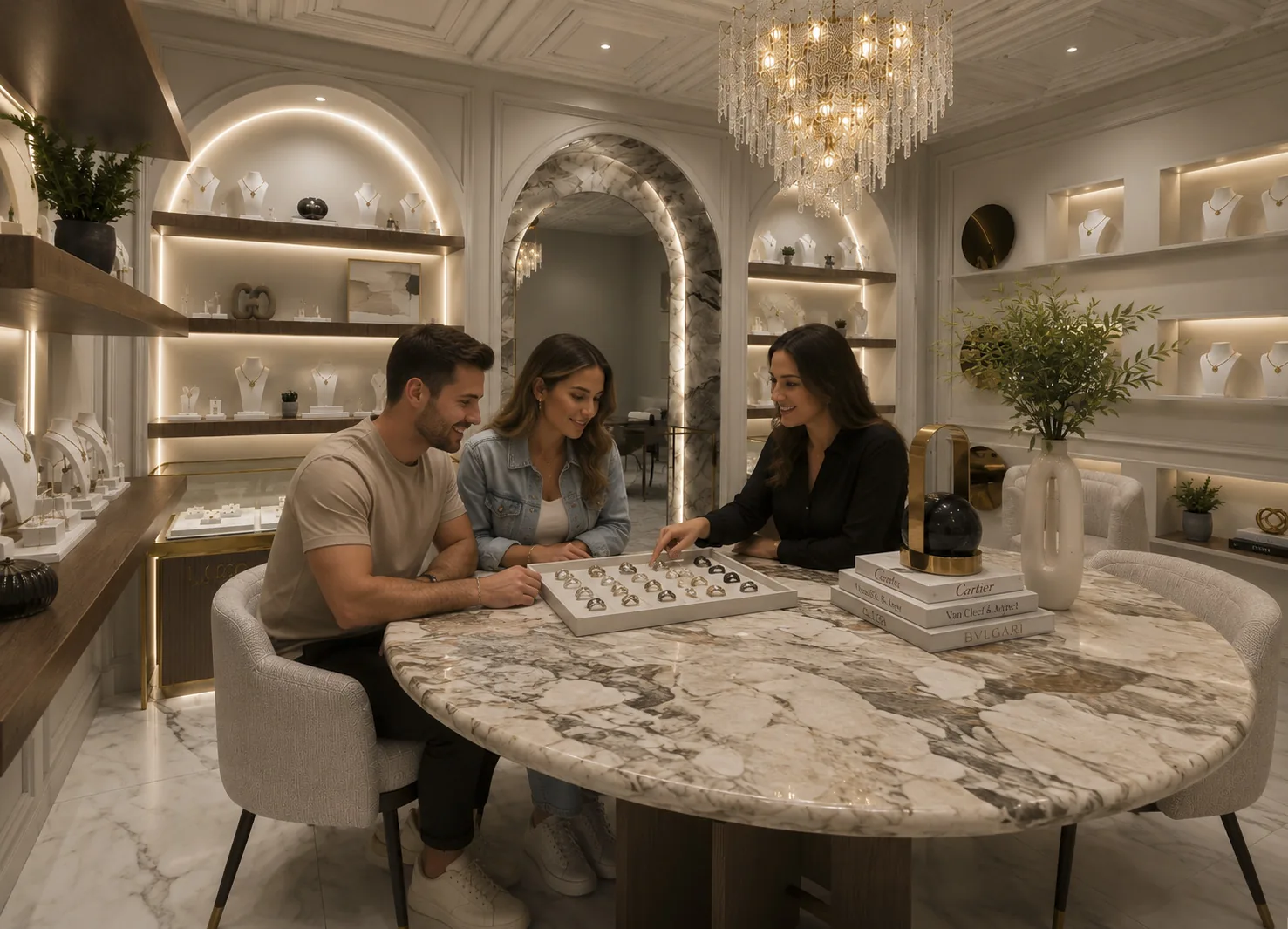
The name of the ring is flexible. The way it fits, wears and works with your life is not.
Wedding band vs. wedding ring: the short answer
Wedding band and wedding ring usually mean the same thing: the ring exchanged during a wedding ceremony and worn as a symbol of marriage. There is no universal jewelry-industry rule that makes one term technically different from the other.
In everyday conversation, “wedding band” sometimes suggests a simpler, more continuous design, while “wedding ring” may be used as the broader category. However, a plain gold ring, a diamond-set band, a sculpted contour band and a full-eternity design can all accurately be called either a wedding band or a wedding ring.
For most shoppers, wedding band and wedding ring are interchangeable terms. The important differences are in design, construction and wearability—not vocabulary.
The common ring terms and how they overlap
| Term | Typical meaning | Can it be a wedding ring? | Primary design concern |
|---|---|---|---|
| Wedding band | A ring exchanged at the ceremony; often associated with a continuous or streamlined shape | Yes | Daily comfort, width, profile and fit |
| Wedding ring | The broad, everyday term for the ring that symbolizes marriage | Yes | How it will be worn over time |
| Eternity band | A ring with gemstones around all or part of the circumference | Yes | Stone security, comfort and sizing flexibility |
| Anniversary band | A ring given to mark an anniversary or milestone | Yes, and it may be added later | How it integrates into an existing stack |
| Stacking band | A ring designed to be worn with one or more other rings | Yes | Total width, spacing and contact points |
| Contour band | A curved or shaped band designed around another ring | Yes | Alignment with the engagement ring |
| Guard or enhancer | One or two bands framing another ring | Yes | Symmetry, scale and long-term wear between rings |
Why people think wedding bands and wedding rings are different
The confusion comes from language, not from a strict manufacturing standard. Jewelry stores, families, regions and cultures may use the terms differently. Historically, “band” often described a continuous ring with a relatively uniform width. As wedding jewelry became more varied, the word expanded to include diamond bands, sculpted bands, mixed-metal rings and custom designs.
Today, product categories add another layer. A retailer may label a page “wedding bands” because that is the more common shopping phrase, while clients may naturally ask for a “wedding ring.” Both can lead to the same collection.
The terminology may change by context
- During the ceremony: people often say wedding ring.
- While shopping: wedding band is especially common.
- For men’s jewelry: wedding band and wedding ring are used almost equally.
- For diamond-set styles: eternity band, anniversary band and wedding band may describe the same physical design.
- For ring stacks: stacking band refers more to how the ring is worn than why it was given.
Which decisions matter more than the name?
The chart below is a practical decision guide, not a grading system. A longer bar means the factor deserves more attention during design and fitting.
The six design questions that define the right wedding ring
1. Will it be worn alone or with an engagement ring?
A band worn alone can be judged as a complete design. A band worn beside an engagement ring must also be evaluated as part of a set. Height, curve, gallery details and side stones can determine whether the two rings sit flush, leave a deliberate gap or require a custom contour.
2. Should the rings touch?
Rings that rub against each other can gradually wear at shared contact points. This does not mean rings must never touch, but the contact should be understood. A well-designed pairing considers prongs, exposed diamond edges, engraving and delicate details that may be affected by repeated friction.
3. How wide should the band be?
Width changes visual proportion and comfort. A narrow band may feel subtle and stack easily. A wider band can feel more substantial and may need a slightly different size because it covers more of the finger. The correct width depends on finger shape, personal style and the dimensions of any neighboring ring.
4. What profile feels best?
Common profiles include flat, domed, half-round, knife-edge, beveled and softly rounded comfort-fit shapes. Profile affects the way the ring looks from the top and how it feels between the fingers. Two bands with the same width can feel completely different because of their profile.
5. Will the design need future resizing?
Plain and partially set bands are generally more adaptable than full-eternity designs. Full-eternity rings can be difficult—or sometimes impractical—to resize because the pattern continues around the entire ring. Future sizing needs should be discussed before choosing the setting layout.
6. What kind of maintenance is realistic?
A plain polished band is usually straightforward to maintain. Textured finishes can soften with wear and may periodically need refinishing. Diamond-set bands require inspection and cleaning. Intricate engraving and milgrain can age beautifully, but the owner should understand how daily wear may change fine details over time.
How common wedding-band styles compare
| Style | Best for | Advantages | Tradeoffs to discuss |
|---|---|---|---|
| Plain metal band | Minimal style, easy everyday wear | Classic, durable, typically easier to resize | Polished surfaces show scratches; finish changes over time |
| Half-eternity band | Diamond presence with more sizing flexibility | Stones stay primarily on top of the finger | Ring rotation can shift the diamond section off-center |
| Full-eternity band | Continuous sparkle from every angle | No plain underside and no need to keep it centered | Limited resizing; diamonds between fingers may feel different |
| Contour band | Engagement rings with low settings or unusual outlines | Can create a close, intentional fit | May look less balanced when worn alone |
| Open-gap band | Large center stones or architectural settings | Creates space without a deep contour | Open ends require careful proportion and stone protection |
| Textured or engraved band | Distinctive detail without gemstones | Visual depth and personality | Texture and fine detail may soften through years of wear |
| Mixed-metal band | Connecting jewelry in different metal colors | Flexible styling and visual contrast | Different metals may wear or patina differently |
Is an eternity ring the same as a wedding band?
An eternity ring describes a design structure, not a single occasion. It may be used as a wedding band, anniversary ring, milestone gift or stacking ring. The term generally refers to a band with diamonds or gemstones extending around all—or sometimes a significant portion—of the ring.
A full-eternity band has stones around the entire circumference. A half-eternity or three-quarter-eternity band leaves some plain metal at the bottom. That plain section can improve comfort, protect stones from heavy underside wear and provide more options if resizing becomes necessary.
Is an anniversary band different from a wedding ring?
An anniversary band is defined primarily by when and why it is given. It may look exactly like a wedding band. Some anniversary bands are added to the original wedding set, some replace an earlier ring and others are worn on the opposite hand.
Because an anniversary band enters an existing jewelry collection, the most important questions are usually compatibility and proportion. The new ring should be evaluated next to the rings it will actually accompany rather than selected in isolation.
Do wedding bands have to match?
No. Partners may choose matching rings, coordinated rings or completely individual designs. Matching can mean identical metal and finish, but it can also mean a subtler connection: the same engraving pattern, a shared edge detail, complementary proportions or a small hidden design element.
The strongest choice is usually the one each person genuinely wants to wear. A coordinated pair can still respect different lifestyles, finger proportions and comfort preferences.
A private, no-pressure appointment can make these fit and proportion decisions easier. See what a no-pressure jewelry consultation should include and why appointment-only jewelry consultations work differently.
Instead of asking whether the rings must match, ask what should connect them—and what should remain personal.
Which type may fit your priorities?
| Your priority | Styles to explore first | Question to ask during consultation |
|---|---|---|
| Simple daily wear | Plain metal, low-profile diamond band | Which profile feels best between my fingers? |
| A flush engagement-ring stack | Straight band if clearance allows; custom contour if it does not | Where do the rings touch, and will that create wear? |
| Maximum sparkle | Full-eternity or high-coverage diamond band | How will stone coverage affect comfort and future sizing? |
| Future flexibility | Plain band, partial-eternity band, adaptable setting pattern | How much can this design realistically be resized? |
| A distinctive, nontraditional look | Textured, engraved, asymmetrical, mixed-metal or sculpted band | How will the details age with daily wear? |
| A meaningful matched set | Coordinated metal, finish, engraving or hidden motif | Which elements should match without making both rings identical? |
How to describe what you want at a wedding-band consultation
You do not need specialized vocabulary. Bring the ring that the new band will be worn beside, explain how you expect to wear the set and identify what matters most to you. Photographs can help communicate style, but the final design should be evaluated on your hand and beside your actual engagement ring whenever possible.
- State whether the ring will be worn alone, stacked or paired with an engagement ring.
- Describe your preference for flush fit, a small intentional gap or a contoured shape.
- Compare several widths and profiles in person.
- Discuss metal, finish, diamonds, gemstones and maintenance.
- Ask about resizing limitations before finalizing a full-eternity or highly detailed design.
- Review where neighboring rings will touch and how that may affect long-term wear.
Call it whatever feels natural. Design it for the life it has to live.
Are wedding bands and wedding rings the same thing?
Yes. In modern use, the terms are generally interchangeable. Some people use “band” for a simpler or more continuous design, but there is no universal technical distinction.
Why do some jewelers say wedding band instead of wedding ring?
“Wedding band” is a common retail and design-category term. It helps distinguish the ring worn with or after an engagement ring, but it does not mean the ring must be plain.
Can a diamond ring be called a wedding band?
Yes. A wedding band may be plain metal, partially diamond-set, full eternity, engraved, textured, sculpted or custom designed.
Is an eternity ring a wedding band?
It can be. Eternity rings are often used as wedding bands, anniversary rings or stacking rings. “Eternity” describes the stone pattern more than the occasion.
What is the difference between a full-eternity and half-eternity band?
A full-eternity band has stones around the entire circumference. A half-eternity band places stones across the upper portion and leaves plain metal underneath, usually allowing more comfort and sizing flexibility.
Is an anniversary band different from a wedding band?
The difference is usually the occasion. An anniversary band is given later to mark a milestone, but its design may be identical to a wedding band.
Is a men’s wedding band also a wedding ring?
Yes. Men’s wedding band and men’s wedding ring generally refer to the same ring.
Do both partners’ wedding rings need to match?
No. Rings can match exactly, coordinate through one or two shared details, or be completely different. Comfort and personal style are more important than strict matching.
Should a wedding band sit flush with an engagement ring?
Only if that is the preferred look and the engagement-ring structure allows it. Some settings need a contour band, while others naturally create a small gap that can be attractive and practical.
Can a straight wedding band fit beside every engagement ring?
No. Low baskets, projecting side stones and unusual center-stone shapes can prevent a straight band from sitting close. A contour, open-gap or custom band may fit better.
Can wedding bands damage engagement rings?
Repeated rubbing can create wear where rings touch, especially near delicate prongs, engraving or exposed diamond edges. A consultation should evaluate contact points and long-term wear.
How wide should a wedding band be?
There is no single correct width. The best width depends on finger proportions, comfort, personal style and whether the band will be worn beside another ring.
Can a full-eternity wedding band be resized?
Resizing is often limited and may be impractical depending on the setting and pattern. Future sizing needs should be discussed before ordering or creating a full-eternity design.
Should the wedding band use the same metal as the engagement ring?
It is often helpful for wear consistency, but mixed-metal sets can be intentional and attractive. The metals, hardness, color and contact points should be evaluated together.
What should I bring to a wedding-band consultation?
Bring the engagement ring or any rings that will be worn with the new band. Also bring inspiration images and be ready to discuss fit, width, comfort, lifestyle, maintenance and future resizing.