
Halo settings can increase visual presence and create a bright outline around the center stone. The best examples keep the halo proportional to the center diamond rather than allowing the surrounding stones to overpower it.
The name “Halo engagement rings” describes a category, not a single formula. Center-stone dimensions, band width, prong or bezel structure, gallery height and accent-stone scale determine whether the finished ring feels refined. A custom consultation is useful when several inspiration images share a mood but not the same construction.
Natural and lab-grown diamonds can both work in halo designs. What matters is matching the halo to the exact center outline: an oval or cushion can vary enough in length-to-width ratio and corner shape that a generic halo leaves uneven spacing. Select the center first, then build the surrounding geometry around its measurements.
CAD can control the gap between center and halo, melee spacing, outer outline and gallery height before the ring is made. It also shows whether the halo or basket projects far enough toward the finger to interfere with a straight wedding band, which is easier to solve in the model than after production.
A well-proportioned halo makes the center stone feel intentionally framed. The size of the halo diamonds, the distance between the center and surrounding stones, and the outline of the halo all change the result. Tiny melee can create a fine line of sparkle; larger halo stones create a bolder perimeter but can make the ring read as a cluster rather than a single-center design.
The halo should follow the actual outline of the center stone. Ovals, cushions and radiants vary meaningfully in length-to-width ratio and corner shape, so a stock halo built around a generic outline can leave uneven gaps or distort the silhouette.
Halo rings contain many small setting points. Shared prongs, bead setting and pavé can all be durable when enough metal remains around the stones, but extremely delicate halos trade some serviceability for visual lightness. The underside matters too: a halo that is supported only at a few points is more vulnerable to distortion than one integrated into a stable gallery.
A halo can sit high, low or nearly level with the center stone. A higher center may expose more of the diamond and make cleaning easier, while a lower integrated halo can create a compact profile. Neither is automatically better; the wearer’s lifestyle and desired wedding-band fit should drive the decision.
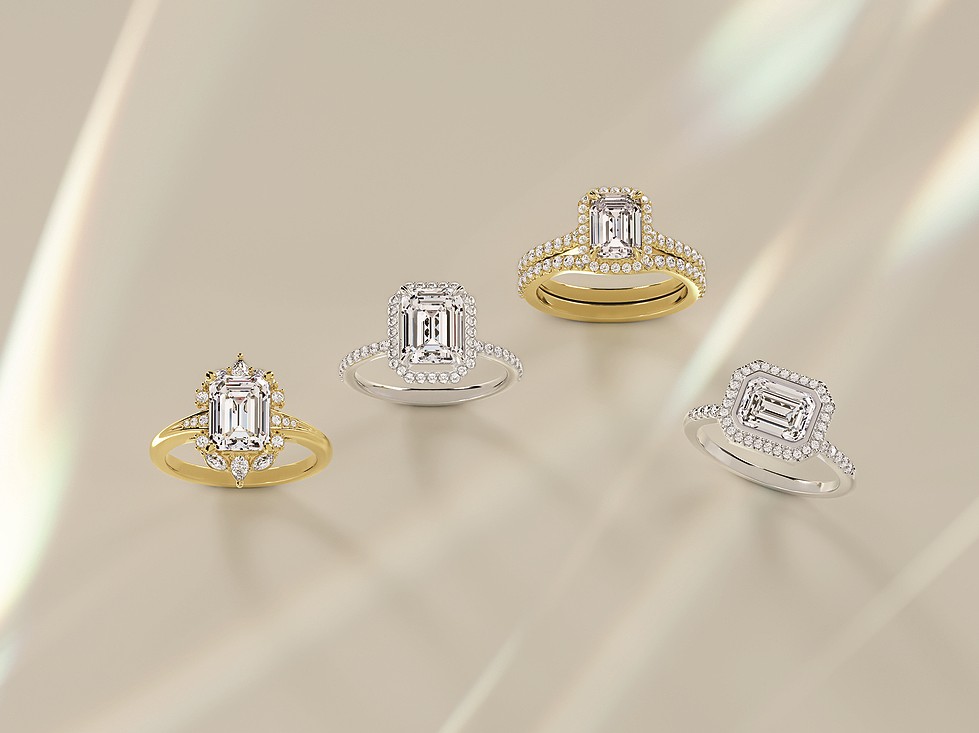
A single halo is usually the most versatile because it adds perimeter sparkle without dramatically changing the ring’s scale. Double halos can be effective when a deliberately larger, ornate look is the goal, but every additional row adds width and more small stones to maintain. A halo does not need to be perfectly round around a round diamond either; cushion-shaped or geometric halos can deliberately change the outline.
If the goal is to preserve a solitaire-like top view, a hidden halo may be a better fit than a conventional face-up halo. The two designs solve different visual problems and should not be treated as interchangeable.
Ask how large the halo melee will be, whether the halo follows the exact center-stone outline, how the small stones are set, and how the head connects to the shank. Look at the ring from the side as carefully as from the top. Also decide whether a straight wedding band must sit flush; the gallery and halo diameter can determine whether that is possible.
The best halo is not the one that makes a center stone look largest in a photograph. It is the one whose proportions, structure and maintenance expectations make sense for the person who will wear it every day.
Compare halo scale, center-stone outline and gallery construction together so the surrounding diamonds enhance the center instead of competing with it.
Explore Engagement RingsHalo Engagement Rings feature a center stone framed by a circle of smaller diamonds.
Yes. A custom halo can be built to the exact outline of the chosen center stone, which is especially useful for ovals, cushions and radiants whose proportions vary from stone to stone.
Yes. Natural and lab-grown centers can both be used. The halo should be proportioned to the actual center dimensions rather than to diamond origin or carat weight alone.
It depends on how the halo and gallery meet the shank. A low halo may require a contoured band; a raised or carefully relieved gallery can sometimes accommodate a straight band.
Platinum and gold are both common. Very delicate halos need enough metal around small stones and shared prongs to remain serviceable, so construction matters more than choosing a metal by color alone.