
A hidden halo adds detail from the side without changing the face-up outline as dramatically as a traditional halo. Gallery height, wedding-band clearance and how exposed the hidden diamonds are all matter.
The name “Hidden halo engagement rings” describes a category, not a single formula. Center-stone dimensions, band width, prong or bezel structure, gallery height and accent-stone scale determine whether the finished ring feels refined. A custom consultation is useful when several inspiration images share a mood but not the same construction.
A hidden halo does not depend on whether the center is natural or lab-grown. Its success depends more on the center stone dimensions and pavilion depth because the accent row sits below the girdle. A deeper stone can force the halo and basket lower or wider than expected, so measurements matter early.
For hidden halos, CAD helps coordinate center height, accent-row visibility, prong placement and the gallery rail. Wedding-band clearance deserves special attention: a low hidden halo may occupy exactly the space a straight band needs, while a modest height adjustment can preserve the look and improve stacking.
A hidden halo places small diamonds around the side of the center setting, below the face-up outline. From directly above, the ring can still read as a solitaire. From an angle, the halo adds a line of sparkle and detail around the gallery. That distinction is important: a hidden halo is primarily a profile feature, not a way to make the center diamond look dramatically larger from the top.
The effect depends on height. If the hidden halo sits too low, it may disappear behind the shank or wedding band. If it sits too high, it can become visible from the top and change the clean outline that often motivates the design in the first place.
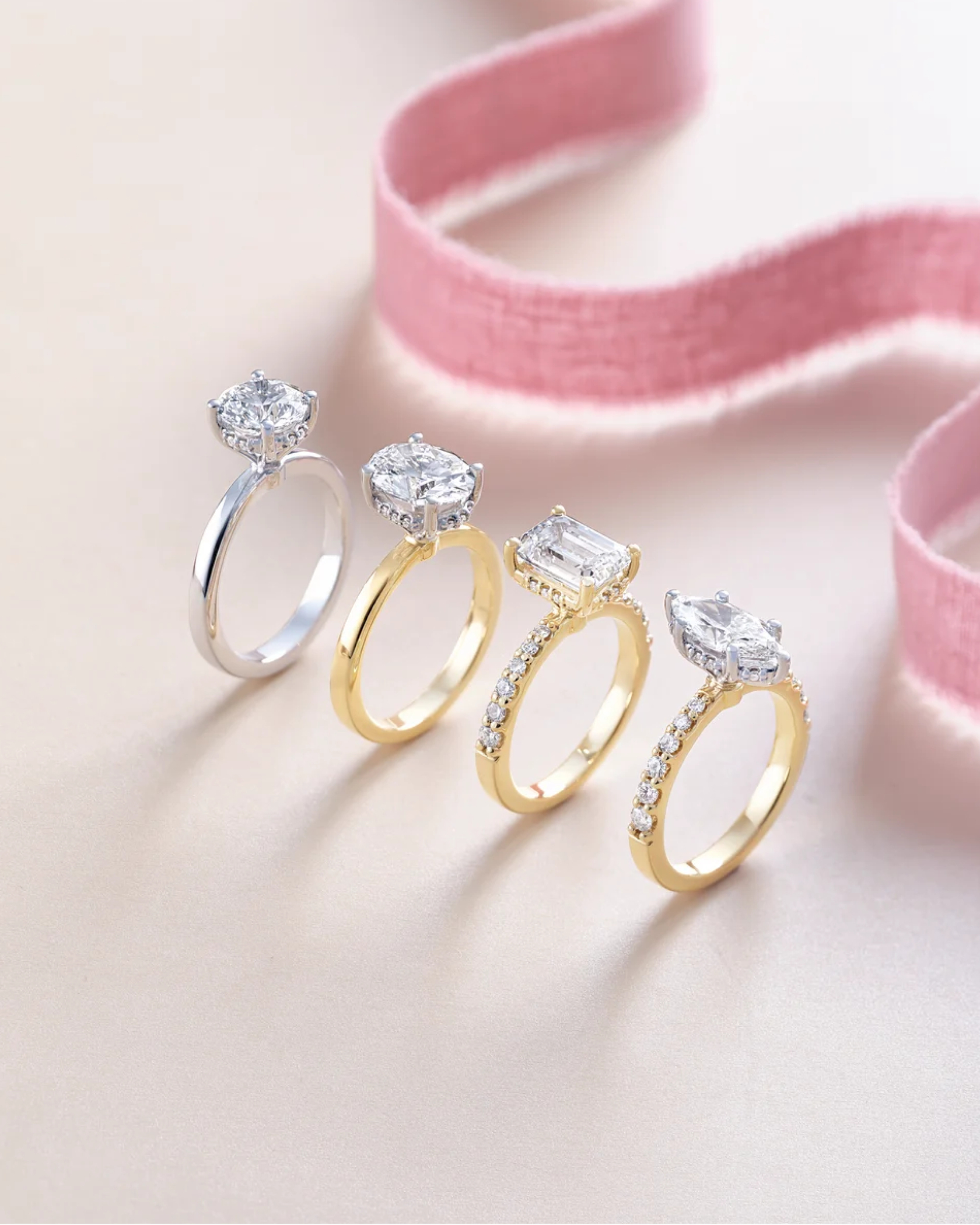
Hidden halos are often drawn extremely fine in renderings. In finished jewelry, the small stones need secure seats, prongs or beads and enough surrounding metal to survive normal wear and future service. A halo that is too thin may look delicate on screen but leave little material for maintenance years later.
The halo also becomes part of the head’s structure. Its connection to the center-stone prongs and gallery should be evaluated as engineering, not decoration. For elongated stones, the ends of the head need particular attention because the setting spans more distance.
A hidden halo often occupies the exact space where a straight wedding band wants to sit. If flush fit matters, the ring can be designed with enough gallery clearance, a bridge beneath the head, or a wedding band shaped specifically around the profile. Each approach changes height and appearance.
This is why the wedding band should be discussed during engagement-ring design rather than months later. A hidden halo can coexist beautifully with a flush band, but only when the two are planned as a system.
Choose a hidden halo when you want side-view detail, extra sparkle in the gallery and a design that still looks relatively clean from above. Skip it if the priority is the simplest possible maintenance, an ultra-low setting with no compromise, or a completely uninterrupted metal gallery.
Before approval, inspect the CAD or sample from the top, side and a normal viewing angle. Confirm where the halo becomes visible, how it is supported and what happens when the intended wedding band is placed beside it.
Review a hidden halo from the side as well as the top; its success depends on gallery height, stone exposure and how securely the accent diamonds are protected.
Explore Engagement RingsHidden Halo Engagement Rings feature a discreet row of diamonds beneath the center stone.
Yes. CAD can position the hidden halo relative to the center stone and prongs so it is visible from intended angles without forcing the head unnecessarily high.
Yes. The hidden halo is a setting detail and can be designed around either a natural or lab-grown center stone.
Often, but not automatically. The hidden halo and lower gallery can extend into the space a straight band needs, so clearance should be checked in profile before the ring is made.
Gold and platinum can both support hidden-halo construction. The key is adequate metal around the accent stones and secure transitions between the gallery, prongs and shank.