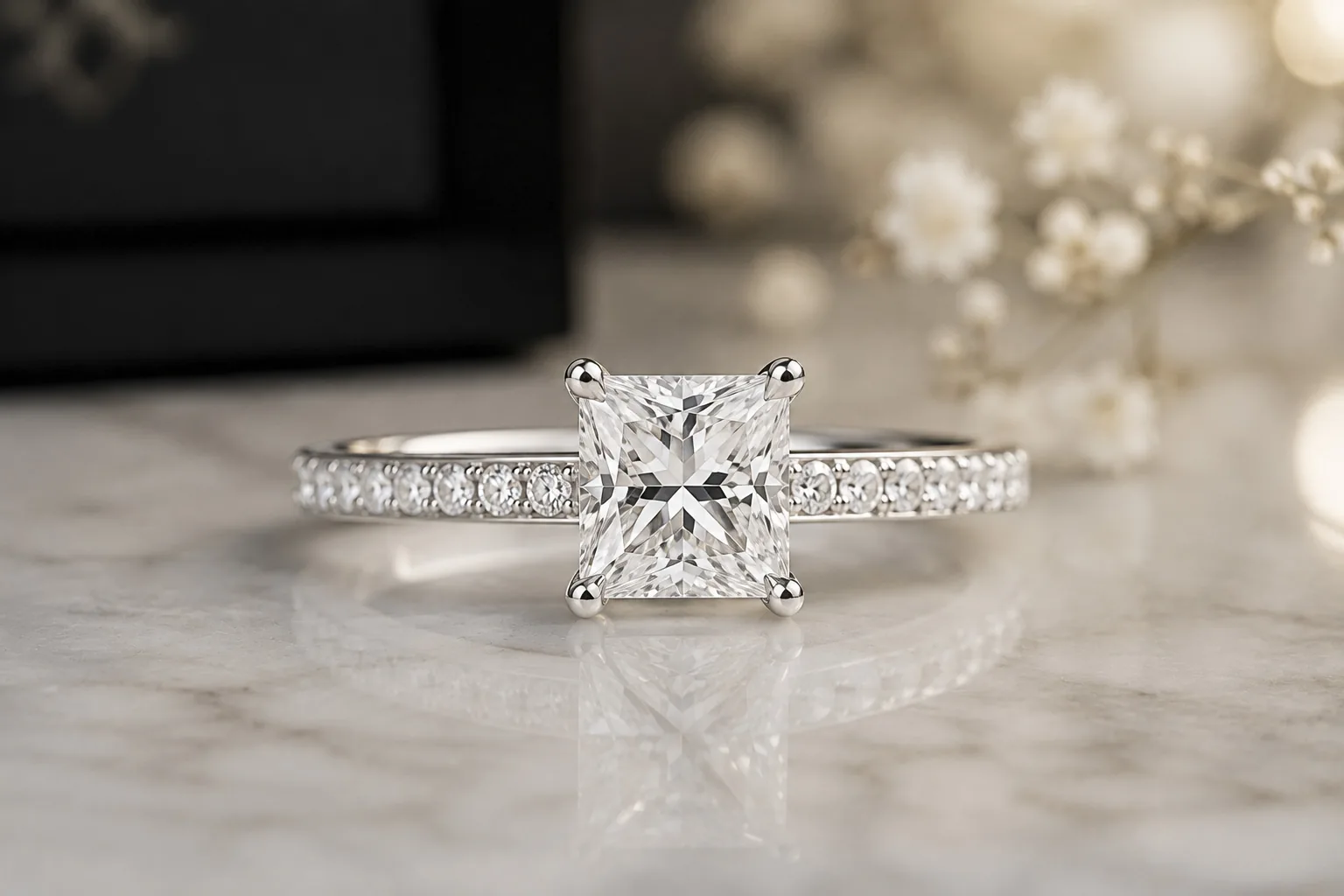
Square is not a personality. The corners and facet pattern decide the mood.
The fast answer
Choose princess for sharp geometry, straight edges and a modern square brilliant look. Choose cushion for rounded corners, softer proportions and a wider range of romantic or vintage-inspired appearances.
| Factor | Princess | Cushion |
|---|---|---|
| Outline | Square with sharp corners | Square or rectangular with rounded corners |
| Visual mood | Modern and geometric | Soft and romantic |
| Sparkle style | Crisp, angular brilliant pattern | Chunky, modified or crushed-ice patterns |
| Corner durability | Requires strong protection | Rounded corners are less vulnerable |
| Setting style | Excellent for clean solitaires and channel-like geometry | Excellent for halos, vintage details and solitaires |
| Shape variability | Usually square, sometimes rectangular | Very wide range of ratios and corner softness |
Princess: the corners are the commitment
The sharp corners create the modern look and the durability concern. A good design protects all four without making the ring feel heavy.
Cushion: the facet pattern is the personality
“Cushion” covers many appearances. Some resemble old mine cuts with broad flashes. Others show fine crushed-ice scintillation. The report alone will not settle the preference.
- Sharp square geometry
- Modern minimal settings
- Crisp straight edges
- Clients who accept protected corners
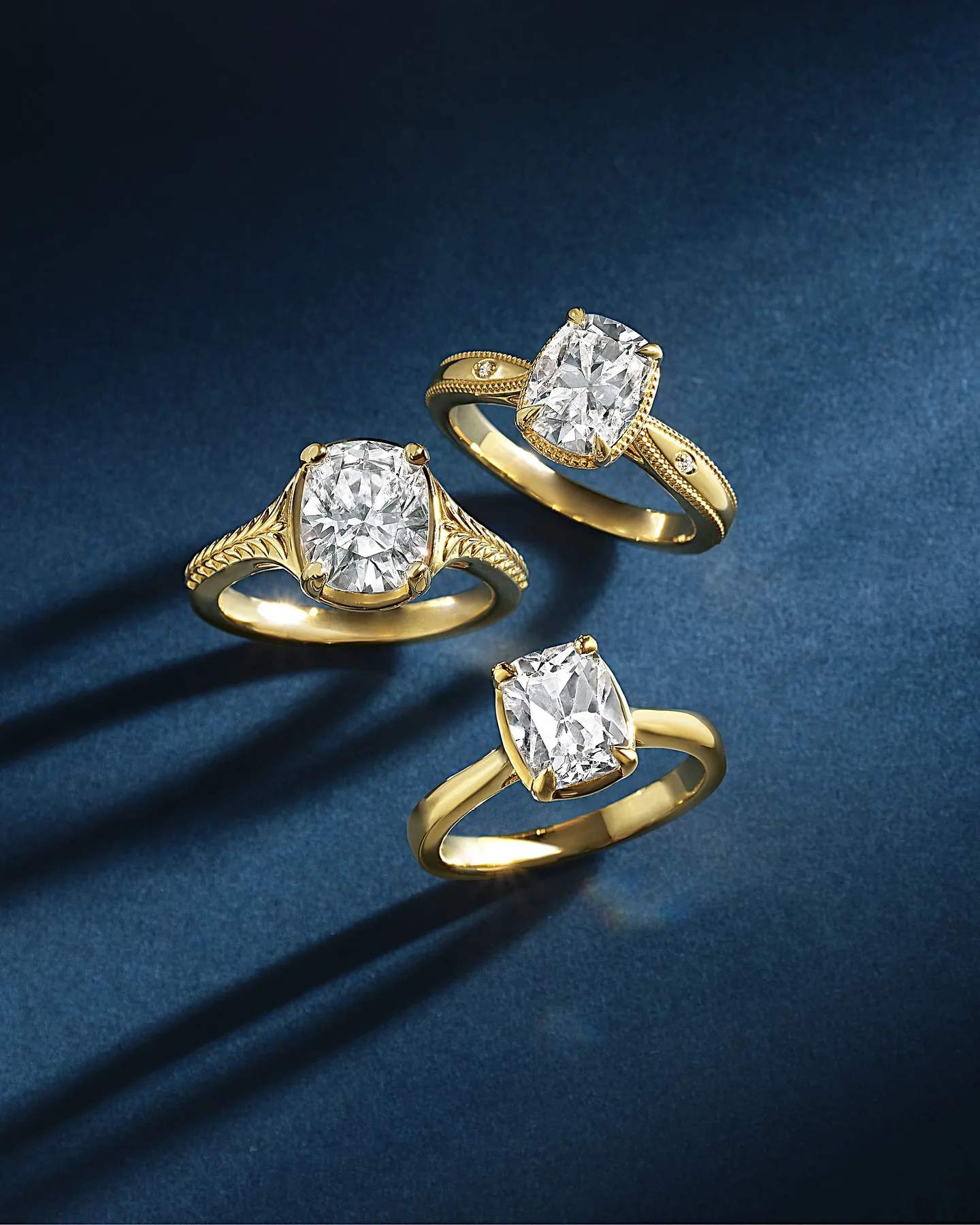
- Soft square or rectangular outlines
- Vintage-inspired design
- Rounded corners
- More facet-pattern choice
For princess cuts, protect the corners. For cushions, inspect the pattern. Neither step belongs at the bottom of the checklist.
Choosing Between Two Square Brilliant Styles
Look past the outline: princess and cushion diamonds behave differently
A princess cut is defined by straight sides, pointed corners and a crisp geometric outline. A cushion softens that geometry with rounded corners and can range from nearly square to distinctly elongated. That difference changes how the stone needs to be protected, how much visual width or length it shows, and what kind of facet pattern appears as the diamond moves.
Corner protection matters more with a princess cut
The four pointed corners are the most vulnerable parts of a princess-cut diamond. V-prongs, substantial corner prongs or a well-designed bezel can shield those points from direct impact. A cushion has no sharp corners, so the setting does not have to solve the same structural problem. That gives a designer more freedom to use delicate-looking prongs without leaving a point exposed.
This does not make a princess cut unsuitable for everyday wear. It means the setting and stone should be designed as a system. If the goal is a very fine solitaire, corner protection should be resolved before the design is finalized.
Cushion is a family of looks, not one facet pattern
Two cushion diamonds with similar measurements can look surprisingly different. Some show broad, distinct flashes with a more traditional appearance. Others use modified brilliant patterns that create many smaller reflections, often described as crushed ice. Neither is automatically better. The useful question is whether the pattern looks lively and balanced to the person wearing it.
Princess cuts also vary, but their visual identity is generally more consistent: angular outline, strong contrast and a distinctly modern square brilliant appearance.
Compare millimeters, not just carat weight
Carat is weight. It does not tell you how large a diamond appears from the top. Compare length and width in millimeters along with depth. A deep stone can hide weight below the girdle. With cushions, length-to-width ratio also changes the personality: ratios near 1.00 read square, while higher ratios create an elongated cushion.
The setting can push either shape modern or romantic
A princess in a low four-prong solitaire can look architectural and minimal. A cushion naturally suits soft halos and vintage-inspired details, but an elongated cushion in a clean solitaire can look very contemporary. Choose the diamond for the outline and light pattern you enjoy, then use the setting to control the overall mood.
What to compare side by side
Place similarly priced candidates next to each other and compare face-up dimensions, facet pattern, corner treatment, color appearance and the setting each stone requires. The preference is often clearer at normal hand distance than it is on a grading report.
Which sparkles more, princess or cushion?
Both can be brilliant and lively. Princess cuts often show sharper, more geometric scintillation; cushions range from chunky flashes to crushed-ice patterns.
Which is more durable?
Cushions have rounded corners. Princess cuts have sharp corners that require secure protection in the setting.
Which looks larger?
It depends on dimensions and depth. Princess cuts can offer strong square coverage, while cushions vary widely in spread and corner shape.
Which is more modern?
Princess generally reads more modern and geometric. Cushion tends to feel softer and can lean vintage or romantic.
Which setting protects a princess cut best?
A setting should securely protect all four corners, often with V-prongs, corner prongs or a bezel.