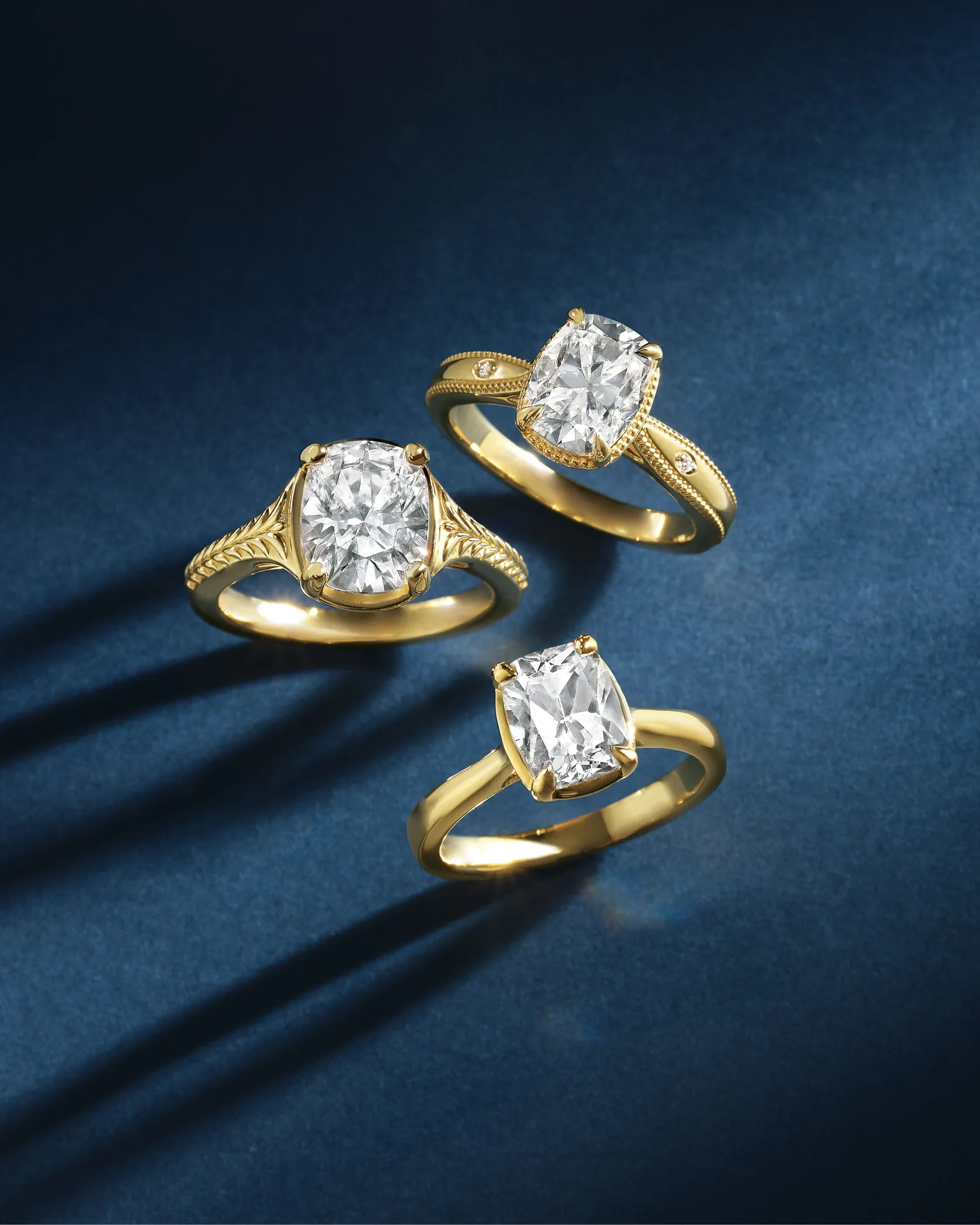
Radiant and cushion diamonds can both be square or elongated and both can deliver brilliant-style sparkle, but they create different outlines and contrast patterns. Radiants have clipped corners and a more geometric frame. Cushions soften the perimeter with rounded corners and can range from broad, chunky flashes to a fine crushed-ice appearance.
Start with outline, not carat weight
Compare millimeter dimensions and length-to-width ratio before comparing carat alone. A deep cushion can carry substantial weight below the girdle, while an elongated radiant may distribute more of its weight across the finger. Two 2.00-carat diamonds can therefore have noticeably different face-up presence.
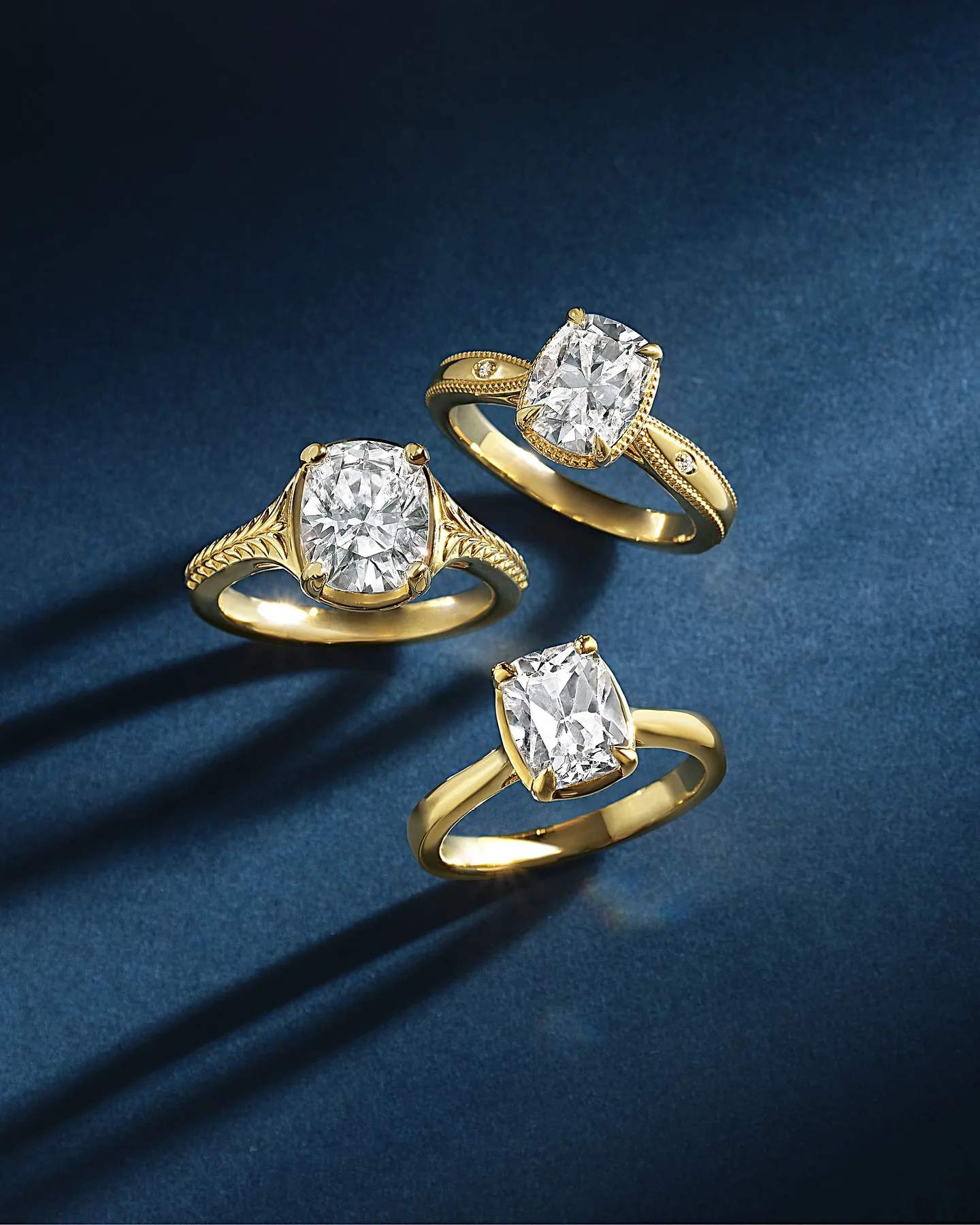
For either shape, outline quality matters. Look for balanced shoulders, pleasing corner transitions and symmetry that remains attractive without relying on the setting to disguise it. If finger coverage is a priority, compare actual dimensions at the same budget.
Radiant facet patterns
Radiants use brilliant-style faceting but do not all produce the same visual texture. Some show crisp, larger flashes with a defined contrast pattern; others have a denser crushed-ice look, especially toward the ends. Neither style is automatically better. The important question is whether brightness reaches the corners and whether the center stays lively as the stone moves.
Elongated radiants can also show bow-tie contrast. A modest bow tie can add definition; a broad dark band that remains obvious in different lighting can dominate the stone. See our diamond bow-tie guide for a more detailed evaluation.
Cushion facet patterns vary even more
“Cushion” describes an outline family, not one optical recipe. Traditional cushion brilliants may show larger, more distinct flashes. Modified cushions can produce smaller reflections or a crushed-ice texture. Antique-inspired cushions may have taller crowns, smaller tables and broad facets that create a very different rhythm from a modern modified brilliant.
This variation is why a cushion should not be purchased from the report alone. Two stones with similar color, clarity, carat and measurements can have completely different personalities.
Corners, prongs and setting design
Radiant corners are clipped rather than pointed, so they avoid the exposed sharp tips associated with princess cuts. Cushions are naturally rounded. Both are generally setting-friendly, but prong placement should follow the actual outline rather than a generic four-corner diagram.
Radiants pair naturally with tailored solitaires, hidden halos and geometric side-stone designs. Cushions can move from clean modern solitaires to vintage-inspired halos without fighting their outline. If the ring must sit flush with a wedding band, gallery height and basket architecture matter more than whether the center is labeled radiant or cushion.
Color can present differently in the two shapes
Fancy shapes can retain body color differently from rounds, and elongated stones may show warmth near the ends or corners. Evaluate color face-up rather than assuming the same letter grade will look identical in every shape. Metal color also changes perception: yellow or rose gold can make slight warmth feel intentional, while a white-metal head provides a more neutral frame.
If you are deciding between multiple elongated shapes, our elongated diamond cuts guide compares how outline and proportions change finger coverage.
Radiant or cushion: which should you choose?
Choose a radiant when you prefer clipped-corner geometry, strong linear finger coverage and an energetic brilliant pattern. Choose a cushion when you prefer a softer perimeter or want access to a wider range of facet personalities, from chunky flashes to crushed ice.
Do not choose from the category name alone. Compare stones of similar budget and dimensions under the same lighting. If one looks better every time you return to it, that visual preference is more useful than forcing the decision through a generic “best shape” rule. You may also want to compare princess vs. cushion or pear vs. marquise if your priority is outline rather than facet family.
| Factor | Radiant | Cushion |
|---|---|---|
| Outline | Rectangular or square with cut corners | Square or rectangular with rounded corners |
| Visual personality | Geometric and energetic | Soft and romantic |
| Facet pattern | Brilliant; may look crisp or crushed-ice | Can be chunky brilliant, modified brilliant or crushed-ice |
| Finger coverage | Excellent in elongated versions | Varies widely by depth and ratio |
| Corner durability | Cut corners help protect the outline | Rounded corners are setting-friendly |
| Best design mood | Modern, tailored, bold | Romantic, vintage-inspired, soft |
Which looks larger, radiant or cushion?
Elongated radiants often provide more finger coverage, while cushions can carry more weight in depth or rounded corners. Compare dimensions rather than carat alone.
Which sparkles more?
Both can be lively brilliant-style cuts. Radiants often show sharper, more energetic scintillation, while cushions can range from chunky flashes to crushed-ice patterns.
Are radiant corners safer than cushion corners?
Radiants have cut corners that reduce vulnerability compared with sharp princess corners. Cushions have rounded corners and are also generally setting-friendly.
Which hides inclusions better?
Busy brilliant facet patterns can help mask inclusions in both, but every diamond should be inspected individually.
Which is more classic?
Cushions have a softer, vintage association. Radiants usually feel more geometric and contemporary.