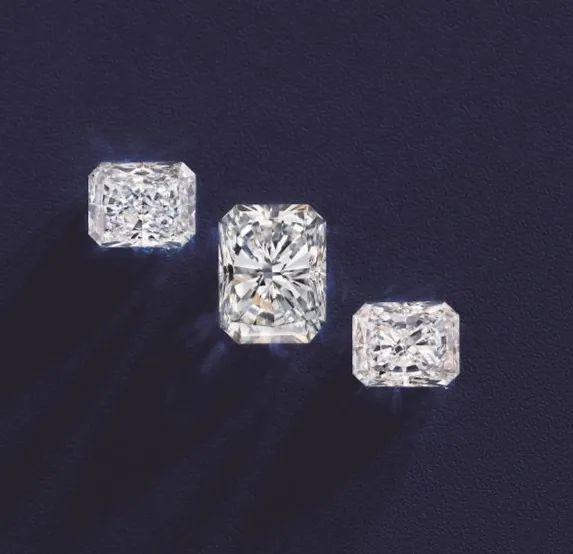
An elongated diamond is a diamond whose length is noticeably greater than its width. Oval, radiant, cushion, emerald, pear and marquise diamonds can all create an elongated look. The most attractive choice is not determined by one “ideal” ratio. It depends on the outline, visible dimensions, facet pattern, bow-tie, setting, wedding-band plan and how the diamond looks on the wearer’s hand.
- The quick answer
- Why elongated diamonds are popular
- Why some look larger than their carat weight
- How length-to-width ratio works
- Shape comparison at a glance
- Oval diamonds
- Elongated radiant diamonds
- Elongated cushion diamonds
- Emerald-cut diamonds
- Pear and marquise diamonds
- Bow-ties and dark areas
- Cut quality and light performance
- Color and clarity
- Settings and wedding-band fit
- Choosing for the hand
- How to compare elongated diamonds
- Frequently asked questions
What is the best elongated diamond cut?
There is no single best elongated diamond shape. An oval is usually the softest and most fluid. A radiant offers a rectangular outline with lively brilliant-style sparkle. An elongated cushion has rounded corners and a more romantic, pillowed character. An emerald cut emphasizes clean lines and broad flashes. A pear is asymmetrical and graceful. A marquise creates the greatest visual length and often exceptional face-up spread.
The best choice is the shape whose outline and movement continue to look balanced in several lighting conditions and on the wearer’s actual hand. The grading report helps narrow the field, but it cannot show whether the outline feels graceful, whether a bow-tie is distracting, whether the ends go dark or whether one ratio looks more natural than another on the finger.
| Shape | Visual character | Sparkle pattern | Primary buying concern |
|---|---|---|---|
| Oval | Soft, elegant and fluid | Brilliant, with moving contrast | Bow-tie, shoulders and end shape |
| Radiant | Architectural but lively | Brilliant or crushed-ice | Center brightness and facet personality |
| Elongated cushion | Rounded, romantic and substantial | Chunky, modified or crushed-ice | Outline consistency and facet pattern |
| Emerald | Clean, restrained and geometric | Broad step-cut flashes | Transparency, symmetry and windowing |
| Pear | Graceful and asymmetrical | Brilliant, often with central contrast | Point alignment, shoulders and bow-tie |
| Marquise | Dramatic and highly elongated | Brilliant, with strong directional movement | Symmetry, bow-tie and tip protection |
Why have elongated diamonds become so popular?
Elongated diamonds satisfy several design goals at the same time. They create a strong vertical line on the finger, often provide more visible length than a compact shape of similar carat weight and feel distinctive without requiring an unusually complicated setting. A simple solitaire can look highly designed when the center diamond has a deliberate, elegant proportion.
They also photograph well. The long axis fills the visual space of the hand in close-up photographs and video. That visibility helped ovals, radiants and elongated cushions become common in engagement-ring inspiration. Yet the popularity is not only a social-media effect. In person, an elongated center stone can make the entire ring feel more composed because the eye follows a clear line from one end of the diamond to the other.
Another reason is flexibility. Elongated diamonds work in delicate solitaires, substantial bezels, three-stone rings, hidden halos, vintage-inspired designs and east-west settings. They can look traditional or modern depending on the band width, prong style, gallery and side-stone arrangement.
The trend has also expanded the language buyers use. Instead of asking only for a carat weight and shape, more buyers now arrive with a preferred ratio, millimeter range, corner style or facet pattern. That can be useful, but it can also create false precision. A ratio is one measurement. It does not describe the complete diamond.
Why can elongated diamonds look larger than their carat weight?
Carat is a measurement of weight, not visible size. Two diamonds of the same carat weight can have different lengths, widths and depths. A diamond that carries more weight below the girdle may look smaller from the top than another diamond with the same weight distributed across a broader face-up area.
Elongated diamonds often appear large because the long axis creates additional visual coverage. The eye is particularly sensitive to length, so even a modest increase in millimeters can change how much presence the diamond has on the finger. This is why an oval, marquise or pear may appear more expansive than a compact diamond at the same carat weight.
That does not mean every elongated diamond is well spread. Some are extremely deep. Some are long but narrow. Some gain length at the expense of width, creating a thin outline that may not provide the balanced presence the buyer expects. Others have generous dimensions but weak brightness near the edges, so the apparent size is not fully supported by light performance.
When comparing visible size, review all of the following:
- Length and width in millimeters. These measurements describe the footprint.
- Depth. Excessive depth can hide weight where it is not visible.
- Outline. Broad shoulders or full corners can make one diamond appear more substantial than another with similar measurements.
- Edge-to-edge brightness. A diamond that remains active near its perimeter often looks larger than one with dark or watery edges.
- Setting coverage. Heavy bezels, thick prongs or a close halo can either emphasize or visually reduce the center outline.
Do not use a generic claim that a certain shape “looks one carat larger.” Compare the actual millimeter dimensions and then view the diamonds in the same setting orientation.
How does length-to-width ratio work?
Length-to-width ratio is calculated by dividing the diamond’s length by its width. A ratio of 1.00 indicates equal length and width. As the ratio increases, the outline becomes longer relative to its width.
For example, a diamond measuring 10.00 by 7.00 millimeters has a ratio of approximately 1.43. A diamond measuring 10.00 by 6.25 millimeters has a ratio of 1.60. Both are elongated, but the second will appear noticeably narrower.
Ratio is useful because it gives buyers a common language for comparing proportions. It is not a beauty grade. Two diamonds can have the same ratio and still look different because of shoulder shape, corner treatment, tip shape, facet pattern and how the outline transitions from the middle to the ends.
| Shape | Fuller appearance | Moderately elongated | Strongly elongated |
|---|---|---|---|
| Oval | About 1.30–1.37 | About 1.38–1.50 | Above about 1.50 |
| Radiant | About 1.00–1.20 | About 1.25–1.40 | Above about 1.40 |
| Cushion | About 1.00–1.10 | About 1.15–1.30 | Above about 1.30 |
| Emerald | About 1.30–1.40 | About 1.40–1.50 | Above about 1.50 |
| Pear | About 1.45–1.55 | About 1.55–1.70 | Above about 1.70 |
| Marquise | About 1.75–1.90 | About 1.90–2.10 | Above about 2.10 |
These ranges are descriptive, not official grading standards. Personal preference remains the deciding factor. A fuller oval may feel classic and generous. A longer oval may feel delicate and dramatic. A cushion at 1.20 can look rectangular if its corners are tight, while another at 1.25 may still feel soft and pillowed because of broad rounded corners.
How do oval, radiant and elongated cushion diamonds differ?
These three shapes are often compared because they can occupy a similar visual space on the finger while producing very different personalities.
Oval versus radiant
An oval has a continuous curved outline and no corners. It usually feels softer and more fluid. A radiant has clipped corners and straighter sides, creating a more architectural frame. Both use brilliant-style faceting, but radiants often show a more complex or crushed-ice interior, while ovals tend to display a recognizable central contrast pattern.
Oval versus elongated cushion
An oval creates uninterrupted curvature. An elongated cushion has corners, even when those corners are very rounded. The cushion often appears wider and more substantial through the middle. Ovals usually emphasize length more clearly, while cushions can feel softer, warmer and more vintage depending on the facet pattern and setting.
Radiant versus elongated cushion
A radiant usually has straighter sides and clipped corners. An elongated cushion has more rounded corners and pillowed edges. Both may show chunky facets or crushed ice. The outline—not only the sparkle pattern—is often the fastest way to distinguish them. A radiant tends to feel crisp. A cushion tends to feel softened.
Oval diamonds: soft outline and brilliant sparkle
Oval diamonds are among the most recognizable elongated shapes. They combine the sparkle style of a round brilliant with a longer silhouette and no pointed corners. Their smooth outline works with minimalist and ornate settings alike.
What ratio is best for an oval diamond?
Many buyers prefer ratios between about 1.35 and 1.50. Ratios near the lower end look fuller. Ratios toward the upper end look longer and narrower. Neither is inherently better. A wearer with a broad finger may prefer a fuller oval for additional width, while another wearer may prefer the elegant line of a more slender stone.
What should you inspect in an oval?
- Shoulders: They should transition evenly from the widest point toward the ends. Pinched shoulders can make the oval look uneven or marquise-like.
- Ends: Some ovals have rounded ends; others are more pointed. Both can be attractive when they match.
- Symmetry: One side should not appear fuller or flatter than the other.
- Bow-tie: Central contrast should move and change rather than remain a dark stripe.
- Brightness at the ends: The tips should not appear consistently dull or gray.
- Color concentration: Warmth may collect near the ends, particularly in larger stones.
Oval diamonds do not receive an overall cut grade from GIA, so the report cannot identify the most attractive stone by itself. Measurements, depth, table and symmetry provide context, but direct comparison remains essential.
Elongated radiant diamonds: structured outline with active sparkle
An elongated radiant combines a rectangular or near-rectangular outline with clipped corners and brilliant-style faceting. It can deliver the clean geometry of an emerald-cut silhouette without giving up the busier sparkle many buyers prefer.
What ratio is best for an elongated radiant?
Ratios from about 1.25 to 1.40 create a clearly rectangular appearance without becoming extremely narrow. Ratios above 1.40 create a more dramatic silhouette. The right choice depends on whether the buyer wants a broad, substantial rectangle or a longer, more elegant line.
Why do radiant diamonds look so different from one another?
“Radiant” describes a shape family, not one exact facet arrangement. Some radiants display broad, organized flashes. Others show many small reflections commonly described as crushed ice. Some have a bright center with darker corners. Others distribute brightness more evenly across the entire face.
The crushed-ice look is not automatically poor quality. It is a visual preference. Some buyers love its fine, glittering texture. Others prefer larger flashes and a more legible facet pattern. The important issue is whether the diamond remains lively rather than hazy, watery or dark through the center.
Do radiants hide inclusions?
The active facet pattern can make some inclusions difficult to locate without magnification. This may allow a buyer to consider lower clarity grades while maintaining an eye-clean appearance. However, a dark inclusion beneath the table, a cloud that affects transparency or an inclusion near a vulnerable corner still deserves careful review.
Elongated cushion diamonds: pillowed corners and varied facet patterns
An elongated cushion occupies the space between a rectangle and a softly rounded shape. Its curved corners and sides can make it feel romantic and substantial, while the longer ratio gives it a modern silhouette.
What ratio is best for an elongated cushion?
Ratios around 1.15 to 1.25 create a subtle rectangular effect. Ratios from about 1.25 to 1.35 look more clearly elongated. Some modern cushions extend beyond 1.35. The outline may appear more or less elongated than the number suggests because corner radius and shoulder fullness affect the visual result.
Why is the facet pattern especially important?
Cushion diamonds can have dramatically different interiors:
- Chunky or antique-inspired facets create broad flashes and visible pattern.
- Modified brilliant facets may produce a combination of broad and fine reflections.
- Crushed-ice patterns create many small, splintered flashes.
A buyer who loves one elongated cushion may dislike another with identical measurements because the facet personality is different. Compare movement before refining color or clarity. The internal pattern often determines whether the diamond feels romantic, modern, vintage or highly glittering.
Elongated emerald cuts: clean lines and broad flashes
Emerald cuts are step cuts. Instead of the small, rapidly changing reflections associated with brilliant cuts, they create broad flashes that turn on and off as the diamond moves. Their long parallel facets produce a hall-of-mirrors effect.
A ratio around 1.35 to 1.45 often feels classic. Ratios above 1.50 look more dramatic and slender. Because emerald cuts are visually open, transparency and facet alignment matter greatly. Inclusions and body color may also be easier to see than in a radiant or oval.
What should you inspect in an emerald cut?
- Even, symmetrical corner cuts
- Parallel steps that create balanced flashes
- A center that does not look empty or glassy
- Minimal windowing, where the viewer can see through the diamond too easily
- Good transparency without persistent haze
- An inclusion pattern that remains unobtrusive without magnification
Emerald cuts reward side-by-side comparison. Small differences in facet alignment can change the rhythm of the entire diamond even when two grading reports look similar.
Pear and marquise diamonds: directional shapes with maximum visual length
Pear-shaped diamonds
A pear combines a rounded end with a pointed end. It can be worn with the point facing toward or away from the wearer, and it naturally creates movement because the outline is asymmetrical.
Inspect the point alignment, shoulder shape and curvature of both sides. Some pears are broad and teardrop-like. Others are long and narrow. A severe bow-tie can divide the diamond, while uneven shoulders can make the point appear off center.
Marquise diamonds
A marquise has two pointed ends and an exceptionally long face-up outline. It often offers substantial visible size for its weight. The shape can make the finger appear longer and can look highly distinctive in a solitaire or east-west setting.
Symmetry is essential. The two points should align on the same axis, and both sides should mirror one another. The points require protective prongs or a bezel because they are vulnerable to impact. A visible bow-tie is common, but it should not remain dark and static in ordinary lighting.
What is a bow-tie in an elongated diamond?
A bow-tie is a band or bow-shaped area of contrast across the center of certain elongated brilliant-cut diamonds. It is most commonly discussed in ovals, pears and marquises, although radiants and cushions can also show dark central regions.
Not every bow-tie is a defect. Diamonds need contrast to create scintillation. When the wearer, lighting or viewing angle changes, some facets return bright light while others reflect darker surroundings. That alternation creates movement.
What does an acceptable bow-tie look like?
- It changes as the diamond moves.
- It contributes contrast without becoming the dominant feature.
- The center still produces brightness and sparkle.
- It does not divide the diamond into two bright ends and one dead middle.
- It remains acceptable in office light, daylight and softer room light.
What does a distracting bow-tie look like?
- A dark horizontal stripe that remains visible at many angles
- A center that consistently looks dull compared with the ends
- A pattern that becomes the first feature noticed
- Contrast that does not break into smaller flashes when the diamond moves
A grading report does not assign a bow-tie grade. A single still photograph can minimize or exaggerate it. Video is more helpful, but the strongest evaluation is a side-by-side comparison under more than one lighting condition.
How should cut quality be judged in elongated fancy shapes?
Most elongated fancy shapes do not receive the same overall laboratory cut grade used for round brilliant diamonds. That means buyers must evaluate a combination of measurable and visible factors rather than relying on one summary grade.
Start with the report, but do not stop there. Review symmetry, polish, depth, table, girdle and measurements. Then examine outline, brightness, contrast, fire, scintillation and transparency.
Brightness
Brightness is the amount of white light returned to the viewer. A strong elongated diamond should not have large persistent areas that appear gray, watery or transparent.
Fire
Fire is the display of spectral color. It becomes easier to see in certain lighting environments and often appears as the diamond or viewer moves.
Scintillation
Scintillation is the pattern of flashes created by movement. A diamond can be bright in a still image but feel less lively in motion. Compare movement, not only a face-up photograph.
Contrast
Contrast gives the facet pattern definition. Too little contrast can make a diamond look washed out. Too much can create a dominant bow-tie or dark center. The goal is balanced movement.
Transparency
A diamond can have good grades but still look hazy or sleepy. Clouds, strain or other characteristics may affect visual transparency. Compare the diamond with a known lively stone to make subtle haze easier to identify.
How should color and clarity be chosen?
Color in elongated brilliant cuts
Ovals, pears, radiants and cushions may concentrate warmth near tips, corners or ends. A color grade represents the diamond as a whole, but the visual distribution can vary. Two diamonds with the same grade may not look equally white face up.
The metal changes the context. Yellow or rose gold can make moderate warmth feel harmonious. White gold or platinum creates stronger contrast. A halo or side stones with a much higher color grade may make the center look warmer than it would in a solitaire.
Color in emerald cuts
Step cuts can reveal body color more readily because their broad facets create a clearer view through the stone. Larger emerald cuts may make subtle warmth easier to notice. Still, the setting, lighting and wearer’s sensitivity to color determine whether a higher grade is valuable.
Clarity in brilliant-style elongated diamonds
Ovals, radiants and many cushions can hide inclusions with active faceting. The best value is often an eye-clean diamond rather than the highest available clarity grade. Location matters. A small inclusion near an edge may be unobtrusive and covered by a prong. A dark crystal under the table may remain visible even at a stronger clarity grade.
Clarity in emerald cuts
Open step facets make inclusions easier to see. Buyers may prefer a higher clarity grade, but grade alone is not enough. Inspect the actual inclusion plot, transparency and face-up visibility.
In every shape, ask three questions: Can the inclusion be seen without magnification? Does it affect transparency? Does its location create a durability concern? Those questions are more useful than chasing rarity that cannot be appreciated in normal wear.
Which settings work best with elongated diamonds?
Solitaire
A solitaire keeps attention on the outline and ratio. It is an excellent choice when the diamond itself has strong proportions and light performance. Band width, prong shape and setting height still influence the final character.
Hidden halo
A hidden halo adds side detail and can support the gallery without changing the face-up outline. It works well when the center diamond should remain visually dominant.
Traditional halo
A halo increases overall presence and can reinforce the elongated outline. The halo should follow the center diamond precisely. Excess space, mismatched corners or heavy metal can make the ring look bulky.
Bezel
A bezel surrounds the diamond with metal, emphasizing its silhouette and protecting the edge. It can look sleek and modern. The bezel should be refined enough that it frames rather than overwhelms the center.
Three-stone setting
Side stones widen the ring and can balance a strongly elongated center. Tapered baguettes, pears, trapezoids, half moons and smaller matching shapes each create a different composition. The side stones should be selected in relation to the center’s exact dimensions.
North-south versus east-west orientation
North-south placement aligns the long axis with the finger and emphasizes length. East-west placement turns the diamond across the finger, creating a lower, wider and more unconventional look. Both can be beautiful when the setting is designed for the chosen orientation.
How does the setting affect wedding-band fit?
A low setting may feel protected and streamlined, but the basket or bezel can prevent a straight wedding band from sitting flush. A higher gallery can create space for a straight band, but it may catch more easily during daily wear.
Before finalizing the engagement ring, decide whether the future wedding band should sit flush, curve around the center, leave a deliberate gap or become part of a fitted stack. The answer affects bridge height, basket width, prong placement and side-stone design.
For a custom engagement ring, the setting should be built around the exact center diamond rather than a generic shape label. A 1.32 radiant and a 1.46 radiant require different proportions. Live CAD makes those relationships visible before production.
Learn more about Live Collaborative CAD Design and flush-fit versus contoured wedding bands.
Which elongated diamond looks best on the hand?
There is no hand shape that requires one diamond shape. The goal is not to correct the hand. It is to create a proportion the wearer enjoys.
A fuller oval or cushion can provide width on a broad finger. A longer oval, emerald, pear or marquise can emphasize a vertical line. A radiant can balance length with stronger corners. An east-west setting can create width and feel intentionally modern.
Finger size alone is not enough. Consider finger length, knuckle width, band width, center-stone dimensions and the planned wedding-band stack. A very thin band may make the center appear larger, but it also changes durability and balance. A wider band may feel more proportional with a substantial stone.
The most reliable method is to compare loose diamonds or realistic models on the hand. A ratio that looks ideal in a product photograph may feel too narrow, too broad or exactly right once it meets the wearer’s finger.
How should you compare elongated diamonds before buying?
- Choose the shape family first. Decide whether the wearer prefers a curved, rectangular, pillowed, step-cut or pointed outline.
- Compare at least three ratios. View a fuller, moderate and strongly elongated example.
- Review millimeter dimensions. Compare visible footprint, not only carat weight.
- Judge the outline. Look for balanced shoulders, even corners, aligned points and smooth transitions.
- Watch the diamond move. Evaluate brightness, fire, scintillation and contrast.
- Inspect the center. Reject persistent darkness, windowing or haze that dominates the diamond.
- Compare color in context. Consider the intended metal, halo and side stones.
- Evaluate clarity practically. Determine whether inclusions are visible, affect transparency or raise structural concerns.
- Place finalists on the hand. Ratio becomes meaningful when it meets the actual finger.
- Plan the complete ring. Setting height, prongs, wedding-band fit and lifestyle should be considered before approving the diamond.
Compare elongated diamonds side by side—not one report at a time.
Reserve a Diamond ConsultationCommon mistakes when buying an elongated diamond
Choosing by ratio alone
Ratio cannot show corner shape, shoulders, tips or facet pattern. Use it to narrow the search, then judge the complete outline.
Assuming more length always means more visible size
A very narrow diamond may have impressive length but limited width. Face-up presence is a combination of both dimensions and edge-to-edge brightness.
Ignoring ordinary lighting
Jewelry lighting is designed to create sparkle. View finalists in softer room light and near a window when possible.
Rejecting every visible bow-tie
Some contrast is normal. Focus on whether the bow-tie remains dark and dominant rather than demanding complete absence.
Buying the certificate instead of the diamond
Grading reports provide essential information, but they do not show personality, movement or hand presence. Use the report to understand the diamond, not to replace visual evaluation.
Designing the setting before selecting the exact stone
Elongated shapes vary substantially. Prong positions, halo outline and gallery dimensions should follow the actual diamond.
Frequently asked questions about elongated diamond cuts
What is an elongated diamond?
An elongated diamond has a length noticeably greater than its width. Oval, radiant, cushion, emerald, pear and marquise diamonds can all have elongated proportions.
Which elongated diamond shape looks largest?
Marquise diamonds often provide exceptional visible length for their weight. Ovals and pears may also look large. Actual millimeter dimensions, depth and brightness matter more than shape alone.
What is a good oval diamond ratio?
Many buyers prefer about 1.35 to 1.50. Lower ratios look fuller, while higher ratios look longer and narrower. The best ratio is the one that appears balanced on the wearer’s hand.
What is a good elongated radiant ratio?
Many elongated radiants fall between about 1.25 and 1.50. Ratios near 1.30 are moderately rectangular, while 1.40 and above create a stronger elongated effect.
What is a good elongated cushion ratio?
Many elongated cushions fall between about 1.15 and 1.35. Corner shape and side curvature can make two cushions with the same ratio look different.
Do elongated diamonds make fingers look longer?
A north-south elongated center creates a vertical line that many people feel lengthens the appearance of the finger. The total effect also depends on band width, setting and hand proportions.
Why do elongated diamonds sometimes look bigger?
They may distribute more weight across visible length and width rather than depth. The long axis also creates strong visual coverage. Compare millimeter dimensions rather than relying only on carat weight.
What is a bow-tie?
A bow-tie is a band of contrast across the center of some elongated brilliant-cut diamonds. Some contrast is normal, but a dark persistent bow-tie can dominate the stone.
Do all oval diamonds have bow-ties?
Most ovals show some central contrast because of their geometry. Severity varies widely. The goal is balanced moving contrast rather than necessarily complete absence.
Can a grading report identify a bow-tie?
No. Laboratory reports do not grade bow-tie severity. It must be assessed through direct viewing or reliable movement video.
What is the difference between a radiant and an elongated cushion?
A radiant usually has straighter sides and clipped corners. An elongated cushion has softer, more rounded corners and pillowed sides. Both can show brilliant or crushed-ice facet patterns.
What is the difference between a radiant and an emerald cut?
Radiants use brilliant-style faceting and create more scattered sparkle. Emerald cuts use step facets and produce broad, organized flashes with a hall-of-mirrors appearance.
Are elongated diamonds more expensive?
Price depends on shape, carat weight, quality and demand. Many fancy shapes cost less per carat than comparable rounds, although highly desirable ratios and outlines may command premiums within a shape category.
Do elongated diamonds hide inclusions?
Radiants, ovals and many cushions can conceal inclusions with active faceting. Emerald cuts reveal inclusions more easily. Inclusion location and transparency still matter in every shape.
Do elongated diamonds show more color?
Some ovals, pears, radiants and cushions concentrate warmth near ends or corners. Emerald cuts may also reveal body color because of their open facets. Compare the diamond in the intended metal.
Which elongated diamond sparkles most?
Ovals, radiants and brilliant-style cushions usually create active sparkle. Emerald cuts produce broader flashes. Individual cut quality matters more than the shape name.
What setting protects an elongated diamond best?
Bezels provide extensive edge protection. Pear and marquise points should have protective prongs or bezel coverage. The best setting balances protection, appearance, height and wedding-band fit.
Can elongated diamonds be set east-west?
Yes. East-west settings turn the long axis across the finger for a wider, modern appearance. The setting should be engineered specifically for that orientation.
Are elongated diamonds good for short fingers?
Many people like the vertical effect on shorter fingers, but there is no required shape for any hand. Personal preference and on-hand comparison are more important.
Should I choose carat weight or dimensions first?
Use both, but visible dimensions explain face-up presence more directly. Carat weight measures mass, while length and width show how much space the diamond occupies from above.