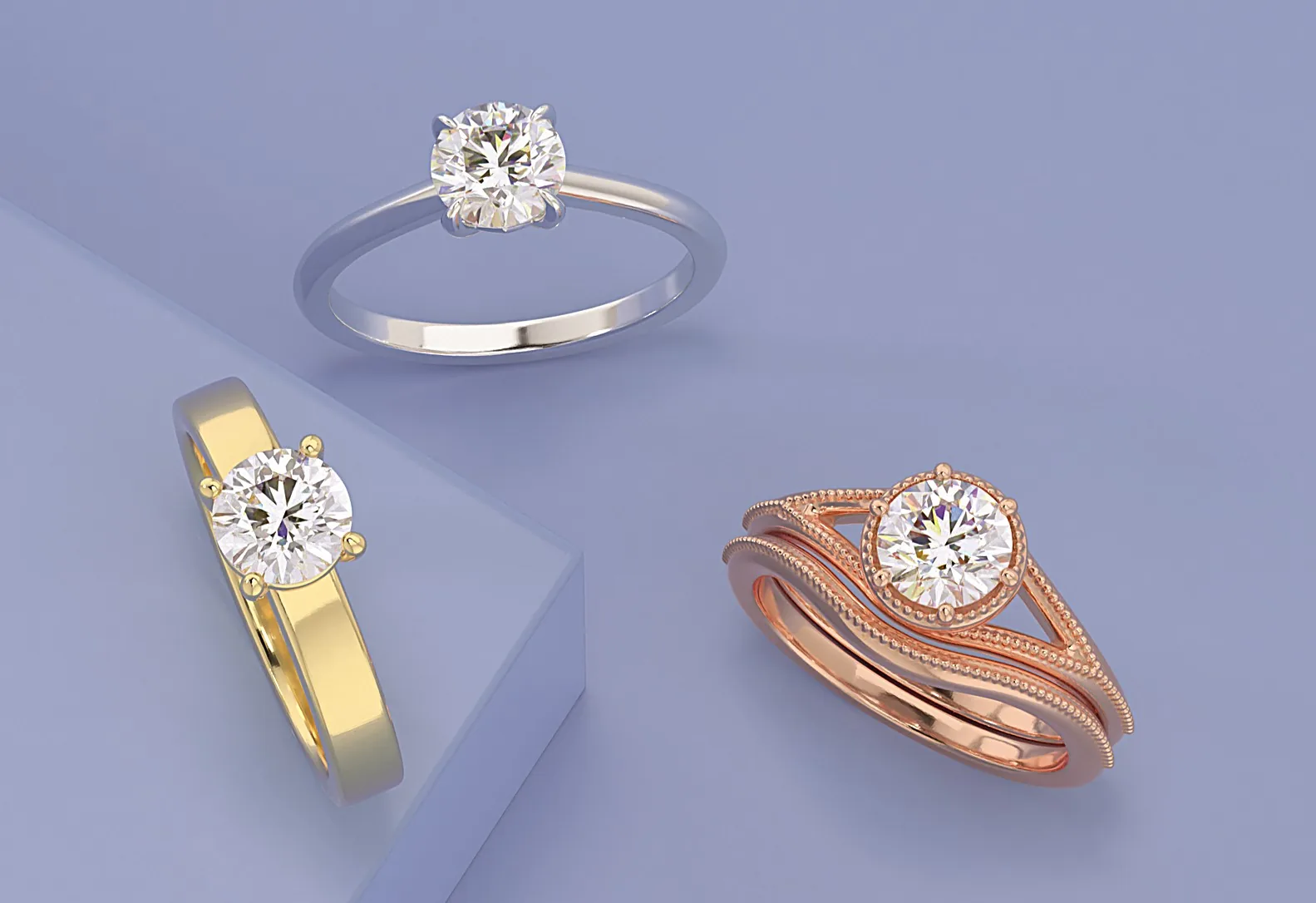
A solitaire engagement ring contains one primary center stone, but “solitaire” does not describe one fixed design. The band may be narrow or substantial, straight or tapered, cathedral or non-cathedral. The center may sit low for protection or higher to create presence and allow a straight wedding band to fit. Four prongs, six prongs, claw prongs, rounded prongs, bezels and specialty baskets all change the outline. In a successful solitaire, each dimension supports the diamond without making the ring feel fragile, bulky or disconnected.
- The fast answer
- What defines a solitaire
- The proportion system
- Band width
- Band thickness and durability
- Straight, tapered and pinched bands
- Four vs. six prongs
- Prong shapes and placement
- Low vs. high settings
- Cathedral vs. non-cathedral
- Basket, bridge and gallery
- Proportions by diamond shape
- Hand and finger proportions
- Lifestyle and maintenance
- Wedding-band fit
- Hidden halos and side details
- Metal choice
- Using CAD for a solitaire
- Common design mistakes
- Frequently asked questions
What proportions make a solitaire engagement ring look balanced?
A balanced solitaire uses a band wide and thick enough to support the center stone, prongs that secure the diamond without dominating it, and a setting height that fits the wearer's lifestyle and future wedding band. There is no universal ideal measurement. A 1.8-millimeter band may look refined with one diamond and under-scaled with another. The correct proportion depends on the diamond's millimeter dimensions, shape, finger size, metal, setting architecture and desired visual weight.
For many everyday solitaire designs, bands in the general neighborhood of 1.8 to 2.3 millimeters can appear slim while retaining useful substance, but this is a design range rather than a rule. Larger stones, wide fingers, extensive pavé, softer metals or an active lifestyle may justify additional width or thickness. The side profile matters as much as the top view.
The band should make the diamond look intentionally important—not as though a large stone was placed on the thinnest ring that could physically hold it.
What is a solitaire engagement ring?
A solitaire is an engagement ring in which one center stone is the primary visual focus. The term does not require a plain band, a round diamond or a particular number of prongs. A solitaire can use an oval, radiant, cushion, emerald, pear, marquise, Asscher or other center shape. It may have a hidden halo or small decorative details beneath the center while still reading as a solitaire from above.
The defining visual idea is restraint. The ring does not depend on a visible halo or substantial side stones to create its identity. That restraint makes proportion more important. In a detailed ring, many elements compete for attention. In a solitaire, the eye immediately notices whether the diamond sits too high, the prongs look uneven, the band appears underbuilt or the shoulders meet the center awkwardly.
A solitaire is therefore not a default setting. It is a design category with fewer distractions and less room for imprecision.
Think of the solitaire as one proportion system
The center diamond, prongs, basket, shoulders, band and future wedding band should be developed together. Changing one element affects the others. Lowering the center may improve protection but prevent a straight wedding band from sitting flush. Narrowing the band may make the center appear larger but increase spinning or reduce long-term durability. Enlarging the prongs may improve security but interrupt the diamond's outline.
| Design element | Visual role | Practical role |
|---|---|---|
| Band width | Controls delicacy, scale and apparent center size | Affects durability, comfort and resistance to spinning |
| Band thickness | Usually less visible from above | Provides structural material for wear and future refinishing |
| Prongs | Frame or interrupt the diamond outline | Secure the center stone |
| Setting height | Creates profile and presence | Affects catching, protection and wedding-band fit |
| Shoulders | Connect the band visually to the center | Can add support and influence comfort |
| Gallery and bridge | Create the private side view | Support the setting and control band clearance |
How wide should a solitaire engagement-ring band be?
Band width is measured across the top of the shank. A narrower band can make the center diamond appear larger by contrast. A wider band can feel more substantial, reduce visual top-heaviness and better support a large center. Neither is automatically more elegant.
The band should be judged against the diamond's face-up dimensions, not only its carat weight. A well-spread oval may cover more vertical space than a deeper diamond of the same weight. A broad radiant or cushion may need more visual support than a compact round. Finger size also changes perception: the same 2-millimeter band may look substantial on one hand and extremely fine on another.
| General band impression | Approximate visual range | Important cautions |
|---|---|---|
| Very delicate | Below roughly 1.8 mm | May require careful engineering; can feel under-scaled with larger stones |
| Slim and refined | About 1.8–2.1 mm | Common visual range, but thickness and metal still matter |
| Balanced and substantial | About 2.1–2.5 mm | Can add stability without necessarily looking heavy |
| Bold or architectural | Above roughly 2.5 mm | Changes the visual relationship with the center and future stack |
These measurements are not grading standards. The finished shape, taper, thickness and finger size can make two bands with the same stated width look different. A knife-edge band, rounded band and flat band distribute visible metal differently.
When a wider band may be better
- The center diamond has a large face-up footprint.
- The wearer's finger is broad or long.
- The ring will be worn continuously through active daily use.
- The design includes pavé that removes some solid metal.
- The wearer dislikes spinning or a top-heavy feel.
- The future wedding band will be substantial.
When a narrower band may be appropriate
- The center stone is modest in scale and should remain visually dominant.
- The wearer consistently prefers delicate jewelry.
- The ring uses a strong metal and sufficient thickness.
- The setting architecture provides appropriate support.
- The band will not be overloaded with pavé or deep engraving.
Band thickness matters even when it is not obvious
Width is what the viewer usually notices from above. Thickness is the amount of metal measured vertically through the shank. A ring can look appropriately wide from the top and still be too thin through the side, leaving limited material for wear, polishing and future sizing.
Excess thickness can feel bulky between the fingers, but insufficient thickness can allow the bottom of the shank to flatten or wear prematurely. The correct dimension depends on metal, finger size, ring width and construction. Areas beneath pavé or engraving require enough material to support the detail.
Very delicate renderings can be misleading because polished metal loses some material during finishing. CAD dimensions must account for the final process rather than describing only the pre-finished model.
Why “as thin as possible” is not a useful specification
A ring is a wearable structure, not a two-dimensional image. It must resist repeated pressure, accidental impact and years of contact with surfaces. Refinement comes from controlled proportion and finish, not from removing every possible fraction of a millimeter.
Straight, tapered or pinched: how the band approaches the center
A straight band maintains a consistent width as it reaches the center setting. It can feel modern, calm and structurally clear. A tapered band narrows toward the center, visually enlarging the diamond and creating a gradual transition. A reverse taper widens toward the center, giving more support and a stronger architectural presence.
A pinched or knife-edge approach can make the band appear especially delicate near the diamond without requiring the entire shank to be equally narrow. This can be an effective compromise when the wearer wants a refined top view but the ring needs more material elsewhere.
Straight band
Best for a clean, consistent and modern appearance. It makes the actual band width easy to understand and pairs predictably with many wedding bands.
Tapered band
Directs the eye toward the center and can make the diamond feel larger. The narrowest area still needs adequate strength.
Reverse taper
Adds visual support near a large center and can create an architectural look. It may make the ring feel more substantial.
Knife-edge or pinched
Creates apparent delicacy through shape rather than extreme thinness. Comfort depends on how sharply the profile is finished.
Four prongs vs. six prongs for a solitaire
Four prongs expose more of the diamond and create fewer interruptions around the outline. On a round diamond, their placement can make the stone appear slightly squarer because the eye connects the four points. Six prongs often reinforce a round outline and create a traditional solitaire appearance.
Six prongs provide more individual contact points, but security depends on the entire setting—not merely the count. Poorly formed six-prong work is not automatically safer than precise four-prong work. The prongs must be positioned correctly, seated against the stone and maintained over time.
| Factor | Four prongs | Six prongs |
|---|---|---|
| Diamond visibility | More open outline | More metal around the perimeter |
| Visual effect on round stone | Can read slightly squarer | Often reinforces roundness |
| Style | Clean and modern | Classic and traditional |
| Security concept | Fewer contact points; each must be precise | More contact points, assuming correct workmanship |
| Maintenance | Every prong remains important | More prongs to inspect and maintain |
Fancy shapes require different logic. Pear and marquise tips need protection. Emerald and radiant corners may use prongs positioned around clipped corners. Oval prongs must be placed so the outline remains balanced and the stone does not appear twisted.
Claw prongs, rounded prongs and specialty prong placement
Claw prongs taper to a refined point and can visually disappear into the diamond when executed well. Rounded or button-style prongs feel softer and more traditional. Double claw prongs can emphasize clipped corners and create an antique or architectural appearance.
The prong should be large enough to secure the stone but not so heavy that it becomes the first thing noticed. Extremely tiny prongs may photograph beautifully when new but provide less material for future tightening and wear.
Prong orientation changes the perceived shape. A round diamond set with prongs at the cardinal points reads differently from one with prongs placed diagonally. Pear, marquise and heart shapes need intentional tip protection. Emerald, Asscher and radiant diamonds often benefit from prong placement that respects their corner geometry.
What good prong work should look like
- Consistent shape and size
- Even contact with the diamond
- Balanced placement around the outline
- No obvious gaps between metal and stone
- No sharp snagging points
- Enough material for long-term maintenance
- A center diamond that sits level
Low-set vs. high-set solitaire engagement rings
A low-set solitaire keeps the center closer to the finger. It may feel streamlined, protected and less likely to catch. A high-set solitaire creates more profile, allows more light and side visibility, and may provide clearance for a straight wedding band.
Height should not be chosen only from side-view photographs. The diamond's depth, basket design and finger anatomy all influence the result. A deep diamond cannot be made extremely low without accommodating its pavilion. Lowering the setting may require the wedding band to contour around the basket.
| Factor | Lower setting | Higher setting |
|---|---|---|
| Daily wear | Often feels protected and streamlined | May catch more easily |
| Side profile | Subtle and close to finger | More visible and dramatic |
| Straight wedding-band fit | May require contour or gap | Often easier to create clearance |
| Center visibility | Less open from the side | More side exposure |
| Lifestyle fit | Often favored for active or hands-on wear | May suit wearers who prioritize presence and stacking |
Does a higher setting make a diamond sparkle more?
Setting height alone does not create cut quality. A well-cut diamond returns light because of its facet structure. Raising it may expose more of the side and change how the ring is viewed, but it does not transform a poorly performing stone. The setting should prioritize proportion, security and wearability.
Cathedral vs. non-cathedral solitaire settings
Cathedral shoulders rise from the band toward the center setting. They visually connect the shank to the diamond and may add lateral support. A non-cathedral ring keeps the shoulders lower, allowing the center setting to stand more distinctly above the band.
Cathedral does not automatically mean high-set. The shoulders can rise into a relatively low basket. Likewise, a non-cathedral head may still sit high. The terms describe how the band approaches the center, not the total height.
Cathedral solitaire
- Creates a graceful rising line
- Can make the center feel integrated
- May add visual and structural support
- Can influence wedding-band clearance
Non-cathedral solitaire
- Keeps the shank visually separate
- Can feel clean and minimal
- Shows more of the basket from the side
- May make the center appear more prominent
The basket, bridge and gallery define the side view
The basket holds the center stone. The bridge is the structural area beneath or between the setting and shank. The gallery is the visible side architecture that may include crossbars, openings, scrollwork, hidden stones or signature details.
An open gallery can feel light and expose more of the diamond. A more enclosed structure can provide a strong architectural look and additional protection. The design should allow practical cleaning access where possible.
The bridge often determines wedding-band fit. A wide or low bridge may force a straight band away from the engagement ring. Raising or narrowing the bridge may create clearance, but that change can affect setting height and structure.
This is why a solitaire should be viewed from every angle. The side profile is not secondary; it is where comfort, band fit and much of the engineering become visible.
How solitaire proportions change by diamond shape
Round solitaire proportions
Round diamonds create a symmetrical center and work with four or six prongs, bezel frames, cathedral shoulders and many band styles. The main decisions are prong count, apparent scale, setting height and whether the band should reinforce or contrast with the round outline.
Oval solitaire proportions
Ovals create vertical length and may appear visually large for their weight. The band must support the elongated footprint without looking disconnected. Prong placement should preserve balanced shoulders and tips. A narrow band can emphasize length, but excessive delicacy may make a large oval feel top-heavy.
Radiant and elongated cushion solitaires
These shapes combine broad face-up presence with defined corners or softened rectangular outlines. The setting should respect the exact corner shape. Four-prong designs can look open and modern, while double claws may reinforce an architectural style. Band width should be evaluated against both length and width.
Emerald and Asscher solitaires
Step cuts have calm, geometric optics. Their settings should avoid visual clutter that competes with the facet pattern. Emerald cuts often benefit from a band that supports their length, while Asschers create a compact square center that can tolerate stronger architectural shoulders.
Pear and marquise solitaires
Both require protected tips and careful alignment. The band and basket must prevent the long shape from twisting visually. A very narrow band can exaggerate size, but stability becomes especially important because the center extends farther along the finger.
| Diamond shape | Primary proportion concern | Setting consideration |
|---|---|---|
| Round | Prong count and visual balance | Four vs. six prongs; classic symmetry |
| Oval | Length, shoulders and top-heaviness | Balanced prongs and adequate band support |
| Radiant | Broad corners and rectangular footprint | Corner-sensitive prong placement |
| Cushion | Rounded corners and facet personality | Basket should follow the actual outline |
| Emerald | Long linear presence | Clean architecture and controlled prongs |
| Asscher | Compact square geometry | Architectural setting can complement depth |
| Pear | Asymmetry and vulnerable point | Tip protection and orientation |
| Marquise | Extreme length and two vulnerable points | Protection, alignment and stability |
How hand and finger proportions affect a solitaire
The same ring looks different on every hand. Finger length, width, knuckle shape and ring size change the apparent scale. Elongated diamonds may create a longer visual line. Broad shapes may provide more horizontal coverage. A narrow band can make the center appear larger, but on a broad finger it may also look visually slight.
There is no need to follow rigid rules about which shape belongs on which hand. The diamond should be placed on the finger and compared. A ratio that looks elegant in isolation may feel too narrow or too broad when worn.
Comfort also depends on the base of the finger and the adjacent fingers. Thick side profiles, sharp knife edges or high shoulders may rub. The inner shape and finish of the shank matter during extended wear.
Design the solitaire for daily life
A solitaire is often considered easy to wear because it has fewer visible stones and details, but its profile still controls daily practicality. High prongs can catch. Very thin pavé bands require regular inspection. Open baskets may collect lotion or debris beneath the center. Sharp claws may snag fabric if poorly finished.
For active wearers, lower settings, protected corners, adequate metal and simplified surfaces can reduce risk. This does not require a heavy ring. It requires deliberate structure.
Lifestyle questions to answer
- Will the ring be worn with medical, work or winter gloves?
- Does the wearer work with children, equipment or textiles?
- Will the ring be removed during exercise?
- How often is professional cleaning realistic?
- Is the wearer comfortable with regular prong inspections?
- Does the wearer dislike jewelry that spins?
- Will several wedding bands eventually be stacked?
How should a wedding band fit with a solitaire?
A solitaire can be designed for a straight wedding band, a contoured band or an intentional gap. A flush fit requires sufficient clearance beneath or beside the center setting. The bridge, basket and height must be coordinated with the future band.
A low-profile solitaire may require a curved band. This is not a design failure when the contour is intentional. A higher setting may allow a straight band but create more profile than the wearer wants. The engagement ring and wedding band should be treated as one system rather than two unrelated purchases.
| Desired band relationship | Engagement-ring implication |
|---|---|
| Straight band sits flush | Requires clearance and intentional bridge design |
| Contoured band | Allows a lower or wider center setting |
| Intentional gap | Provides flexibility and a distinct layered look |
| Multiple stacked bands | Requires planning for total width, height and comfort |
Can a solitaire have a hidden halo?
Yes. A hidden halo sits beneath the center stone and is usually visible from the side rather than the top. Because the center remains the only dominant face-up stone, many hidden-halo rings still read as solitaires.
A hidden halo adds sparkle and detail to the gallery, but it also adds small stones, setting work and maintenance. Its diameter must follow the center stone and basket. A poorly proportioned hidden halo can look bulky, interfere with the wedding band or expose small stones to contact.
Other subtle details may include a single hidden gemstone, engraved initials, a meaningful motif, a polished crossbar or a contrasting prong metal. The strongest details feel integrated rather than attached after the main design is complete.
How metal choice affects solitaire proportions
Platinum, yellow gold, white gold and rose gold create different visual and practical effects. Platinum is dense and naturally white. White gold provides a bright appearance but may use rhodium plating. Yellow and rose gold create contrast with the center diamond and can make the band feel visually warmer.
A two-tone solitaire can use a yellow or rose gold band with white prongs, reducing visible color around the center while preserving a warm shank. The transition should be designed cleanly so the head does not look like an unrelated component.
Metal choice also affects how delicate dimensions perform. The correct width and thickness should be selected for the actual alloy and construction rather than copied from a photograph of a different ring.
Why CAD is especially useful for a simple solitaire
CAD allows millimeter-level changes to be viewed around the exact center diamond. Band width, taper, thickness, cathedral rise, setting height, prong placement, gallery openings and wedding-band fit can be adjusted before production.
This is especially valuable because small changes have a large visual effect in a simple design. Moving a shoulder, changing a prong angle or lowering the basket may alter the entire personality of the ring.
During Live Collaborative CAD Design at Diamond Consulate, the client can see how each decision affects the others. A lower setting may require a contour band. A narrower top view may need additional thickness. Larger prongs may improve maintenance potential but change the diamond outline.
The final ring should not be a surprise in height, band width or wedding-band relationship. CAD cannot replace craftsmanship, but it can make the design decisions visible before manufacturing begins.
Common solitaire engagement-ring design mistakes
- Choosing the thinnest possible band. Visual delicacy should not require structural weakness.
- Designing from the top view only. Height, gallery, bridge and comfort live in the side profile.
- Using a generic basket for an unusual diamond. The setting should follow the exact dimensions and corners.
- Assuming more prongs always means safer. Precision and maintenance matter as much as count.
- Ignoring the wedding band. Flush fit, contour or gap should be intentional.
- Setting the center too high only for presence. Height should serve wearability and band clearance.
- Making prongs disappear at all costs. Extremely small prongs may offer less material for future maintenance.
- Adding a hidden halo without considering clearance. Side stones can affect the band and maintenance.
- Copying dimensions from another ring. Different stones, metals and fingers need different proportions.
- Confusing simple with generic. A solitaire becomes personal through proportion, profile and precise details.
Solitaire engagement-ring design checklist
- Select the exact center diamond before finalizing the custom setting.
- Review its length, width and depth in millimeters.
- Choose a band width that supports the center visually and structurally.
- Confirm sufficient band thickness after finishing.
- Decide between straight, tapered, reverse-tapered or knife-edge shoulders.
- Choose prong count and placement for the actual diamond shape.
- Review prong style from the top and side.
- Set the center height around lifestyle and wedding-band priorities.
- Choose cathedral or non-cathedral shoulders intentionally.
- Review the basket, bridge and cleaning access.
- Decide whether the wedding band should sit flush.
- Account for future stacked bands.
- Evaluate hidden-halo maintenance and clearance.
- Confirm metal and any two-tone transitions.
- Review millimeter dimensions in CAD rather than judging only the rendering.
- Inspect the finished ring for level setting, even prongs and smooth finishing.
How Diamond Consulate approaches solitaire design
Diamond Consulate is a private, appointment-only jewelry studio in Oklahoma City. Solitaire engagement rings can be developed through side-by-side diamond comparison at The Diamond Table and Live Collaborative CAD Design.
The process begins with the exact center stone, the wearer's hand, lifestyle and desired wedding-band relationship. The purpose is not to add complexity to a simple ring. It is to make the simplicity precise.
When an existing solitaire already has the correct proportions, there is no need to redesign it merely to call it custom. Custom becomes valuable when band width, profile, prongs, setting height or future band fit need to be resolved around one person and one diamond.
Frequently asked questions about solitaire engagement-ring proportions
What is a solitaire engagement ring?
A solitaire engagement ring has one primary center stone as its dominant visual feature. The band, basket and gallery may still include subtle details.
What band width is best for a solitaire engagement ring?
There is no universal best width. Many slim solitaires fall around 1.8 to 2.3 millimeters, but the correct width depends on the diamond, finger, metal, thickness and lifestyle.
Is a 1.5 mm engagement-ring band too thin?
It may be too delicate for some center stones, metals and lifestyles. Width must be evaluated together with thickness, construction and long-term wear.
Does a thinner band make the diamond look bigger?
A narrow band can make the center appear larger by contrast, but excessive thinness may look under-scaled or reduce durability.
Should a larger diamond have a wider band?
Often, a large face-up footprint benefits from more visual and structural support. The answer depends on the stone's dimensions and the desired style.
Are four or six prongs better?
Four prongs expose more of the diamond, while six often create a classic outline and more contact points. Workmanship and placement matter more than count alone.
Do six prongs make a round diamond look rounder?
They often reinforce a round outline, while four prongs can make the eye perceive a slightly squarer shape.
Are claw prongs secure?
Properly made claw prongs can be secure. They need sufficient material, accurate seating and regular inspection.
Is a low-set solitaire safer?
A lower setting may catch less and protect the center better in daily wear, but the complete basket and prong design determine security.
Does a high setting make a diamond sparkle more?
Height does not create cut quality. It changes side visibility and profile but does not transform the diamond's inherent light performance.
What is a cathedral solitaire setting?
A cathedral setting has shoulders that rise from the band toward the center stone, visually connecting and sometimes supporting the setting.
Is cathedral or non-cathedral better?
Neither is universally better. Cathedral shoulders feel integrated and graceful, while non-cathedral designs can feel cleaner and more distinct.
Can a low solitaire sit flush with a straight wedding band?
Sometimes, but very low baskets often block a straight band. Bridge design and clearance must be planned from the beginning.
Can a solitaire have a hidden halo?
Yes. A hidden halo sits beneath the center and can preserve the solitaire appearance from above while adding side sparkle.
Does a hidden halo make the center look larger?
Usually it does not significantly change the face-up outline because it sits beneath the center. Its main effect is side detail and sparkle.
Which diamond shape is best for a solitaire?
Round, oval, radiant, cushion, emerald, Asscher, pear and marquise diamonds can all work. The best shape is the one whose outline and light pattern the wearer prefers.
Do oval solitaires need wider bands?
Not always, but large or elongated ovals may benefit from enough width and thickness to avoid a visually top-heavy or unstable ring.
What metal is best for a solitaire engagement ring?
Platinum and gold alloys can all work. The decision depends on color preference, maintenance, construction and desired dimensions.
Why use CAD for a simple solitaire?
CAD makes small but important changes in band width, taper, prongs, setting height and wedding-band fit visible before production.
How do I know whether a solitaire is well proportioned?
View it from the top and side. The band should support the center, the prongs should be balanced, the height should suit the wearer and the future wedding-band fit should be intentional.