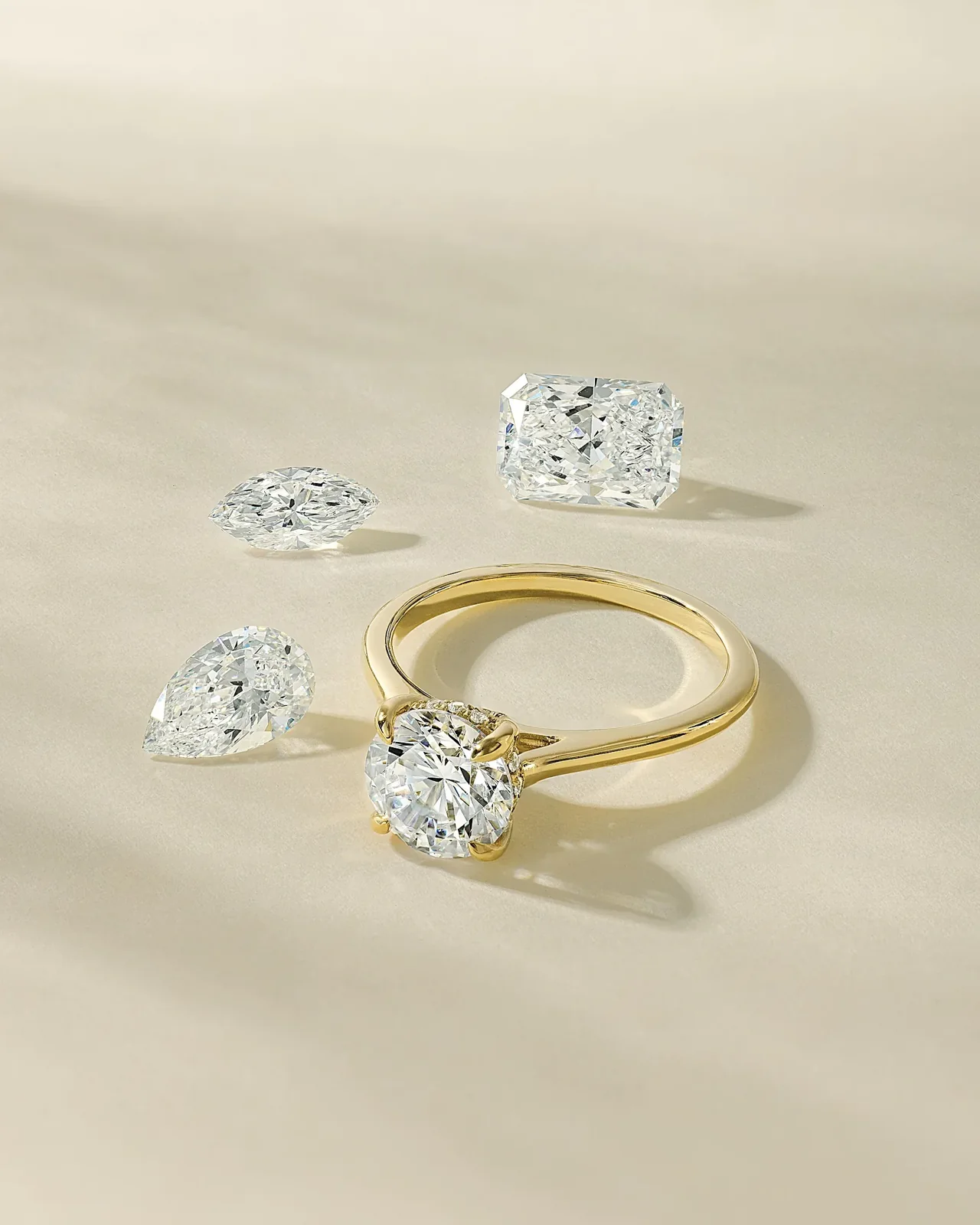
Brightness is white light returned from the diamond. Fire is white light separated into spectral colors. Scintillation is the pattern of bright and dark flashes created as the diamond, light source or viewer moves. Attractive stones balance these effects rather than remaining uniformly bright or persistently dark.
Why cut matters most
Diamond has exceptional optical properties, but the cutter determines how the finished facets use them. Crown and pavilion angles, table size, depth, facet alignment, symmetry and polish influence whether light returns toward the viewer or leaks away. That is why a well-cut diamond can look more alive than a higher-color, higher-clarity stone with weaker proportions.
Shape changes the style of sparkle
Round brilliants produce a balanced, high-energy pattern. Radiants and many cushions can create dense sparkle. Ovals, pears and marquises combine brilliant faceting with elongated outlines and may show a bow-tie region. Emerald and Asscher cuts intentionally create broad flashes and hall-of-mirrors contrast; judging them by round-brilliant sparkle misses their appeal.
Lighting changes everything
Jewelry spotlights create dramatic fire and scintillation. Diffuse daylight often emphasizes brightness. Office and restaurant lighting produce different effects again. Compare diamonds in more than one environment so you do not choose a stone that only comes alive under a sales counter spotlight.
A clean diamond sparkles more
Skin oils, lotion, soap residue and dust coat facets and interfere with light entering and leaving the diamond. A beautifully cut stone can look dull when dirty. Gentle cleaning and periodic professional inspection restore the optical surfaces while also giving a jeweler a chance to check prongs and stone security.
Do color and clarity increase sparkle?
Not in the simple way grade charts imply. Moving from G to D color does not automatically create more sparkle, and moving from VS2 to VVS1 does not automatically make a transparent, eye-clean stone brighter. Severe inclusions or transparency issues can affect appearance, but microscopic rarity and visible light performance are different buying decisions.
How to compare sparkle
Compare similar-size diamonds side by side and rock them slowly. Look at the center and edges for persistent dark zones. Step away from the brightest lights. Then decide which pattern you prefer: broad flashes, rapid scintillation, crushed-ice texture or the quieter geometry of a step cut. The goal is not a specification called sparkle; it is a diamond whose light performance you enjoy.
Contrast is part of sparkle, not a defect by itself
A diamond cannot flash without alternating bright and dark areas as the viewing geometry changes. Healthy contrast gives scintillation definition. The problem is persistent darkness that stays in the same place and dominates the face-up view. This is why a still photograph can be misleading: movement reveals whether dark areas participate in a lively pattern or remain visually dead.
Elongated brilliant cuts add another layer because some bow-tie contrast is normal. See what causes a diamond bow tie before assuming every dark band in an oval or pear is automatically poor cut.
Setting design can preserve or mute light performance
Most sparkle comes from the diamond's facet architecture, but the finished ring still affects what you see. Heavy buildup of lotion under the stone, a very enclosed design, or metal positioned where it is visually distracting can change the presentation. A secure setting should protect the diamond without asking metal to compensate for a weak stone.
When comparing diamonds, choose the stone before relying on a setting to make it look brighter. Then choose a mounting that supports the shape and lifestyle. For the larger decision framework, see how to choose a diamond.
What makes a diamond sparkle?
Sparkle is the combined visual effect of brightness, fire, scintillation and contrast as the diamond, light or viewer moves.
Does cut affect sparkle?
Yes. Proportions, symmetry and polish influence how a diamond handles light. Cleanliness and lighting also strongly affect what the wearer sees.
Why does my diamond look dull sometimes?
Oil, lotion, soap film, lighting conditions and obstruction from the setting can reduce visible brightness and scintillation.
Do larger diamonds sparkle more?
Not automatically. Larger stones can show larger flashes, but size does not guarantee strong light return.
Which shape sparkles the most?
Round brilliants are engineered for a highly consistent brilliant pattern, but many fancy shapes can be extremely lively. Preference matters.