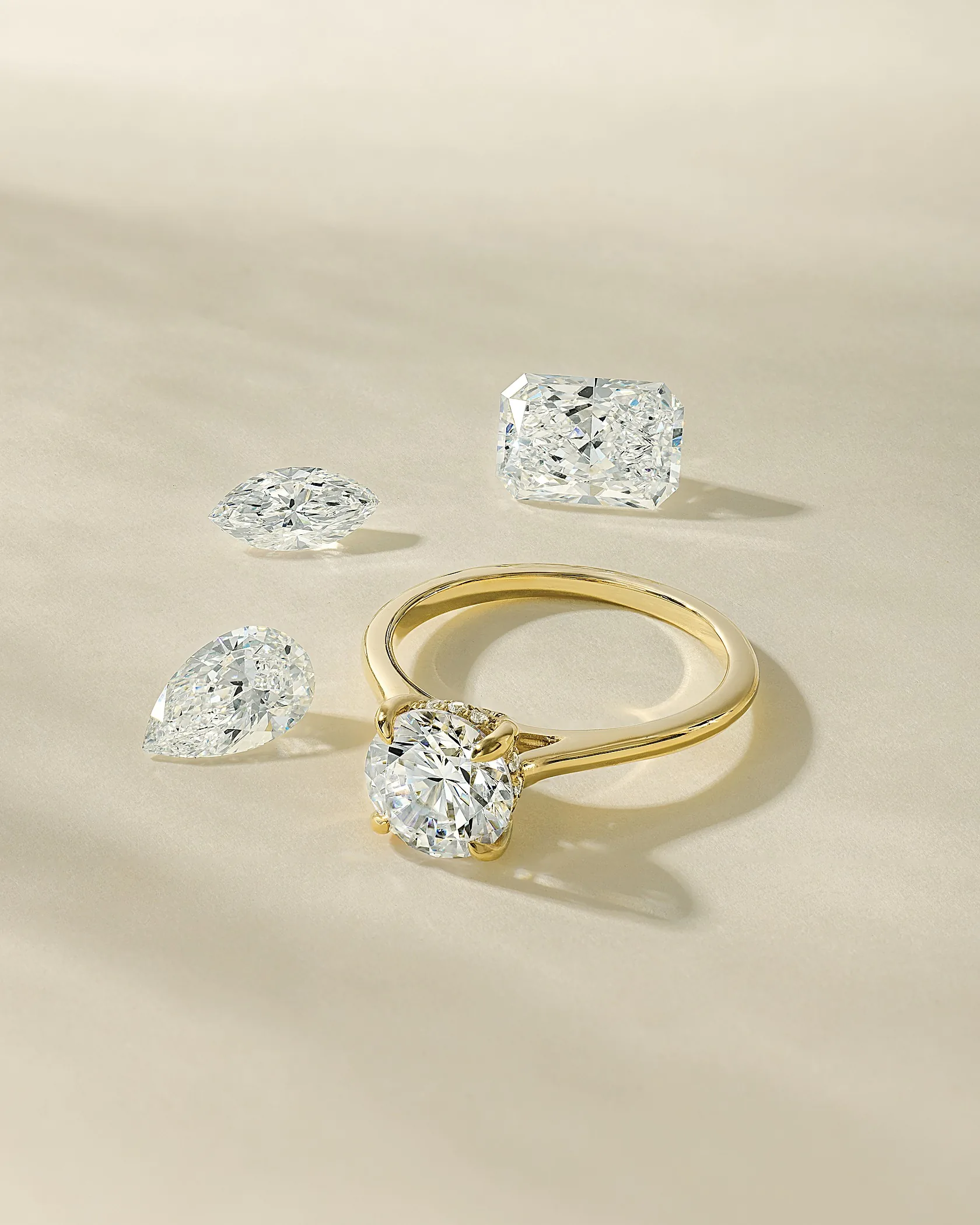
The internet loves absolutes. We prefer three diamonds on the same table.
If a client cannot consistently see the difference between two diamonds, we do not believe a grading label alone should pressure them into paying more.
First: cut really does matter
Cut describes how a diamond's proportions, facet arrangement and finish influence the way light travels through and returns from the stone. Brightness, fire, scintillation and contrast are all affected by the cutting.
A poorly proportioned diamond can leak light, appear dark or carry unnecessary weight where it adds cost but little visible size.
That is the science. The practical buying question is different: how much improvement can the client actually see, and what does that improvement cost?
The old rule and the modern report
For much of the jewelry industry's history, buyers and jewelers selected diamonds without an overall GIA cut grade. Proportions, finish and appearance were evaluated through measurements and direct observation.
Modern cut grades are useful. They create a shared vocabulary and help identify candidates. But a grade is still a category containing many combinations of proportions and appearances.
Excellent does not mean every Excellent diamond looks identical. Very Good does not mean unattractive. Good does not automatically mean dull.
What the labels can—and cannot—tell you.
| Grade | What it generally signals | What still needs to be checked |
|---|---|---|
| Excellent | Falls within the laboratory's highest overall cut category | Specific proportions, visual personality, price premium and whether the buyer sees a meaningful advantage |
| Very Good | Strong overall performance with one or more factors outside the Excellent range | Whether the tradeoff is visible and whether the price difference is useful elsewhere |
| Good | Acceptable overall cut performance with broader proportion tradeoffs | Brightness, spread, dark areas, leakage, symmetry and how the stone appears once mounted |
| Fair or Poor | More significant performance concerns are likely | Usually requires strong justification and careful direct evaluation |
The lower the grade, the more carefully the actual diamond should be evaluated. That is different from declaring every grade below Excellent unworthy of consideration.
What people notice in real life
A grading environment is controlled. Daily life is not.
Diamonds are worn under restaurant lighting, office lighting, sunlight, car interiors and kitchen fixtures. They collect lotion, soap and ordinary film. They move. The viewer changes distance. The setting partially surrounds the stone.
In controlled side-by-side comparison, differences can be visible. Once two reasonably well-cut diamonds are mounted, clean and moving in ordinary wear, many clients find the practical difference smaller than the internet promised.
That does not make the difference imaginary. It means visibility, context and price should be considered together.
The price question
An Excellent cut diamond may cost more than a comparable Very Good or Good diamond. Sometimes that premium buys a clearly more compelling stone. Sometimes it buys a label the client cannot reliably identify.
| Situation | Paying for Excellent may be worthwhile when... | A lower grade may be reasonable when... |
|---|---|---|
| Round brilliant center stone | The client strongly values maximum optical performance and sees the difference | A Very Good or Good candidate is bright, attractive and meaningfully better priced |
| Fixed total budget | The premium does not force visible compromises elsewhere | The savings improve size, setting quality or overall ring design more noticeably |
| Large center diamond | Performance differences become visually meaningful across a larger face | The selected lower-grade stone still performs attractively in direct comparison |
| Buyer cannot see the difference | The premium still has personal or technical value to that buyer | The money can solve a more visible priority |
The report becomes
even less complete.
Fancy shapes—ovals, radiants, cushions, pears, emerald cuts and others—cannot be judged by borrowing a round brilliant rulebook.
Facet pattern, outline, length-to-width ratio, bow tie, corner shape, depth distribution and face-up spread all matter. Two fancy-shape diamonds with similar grades and measurements may look unrelated in person.
For these diamonds, direct comparison is not an optional flourish. It is often the most useful part of the selection process.
What to examine instead of chasing one word
Does the stone return light?
Look for an appealing balance of bright and dark areas rather than a flat or persistently dull appearance.
Do you see flashes of color?
Fire changes with lighting. Compare under more than one condition when possible.
Does the pattern come alive in motion?
Static photos and reports cannot fully show the on-off sparkle pattern created as the diamond moves.
Where is the carat weight?
A deep stone may carry weight beneath the setting instead of across the visible face.
Does the pattern feel balanced?
Uneven shape or facet pattern can matter more than a one-step report difference.
What else could the premium improve?
Compare the cut premium with visible changes in size, design, metal or the rest of the project.
A diamond does not sparkle because a certificate says it should.
Compare cut grades in personOur practical position
We do not say cut is irrelevant. It is not.
We also do not believe every client must automatically buy Excellent because an article ranked the 4Cs in a fixed order.
A strong candidate may be Excellent, Very Good or occasionally Good. The useful questions are:
Does it look beautiful?
Can the client see the difference?
Is the premium worth more than the alternative use of that budget?
Reports guide the comparison. They do not replace it.
Is cut the most important of the 4Cs?
Cut strongly affects light performance, but the most important purchasing factor depends on the buyer. Diamond Consulate recommends comparing actual diamonds rather than treating one grade as an automatic command.
Does every diamond need an Excellent cut grade?
No. Some Good and Very Good diamonds can be attractive, especially once mounted and viewed in normal wear. The actual proportions, appearance and price difference should be compared.
Can people see Excellent versus Very Good cut?
Sometimes, particularly in controlled side-by-side viewing. In everyday wear, many buyers find the difference smaller than expected once both diamonds are clean, mounted and moving.
Does GIA grade cut on every shape?
GIA's overall cut grade traditionally applies to standard round brilliant diamonds. Fancy shapes require broader evaluation of proportions, symmetry, facet pattern and appearance.
What should I compare besides the cut grade?
Compare brightness, contrast, fire, scintillation, face-up size, symmetry, visible leakage, transparency and price.