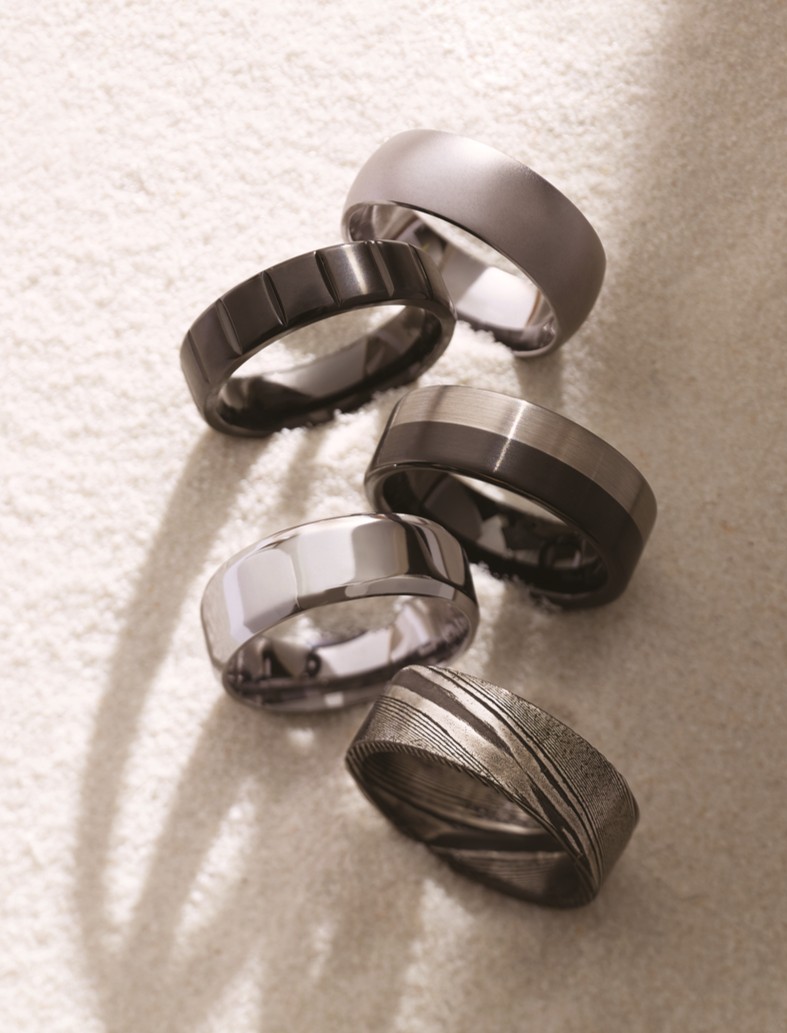
Tungsten is excellent at being tungsten. The mistake is buying it while expecting it to behave like gold, platinum or another repairable precious metal.
The short answer
Tungsten wedding bands are worth it for people who want a substantial ring, excellent resistance to everyday surface scratching and a lower initial price than most gold or platinum bands. They are less suitable for anyone who expects future resizing, traditional repair, heirloom restoration or a ring that can bend rather than crack under extreme force.
Tungsten carbide is one of the hardest materials commonly used for wedding bands. That hardness helps the ring maintain a polished or brushed appearance, but it also creates an important tradeoff: tungsten is comparatively brittle. A severe impact may crack or shatter the ring instead of bending it.
The right decision therefore depends less on whether tungsten is universally “good” and more on whether its exact strengths fit your lifestyle, expectations and long-term plans.
Tungsten wedding bands at a glance
| Factor | How tungsten performs | What it means for the wearer |
|---|---|---|
| Scratch resistance | Excellent | Resists ordinary surface scratching better than gold, platinum and many alternative metals |
| Impact behavior | Hard but brittle | May crack or fracture under a severe blow rather than bend |
| Weight | Heavy and dense | Feels substantial; some people love the weight and others find it cumbersome |
| Resizing | Usually not possible | A size change generally means replacing the ring |
| Traditional repair | Very limited | Cracks, structural damage and many inlays cannot be repaired like gold |
| Price | Usually accessible | Often costs substantially less than a comparable precious-metal band |
| Color | Natural gray with many finish options | Can appear gunmetal, polished gray, black, gold-tone or combined with inlays |
| Maintenance | Low for the tungsten surface | Coatings, plating and decorative inlays may require different care |
| Emergency removal | Can be removed by controlled fracture | Requires a method different from cutting a gold ring |
| Best fit | Scratch-conscious, budget-conscious wearers | Best when replacement is acceptable if size or condition changes |
What is a tungsten wedding band actually made from?
Most rings marketed as tungsten wedding bands are made from tungsten carbide, not pure tungsten. Tungsten powder is combined with carbon and a metallic binder, then compressed and sintered at high temperature to form an extremely hard material.
Pure tungsten is difficult to form into the polished jewelry most people recognize. Tungsten carbide provides the hardness, density and distinctive substantial feel that made these rings popular as alternative-metal wedding bands.
Why the binder matters
The quality and composition of the binder can affect durability, skin compatibility and corrosion resistance. Many quality rings use a nickel-based binder intended for jewelry. Lower-quality products may use cobalt or other formulations that can behave differently when exposed to skin chemistry, moisture or chemicals.
Two tungsten rings that look nearly identical online may therefore differ in material quality, machining, edge comfort, coating durability and warranty support. Price alone does not reveal those differences.
Why tungsten became popular for wedding bands
Tungsten wedding bands gained popularity because they solve several problems at once. They create a bold, modern look, maintain their finish better than many softer metals and make a substantial ring available at a comparatively modest price.
They also support a wide range of styles: polished gray, brushed charcoal, beveled edges, faceted surfaces, black coatings, gold-tone finishes, wood inlays, meteorite-style inlays, carbon fiber, colored grooves and combinations of several materials.
For someone who never enjoyed traditional yellow-gold jewelry, tungsten can feel less formal and more personal. Its industrial character is part of the appeal.
The main advantages of tungsten wedding bands
1. Exceptional resistance to surface scratches
Tungsten carbide is significantly harder than gold, platinum, silver, titanium and cobalt chrome. Ordinary daily contact with desks, keys and many household surfaces is less likely to leave visible scratches on the tungsten itself.
That does not mean every part of every tungsten ring is scratch-proof. Black coatings, gold-tone plating, colored surfaces and decorative inlays may scratch or wear differently from the underlying tungsten carbide.
2. A substantial, heavy feel
Tungsten is dense. A wide tungsten band can feel noticeably heavier than titanium and often heavier than a similarly sized gold ring. Many wearers associate that weight with quality and permanence.
Weight is personal. Someone who wants to feel the ring on the hand may love tungsten. Someone who dislikes jewelry or works at a keyboard all day may prefer titanium, cobalt or a narrower precious-metal band.
3. Accessible pricing
Tungsten bands are usually less expensive than gold or platinum because their value is based primarily on manufacturing, design and finishing rather than precious-metal content. This allows buyers to choose wider profiles, detailed finishes and decorative inlays without the price increasing as dramatically as it might in gold.
4. Low routine maintenance
A plain, uncoated tungsten band usually requires little more than gentle cleaning. Its polished or brushed surface tends to retain its original character well. It will not need rhodium plating like many white-gold rings, and it does not develop the same type of surface patina associated with platinum or gold.
5. Broad modern design options
Tungsten works particularly well for clean geometric profiles, beveled edges, satin centers and contrasting finishes. It also provides a strong structure for decorative channels and inlays, although the inlay may be less durable than the tungsten surrounding it.
The disadvantages and tradeoffs
Tungsten rings usually cannot be resized
This is the most important long-term limitation. Gold and platinum bands can often be cut, adjusted and soldered by a skilled jeweler. Tungsten cannot be resized using those traditional methods.
If your finger size changes because of age, weight fluctuation, swelling, climate, medication or an injury, the usual solution is replacement. A lifetime size-exchange policy can reduce the financial inconvenience, but it does not preserve the original physical ring.
Tungsten can crack or shatter
Hardness and toughness are not the same property. Tungsten carbide is extremely hard, meaning it resists scratching and indentation. It is less tolerant of certain sharp impacts. A strong blow against concrete, tile, steel or heavy equipment can fracture the ring.
This does not mean tungsten rings routinely break during normal wear. It means their failure mode differs from gold. Gold tends to scratch, dent or bend. Tungsten is more likely to stay unchanged until an impact exceeds what the material can tolerate.
Repair options are limited
A cracked tungsten band generally cannot be soldered back together. Damaged plating may not be restorable to the original factory finish. A broken wood, shell, carbon-fiber or other inlay may also require replacing the entire ring.
Decorative coatings may wear
Natural tungsten carbide has a gray color. Black, white, blue, rose-gold or yellow-gold appearances are typically produced through coatings, plating or surface treatments. The underlying tungsten may remain highly scratch-resistant while the decorative finish shows wear.
It has little precious-metal value
Tungsten is valuable as an engineered material, but a tungsten ring does not generally carry the intrinsic precious-metal value of gold or platinum. Buyers should choose it for design and performance, not as a store of metal value.
Is tungsten truly scratch-proof?
The tungsten-carbide body is highly scratch-resistant, but “scratch-proof” is too absolute for a finished piece of jewelry.
Materials of equal or greater hardness can scratch tungsten. Diamonds, certain abrasives and some industrial materials can mark it. More commonly, the vulnerable part is not the tungsten itself but a coating, plated color, polished edge or decorative inlay.
A plain natural-gray tungsten band with a simple brushed or polished finish usually maintains its appearance better than a heavily coated or multi-material design. The more components a ring contains, the more its long-term wear depends on the weakest component.
Does tungsten tarnish, rust or turn your finger green?
Quality tungsten carbide does not tarnish like silver and should not rust like ordinary steel. It also should not turn the finger green under normal conditions. Reactions associated with inexpensive jewelry are more likely to involve the binder, a coating or another decorative material rather than the tungsten carbide itself.
Anyone with a known nickel or metal sensitivity should ask about the exact composition of the ring. “Hypoallergenic” is not a universal guarantee, particularly when the ring contains multiple materials.
Can a tungsten ring be removed in an emergency?
Yes. A tungsten ring can be removed in an emergency, but it is not removed the same way as a gold or platinum ring. Precious-metal bands are commonly cut with a ring cutter. Tungsten carbide is typically fractured using controlled pressure from an appropriate tool, such as locking pliers or a dedicated ring-breaking device.
Emergency professionals should evaluate the situation and use the technique appropriate for the ring and injury. The inability to cut tungsten with a conventional ring cutter does not mean the ring is permanently trapped.
A ring should never be treated as protective equipment. Remove any wedding band before work or recreation where machinery, crushing force, electrical hazards or ring avulsion are possible.
Is tungsten safe for mechanics, construction workers and active jobs?
The question is not simply whether tungsten is strong. Many workplaces recommend removing all rings around machinery, moving parts, electrical systems, heavy lifting and climbing. A ring of any material can catch, pinch or transfer force to the finger.
Some professionals wear a silicone band while working and reserve their tungsten, gold or platinum wedding band for off-duty wear. That approach protects both the finger and the permanent ring.
Tungsten vs. other wedding-band metals
| Metal | Weight | Scratch behavior | Resizing | Typical tradeoff |
|---|---|---|---|---|
| Tungsten carbide | Heavy | Excellent resistance | Usually no | Can fracture and has limited repairability |
| Titanium | Very light | Moderate | Usually limited or no | Shows scratches more readily but is less brittle |
| Cobalt chrome | Medium | Good | Often limited | Bright white look with fewer traditional repair options |
| 14K gold | Medium | Will scratch and patina | Often yes | Higher cost but repairable and precious |
| 18K gold | Medium to heavy | Softer; develops patina | Often yes | Richer color and higher gold content at greater cost |
| Platinum | Heavy | Scratches and develops patina | Often yes | Premium price, density and excellent repairability |
Tungsten vs. titanium
Choose tungsten when you want weight and maximum surface hardness. Choose titanium when you want an extremely lightweight ring and are comfortable with more visible scratches. Neither is generally chosen for easy traditional resizing.
Tungsten vs. cobalt
Cobalt chrome often provides a brighter, whiter appearance closer to platinum or white gold. Tungsten is usually heavier and more scratch-resistant. Cobalt may feel more familiar to someone who prefers the look of a traditional white metal.
Tungsten vs. gold
Tungsten wins on scratch resistance and initial price. Gold wins on repairability, resizing, precious-metal value, heirloom potential and the ability to restore or modify the ring decades later.
Tungsten vs. platinum
Both can feel substantial, but they behave very differently. Tungsten maintains a crisp surface and may fracture under severe impact. Platinum scratches, develops patina and can deform, yet it can usually be repaired and refinished by a skilled jeweler.
Which tungsten finish lasts longest?
The most durable choice is generally a simple ring that relies on the natural tungsten-carbide surface rather than a colored coating. Polished gray, satin gray and brushed gray finishes tend to age more predictably.
Black tungsten is popular, but the black appearance is normally a surface treatment. Depending on the process and wear, scratches may reveal a contrasting gray material beneath. Gold-tone and rose-tone finishes can have similar considerations.
What about wood, meteorite and carbon-fiber inlays?
Inlays make a tungsten ring distinctive, but they add a material with its own care requirements. Wood may be affected by moisture or damage to its protective coating. Meteorite-style materials may require protection from corrosion. Shell and stone can chip. Carbon fiber and resin can scratch differently from tungsten.
Choose an inlay because you love the design, but understand that the inlay—not the tungsten body—may determine the ring's practical lifespan.
Comfort fit, width and sizing
Many tungsten bands use a comfort-fit interior, meaning the inside edges are rounded. This can make a wide, heavy band easier to wear, but it also affects sizing. A comfort-fit band may feel different from a flat-interior ring of the same labeled size.
Wider bands typically fit more snugly than narrow bands. Because tungsten cannot usually be resized, it is especially important to be measured using a ring with a similar width and interior profile. Finger size should ideally be checked when the hand is at a normal temperature and not unusually swollen or cold.
How long does a tungsten wedding band last?
A quality tungsten ring can remain wearable for many years and may preserve its surface appearance exceptionally well. Its actual lifespan depends on impact exposure, coatings, inlays, fit and whether the wearer's finger size remains stable.
The ring may look newer than a gold band after years of ordinary wear, yet it is less adaptable if life changes. A gold ring can often be resized, repaired, engraved again or restored. A tungsten ring is more commonly replaced.
Can a tungsten band be an heirloom?
It can carry emotional meaning and be passed down, but it is less adaptable as a functional heirloom. A future wearer may not share the same finger size, and the ring generally cannot be altered. Decorative coatings and inlays may also be difficult to restore decades later.
For buyers who want a ring that can be repaired, modified and worn by another generation, gold or platinum is usually the more practical heirloom material.
Who should choose tungsten?
- You strongly prefer a substantial, heavy ring
- You want excellent scratch resistance
- You prefer a modern gray, black or industrial aesthetic
- You want a wider band without a precious-metal price
- You are comfortable replacing the ring if your size changes
- You value low routine maintenance
- You expect significant finger-size changes
- You want a ring that can be repaired and refinished for generations
- You dislike heavy jewelry
- You work in an environment with repeated severe impacts
- You want intrinsic precious-metal value
- You want future design modifications or stone-setting changes
Common tungsten-ring misconceptions
“Tungsten is indestructible.”
It is extremely hard and scratch-resistant, but it can fracture under sufficient impact.
“A tungsten ring can never be removed.”
It can be removed by controlled fracture using an appropriate emergency technique.
“All tungsten rings are the same.”
Binder composition, finishing, coatings, inlays, comfort, manufacturing quality and warranty policies vary considerably.
“Black tungsten stays black forever.”
Black is usually a surface finish. It may wear or scratch even when the tungsten beneath remains intact.
“A more expensive tungsten ring contains more valuable metal.”
Price differences usually reflect design, production quality, branding, inlays, finishing and service—not precious-metal content.
What to ask before buying a tungsten wedding band
- Is the ring tungsten carbide? Confirm the actual material rather than relying on a generic “tungsten” label.
- What binder is used? This may matter for quality and metal sensitivity.
- Is the color natural or coated? Ask how black, blue, gold-tone or rose-tone surfaces are produced and how they wear.
- Can the inlay be repaired? Learn what happens if wood, shell, carbon fiber or another insert is damaged.
- What is the size-exchange policy? This is particularly important because the ring generally cannot be resized.
- What does the warranty cover? Distinguish manufacturing defects from impact damage, worn coatings or damaged inlays.
- Is the band comfort fit? Try the correct width and profile rather than assuming your usual size.
- Can it be engraved? Many tungsten rings can be laser engraved, but engraving options vary.
Buy tungsten for the properties it genuinely offers: weight, hardness, modern design and value. Do not buy it expecting future resizing, traditional repair or precious-metal behavior.
What we recommend during a wedding-band consultation
At Diamond Consulate, the decision begins with how the ring feels and how the wearer actually lives. We compare width, weight, profile, finish and long-term expectations rather than declaring one material universally superior.
Someone who loves a heavy, modern ring and rarely changes finger size may be delighted with tungsten. Someone who wants a lifelong heirloom that can be resized and restored may be better served by gold or platinum. A client who dislikes weight may prefer titanium or a narrower band.
The best result comes from trying the materials side by side. The visual difference matters, but the physical difference in weight and fit is often what makes the decision obvious.
Are tungsten wedding bands worth it?
Yes, for buyers who prioritize scratch resistance, substantial weight, modern styling and lower initial cost. They are less suitable when resizing, repairability or heirloom restoration is important.
Do tungsten rings scratch?
The tungsten-carbide body is highly scratch-resistant, but diamonds, abrasives and similarly hard materials can mark it. Coatings and decorative inlays may scratch more easily than the tungsten itself.
Can tungsten wedding bands break?
Yes. Tungsten carbide is hard but comparatively brittle. A severe impact can crack or shatter the ring instead of bending it.
Can a tungsten ring be resized?
Usually not. If the wearer's finger size changes, replacing the ring is generally more practical than altering it.
Can a tungsten ring be removed in an emergency?
Yes. It is typically removed by controlled fracture using appropriate tools rather than cut like a gold or platinum band.
Is tungsten heavier than gold?
Tungsten is very dense and often feels heavier than a similarly sized gold ring, although exact weight depends on width, thickness and design.
Is tungsten heavier than titanium?
Yes. Titanium is exceptionally light, while tungsten is chosen by many wearers specifically for its substantial weight.
Does black tungsten scratch?
The black surface treatment can scratch or wear even though the tungsten-carbide body underneath remains highly scratch-resistant.
Does tungsten tarnish or rust?
Quality tungsten carbide does not ordinarily tarnish like silver or rust like common steel. Coatings, binders and inlays may have different care requirements.
Can tungsten turn your finger green?
A quality tungsten-carbide ring should not normally turn the finger green. A reaction may involve a low-quality binder, coating or decorative material.
Can tungsten wedding bands be engraved?
Many can be laser engraved. The available font, depth and placement depend on the ring's finish and the equipment used.
Is tungsten good for someone who works with their hands?
It resists scratches well, but no rigid ring should be worn around machinery, electrical hazards or situations with avulsion and crushing risk. A silicone work band may be safer.
How long will a tungsten wedding band last?
A quality ring can remain wearable for many years if it avoids severe impact and its size remains suitable. Coatings and inlays may determine the practical lifespan.
Is tungsten better than titanium?
Neither is universally better. Tungsten is heavier and more scratch-resistant; titanium is much lighter and less brittle but develops surface scratches more readily.
Is tungsten better than gold?
Tungsten offers superior scratch resistance and lower cost. Gold offers resizing, repairability, precious-metal value and greater long-term adaptability.