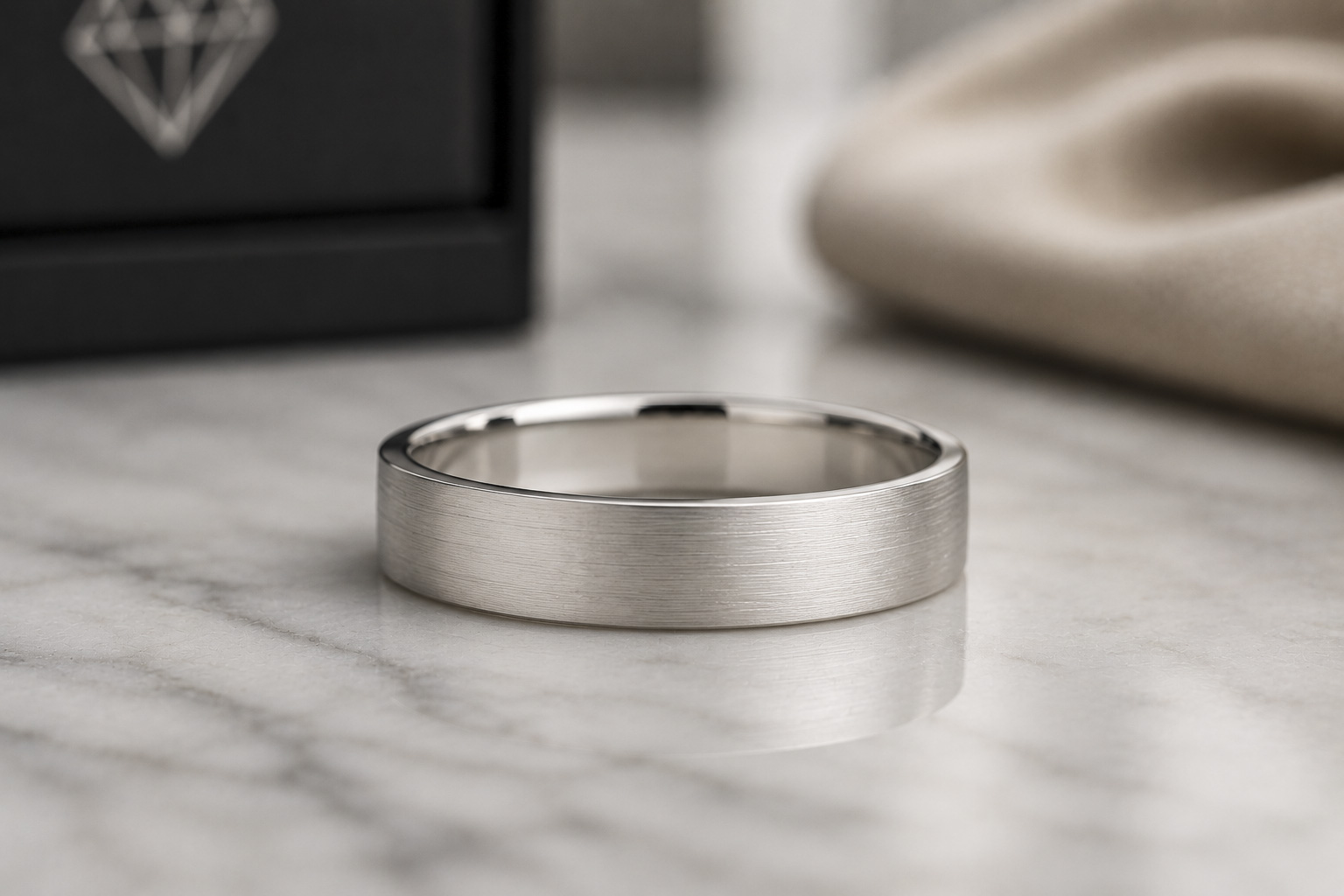
Matte does not mean maintenance-free. It means the surface wears differently.
The 30-second answer
A brushed wedding band uses directional abrasion to create a low-reflection surface with visible grain. It usually shows fine everyday marks less sharply than high polish, but high-contact areas can burnish and become smoother over time. Choose brushed if you like quiet texture and intentional contrast—not because you expect the finish to remain unchanged forever.
Brushed wedding bands are popular because they feel understated, modern and tactile without becoming visually busy. The finish can soften the appearance of yellow, white or rose gold, reduce mirror-like reflection and highlight the geometry of a flat, beveled or grooved band.
The word “brushed” is often used loosely. A true brushed finish normally shows directional lines. Satin is usually softer and more uniform. Sandblasted finishes appear more diffuse or granular. Matte can refer broadly to any low-reflection surface. Understanding these differences matters because each finish looks and ages differently.
If you only remember ten things
- Brushed finishes show directional grain.
- Satin finishes are usually softer and more uniform.
- Sandblasted finishes are more diffuse and granular.
- Brushed bands still scratch.
- High-contact areas may become shinier with wear.
- Many gold and platinum bands can be professionally rebrushed.
- Alternative-metal refinishing options vary.
- The direction of the brush changes the visual proportion of the band.
- Polished bevels and grooves can preserve visual contrast.
- The best finish is one whose aging pattern you are comfortable seeing.
What is a brushed wedding band?
A brushed wedding band has fine, intentionally applied lines across the surface. These lines are created through controlled abrasion and reduce the amount of sharp reflection from the metal.
The effect can range from subtle and silky to clearly linear and industrial. The appearance depends on the abrasive, pressure, direction, metal and final finishing technique. A softly brushed platinum ring can look very different from a deeply cross-brushed titanium band, even though both may be described as matte.
Brushed vs. satin vs. sandblasted vs. high polish
| Finish | Surface look | Wear pattern | Best for |
|---|---|---|---|
| Brushed | Directional lines | Can polish at high-contact points | Modern, tailored texture |
| Satin | Soft, even low sheen | Can become unevenly burnished | Quiet, refined matte appearance |
| Sandblasted | Fine diffuse texture | Can smooth with wear | Strong matte or contemporary look |
| High polish | Mirror-like reflection | Shows fine scratches clearly | Classic, formal shine |
| Hammered | Faceted or dimpled texture | Raised points polish first | Organic or artisanal character |
Brushed vs. satin
Brushed and satin are related but not identical. Brushed finishes typically show visible directional grain. Satin finishes usually appear softer, more even and less obviously linear.
A client who wants texture may prefer brushed. A client who wants only reduced reflection may prefer satin. The distinction can be subtle, so the best approach is to compare physical samples rather than relying on terminology alone.
Brushed vs. sandblasted
Sandblasted finishes use fine particles to create a diffuse, evenly textured surface. They often feel more uniformly matte and can appear slightly frosted. Brushed finishes retain directional movement.
Sandblasted surfaces may show polished contact zones strongly because the original texture is so diffuse. Brushed finishes can blend directional marks more naturally into later wear.
Brushed vs. polished
High polish reflects light sharply and produces a traditional jewelry appearance. Fine scratches are often easy to see, especially when the ring is new. Brushed finishes reduce this contrast, so some marks blend more easily.
That does not mean brushed is more durable. The same metal is underneath. The surface simply presents wear differently.
How brushing direction changes the design
The direction of the grain affects visual proportion. Horizontal brushing can make a band feel longer and calmer. Vertical brushing can emphasize width. Diagonal brushing introduces movement. Cross-brushing creates a more technical or industrial appearance.
| Direction | Visual effect | Common use |
|---|---|---|
| Horizontal | Lengthens and quiets the band | Classic flat or domed bands |
| Vertical | Emphasizes width | Bold modern rings |
| Diagonal | Adds motion | Contemporary or asymmetric designs |
| Cross-brushed | Creates layered texture | Industrial or technical styling |
| Radial | Moves outward from a focal point | Custom geometric designs |
Do brushed wedding bands show scratches?
Yes. All wedding bands show wear. A brushed finish may hide some fine marks because they blend into the directional grain, but deeper scratches can cross the finish and remain visible.
The more noticeable change is often burnishing. High-contact areas on the palm side or edges may become smoother and shinier. This creates a mixed surface that some clients appreciate and others want restored.
How brushed finishes age
A brushed ring usually becomes less uniform over time. Edges polish. Flat centers may develop random marks. Raised rails may brighten. Grooves may preserve their original texture longer because they receive less contact.
The aging pattern depends on occupation, hand dominance, ring width, metal and how often the band contacts hard surfaces. A wide flat ring may show more desk wear than a narrow domed band.
Choose the finish based on how it will age—not only how it looks on day one.
Can a brushed finish be restored?
Many gold and platinum wedding bands can be professionally rebrushed. The jeweler recreates the original grain direction and depth. Polished edges or grooves may also be restored at the same time.
Repeated aggressive refinishing should be avoided because surface material can be removed. A light professional refinish performed when needed is generally more appropriate than frequent cosmetic correction.
Alternative metals vary. Tungsten, titanium, cobalt and ceramic may have limited refinishing options depending on construction, coating and manufacturer.
Brushed 14K gold wedding bands
14K gold is a practical choice for brushed bands because it offers traditional precious-metal serviceability and a range of colors. The finish can soften the appearance of yellow gold, reduce glare in white gold and make rose gold feel more muted.
14K white gold may still require rhodium plating if a bright white appearance is desired. Brushing over plated surfaces should be handled professionally.
Brushed 18K gold wedding bands
18K gold has higher gold content and often richer color. A brushed finish can make 18K yellow gold feel sophisticated and less reflective while preserving its warmth.
Because many 18K alloys are softer than comparable 14K alloys, the finish may change more quickly in high-contact areas. That does not make it unsuitable; it simply affects the expected wear pattern.
Brushed platinum wedding bands
Platinum naturally develops patina, making it especially compatible with brushed and satin treatments. The original grain will still evolve, but the transition can feel harmonious because the metal already tends toward a softer surface over time.
Platinum’s density gives wide brushed bands a substantial feel. Clients who dislike heavy jewelry should compare weight before ordering.
Brushed tungsten wedding bands
Tungsten carbide can hold a crisp brushed appearance and resists many everyday scratches better than precious metals. However, coatings, inlays and polished edges may age differently.
Tungsten usually cannot be resized and may not be traditionally refinished. Replacement is often the long-term solution if the finish or size no longer works.
Brushed titanium wedding bands
Titanium is lightweight and well suited to modern brushed finishes. It can show surface marks despite being strong. Resizing and refinishing options may be limited depending on design.
Brushed cobalt wedding bands
Cobalt has a bright white appearance and can support brushed or satin finishes. It generally feels heavier than titanium and lighter than tungsten. Service options vary.
Brushed black wedding bands
Black wedding bands often use coatings, treatments, ceramic, tungsten or darkened metals. A brushed black surface can look dramatic, but scratches may reveal a different underlying color if the black is only a surface coating.
Ask whether the color runs through the material or sits on the surface. This determines how wear will appear and whether refinishing is possible.
Brushed yellow, white and rose gold
| Metal color | Brushed appearance | Design effect |
|---|---|---|
| Yellow gold | Warm, muted glow | Traditional metal with modern restraint |
| White gold | Cool, technical surface | Clean and contemporary |
| Rose gold | Soft copper warmth | Romantic but understated |
| Platinum | Soft natural white | Luxury with quiet patina |
Flat, domed and beveled profiles
Finish and profile work together. A flat band displays directional grain clearly. A domed band softens the effect as light moves across the curve. A beveled band can combine a brushed center with polished edges for contrast.
Flat brushed bands
Flat bands feel modern and architectural. They provide a broad surface for visible grain but can show desk contact clearly.
Domed brushed bands
Domed profiles feel more traditional and often glide over surfaces more easily. The brushing appears softer because the curvature breaks up reflection.
Beveled brushed bands
Beveled bands are ideal for mixed finishes. A brushed center can be framed by polished bevels, creating a durable visual boundary.
Polished edges, grooves and rails
Brushed finishes pair especially well with polished details. Polished bevels, edge rails, center grooves or raised borders create contrast and make the finish feel intentional.
These design elements also age differently. Raised polished sections may scratch, while recessed brushed areas stay protected. The changing contrast becomes part of the design.
Brushed bands with diamonds
Diamonds create a bright contrast against a matte surface. Channel-set, flush-set or bezel-set stones can look especially crisp in a brushed band.
The setting should be chosen for security and maintenance, not only appearance. Fine brushed grain near small stones may be difficult to restore without affecting prongs or beads.
Brushed bands with engraving
Engraving can be applied inside or outside a brushed band. Exterior engraving should be planned with the grain direction. Deep engraving can remain visible even as the surface changes, while very fine detail may soften over time.
Hand engraving, machine engraving and laser engraving each create different results. The finish may need to be applied before or after engraving depending on the desired contrast.
Brushed bands for different lifestyles
| Lifestyle | What to expect | Possible direction |
|---|---|---|
| Office work | Desk and keyboard contact on palm side | Brushed center with durable edge profile |
| Healthcare | Gloves, sanitation, frequent washing | Smoother low-profile design |
| Trades | Heavy abrasion and impact | Remove during hazardous work |
| Fitness | Pressure and equipment contact | Remove before lifting |
| Frequent travel | Low-key appearance may appeal | Simple brushed precious-metal band |
| Low-maintenance preference | Finish still changes | Choose texture you accept as it evolves |
Are brushed bands lower maintenance?
They can feel lower maintenance because fine marks are less obvious than on high polish. But they still require cleaning, inspection and occasional refinishing if you want the original appearance restored.
Clients who want truly minimal cosmetic maintenance should focus less on keeping the finish perfect and more on choosing a finish that looks good as it changes.
Can I brush a polished wedding band later?
Often yes, especially with gold or platinum. A jeweler can convert many polished bands to brushed or satin finishes. The result depends on profile, engraving, stones and edge details.
Converting a brushed band back to high polish is also often possible, though repeated refinishing can soften edges and details.
Custom brushed wedding band ideas
- Horizontal brush on a domed band
- Satin center with soft polished edges
- Fine brush in yellow gold
- Single recessed groove
- Low-contrast mixed finish
- Cross-brushed flat band
- Black brushed center with bright edges
- Vertical grain on a wide profile
- Deep center channel
- Asymmetric brushed and polished sections
Common myths
- Brushed bands do not scratch
- Matte finishes never need maintenance
- Brushed and satin are identical
- Any metal can be refinished the same way
- Brushed always looks casual
- Polished edges stay perfect
- All metals show wear
- High-contact areas can burnish
- Grain direction creates a distinct effect
- Service options depend on material
- Brushed can look formal or architectural
- Mixed finishes evolve together
A practical decision tree
Do you want visible directional texture? Choose brushed.
Do you want a softer, more uniform matte surface? Compare satin.
Do you want the strongest diffuse matte appearance? Compare sandblasted.
Do you want low reflection but clear geometry? Choose brushed with polished bevels or rails.
Do you want easy refinishing? Favor gold or platinum over alternative metals.
Do you dislike visible finish changes? Remember that every finish changes; choose the aging pattern you prefer.
Do you want the ring to look wider? Compare vertical grain.
Do you want the band to feel longer and calmer? Compare horizontal grain.
Buyer checklist
- Compare brushed, satin, sandblasted and polished samples.
- Confirm grain direction.
- Confirm the metal and whether it can be refinished.
- Review how the finish will change at contact points.
- Choose flat, domed or beveled profile.
- Confirm edge, groove and rail finishes.
- Discuss diamond-setting maintenance.
- Review engraving placement.
- Ask whether coatings are involved.
- Understand resizing limits.
- Confirm the exact width and thickness.
- Choose a finish you will like after it begins to wear.
Do you want the ring to stay visually quiet—or do you want the contrast between textures to become the design?
What is a brushed wedding band?
A brushed wedding band has fine directional lines that reduce reflection and create a matte or low-sheen surface.
Is brushed the same as satin?
No. Brushed finishes usually show more directional grain, while satin finishes tend to look softer and more uniform.
Is brushed the same as matte?
Brushed is one type of matte finish. Matte is a broader term that also includes satin, sandblasted and other low-reflection surfaces.
Do brushed wedding bands scratch?
Yes. Fine marks may blend into the grain, but deeper scratches and polished contact areas can still appear.
Do brushed bands become shiny?
High-contact areas can burnish and become smoother or shinier over time, especially on the palm side and edges.
Can a brushed finish be restored?
Many gold and platinum bands can be professionally rebrushed. Alternative-metal refinishing options vary.
Which metals work best with brushed finishes?
Gold, platinum, titanium, cobalt and tungsten can all support brushed looks, but serviceability and wear differ.
Is brushed gold durable?
The finish does not change the underlying durability of the gold. It changes how scratches and wear appear.
Does brushed platinum stay matte?
Platinum develops patina and high-contact areas can change. The original brushing can usually be restored professionally.
Are brushed tungsten rings scratch-proof?
No. Tungsten is highly scratch-resistant, but coatings, inlays and polished sections may still wear or scratch.
Can a polished ring be changed to brushed?
Often yes, especially in gold or platinum. Stones, engraving and profile may affect the result.
Can a brushed ring be polished later?
Often yes. Repeated refinishing should be limited because it can soften edges and remove material.
Which brushing direction looks best?
Horizontal grain feels longer and calmer, vertical grain emphasizes width and cross-brushing creates a more industrial look.
Do brushed bands hide scratches better?
They often hide fine marks better than high polish, but deeper scratches and burnished areas can remain visible.
Are brushed wedding bands lower maintenance?
They may look acceptable with more surface wear, but they still need cleaning, inspection and optional refinishing.
Can brushed bands include diamonds?
Yes. Flush-set, channel-set and bezel-set diamonds can contrast beautifully with a brushed surface.
Can brushed wedding bands be engraved?
Yes. Interior and exterior engraving are possible, though the grain direction and finish sequence should be planned.
Do brushed black wedding bands show scratches?
They can. If the black color is a coating, scratches may reveal a different underlying color.
Are brushed bands good for active lifestyles?
They may disguise some wear, but the ring should still be removed for lifting, machinery and high-impact activities.
How do I choose between brushed and polished?
Choose brushed for quiet directional texture and polished for mirror-like reflection. Compare how each finish looks as it begins to wear.