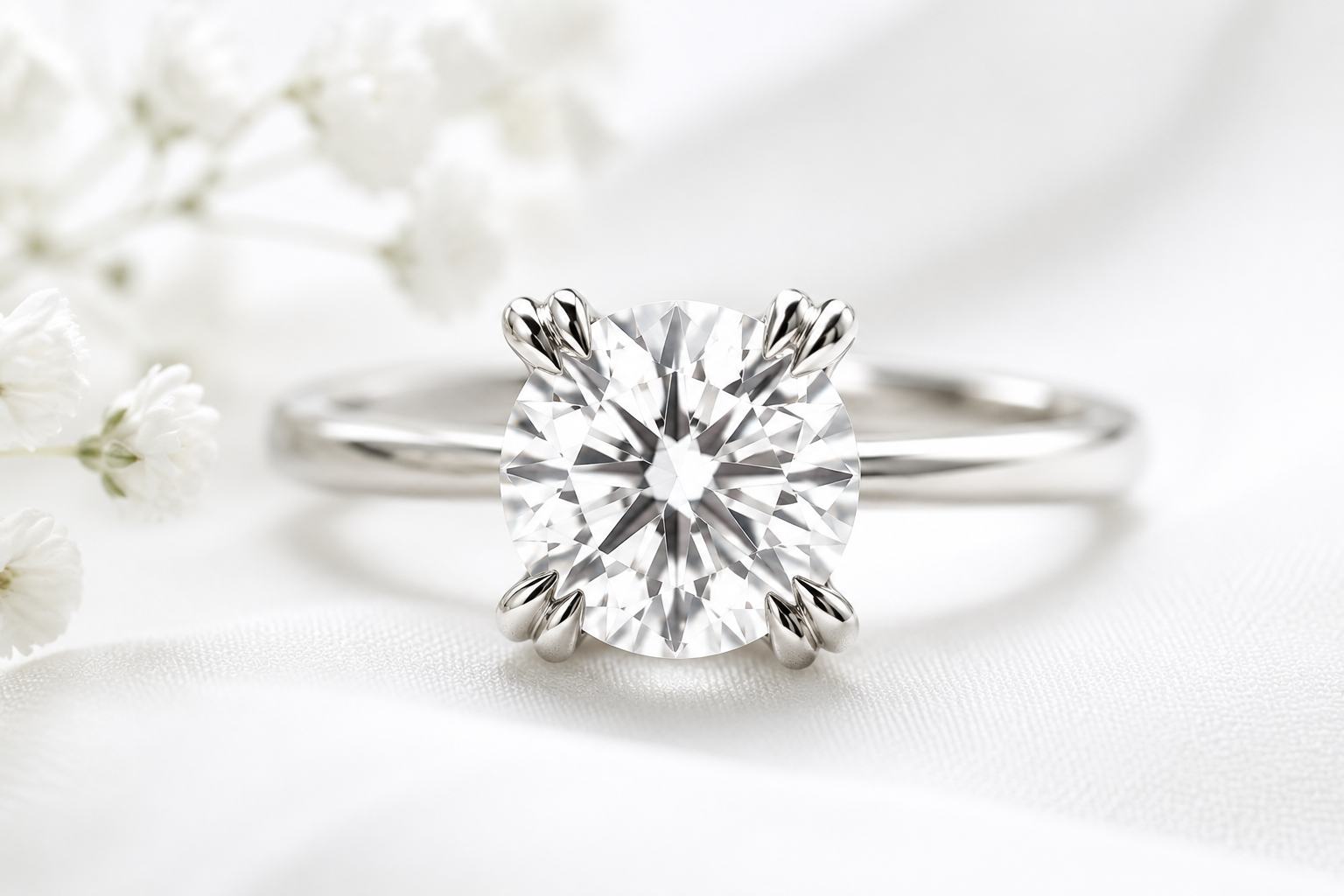
Claw prongs are tapered prongs finished to a fine point rather than a rounded bead. They hold the diamond while creating a slimmer, sharper and more intentional visual frame.
Why are claw prongs trending?
Engagement-ring design has moved toward cleaner silhouettes, elongated diamond shapes and highly considered details. Claw prongs fit that direction perfectly. Instead of ending in a rounded bead, the prong narrows toward the diamond, creating a slimmer and more tailored frame. The look works with minimalist solitaires, geometric center stones and vintage-inspired designs without requiring extra ornament.
Claw prongs vs. round prongs
Both styles can hold a diamond securely when properly engineered. The difference is primarily visual: a round or button prong has a softer finish, while a claw prong tapers to a pointed or softly pointed tip. Claws can appear finer from the top and may reveal more of the diamond outline. The best choice is the one that supports the ring’s overall design rather than simply following a trend.
Single claw vs. double claw prongs
Single claw prongs use one tapered prong at each contact point and are ideal when minimal visible metal is the goal. Double claw prongs place two fine claws near a corner or contact point. They can add a subtle vintage influence and look especially elegant on emerald, radiant, cushion and Asscher cuts. Double claws should remain proportional; if they become too heavy, they can compete with the stone.
What are petite claw prongs?
Petite claw prongs are intentionally fine, tapered prongs designed to minimize visual interruption. Petite should never mean underbuilt. Metal thickness, alloy, prong length, basket structure and diamond size determine how fine a prong can safely be. In custom design, the goal is not the smallest possible prong—it is the smallest appropriate prong for that diamond and setting.
Which diamond shapes look best with claw prongs?
Claw prongs can work with nearly every shape. Ovals benefit from fine claws that preserve their elongated outline. Emerald and Asscher cuts pair naturally with single or double claws at their clipped corners. Radiant and cushion cuts gain definition without bulky rounded tips. Round diamonds can use four or six claw prongs for a refined solitaire look. Pear and marquise shapes still require deliberate protection at their vulnerable points; a pointed aesthetic never replaces proper structural protection.
Are claw prongs secure?
Yes—when the ring is properly designed, set and maintained. The visible tip is only one part of prong security. The amount of metal over the crown, the seat cut into the prong, contact with the diamond, supporting gallery and quality of the setting work all matter. A beautifully pointed claw should not be filed so thin that durability is sacrificed.
Do claw prongs snag?
Any raised prong can catch if it is lifted, damaged or poorly finished. A properly finished claw should lie smoothly against the diamond and should not have a sharp edge projecting upward. If a ring begins catching hair or clothing when it did not before, have it inspected; that can be an early sign that a prong has shifted or worn.
Do claw prongs require more maintenance?
They require the same fundamental habit as other prong-set engagement rings: periodic inspection. Fine prongs have less excess metal by design, so wear should not be ignored. Remove the ring for activities that can crush, bend or heavily abrade the setting, and have it checked after a significant impact.
Can an existing ring be changed to claw prongs?
Sometimes, but simply filing round prongs into points is not always appropriate. If existing prongs are short or worn, reshaping them can remove metal needed for security. A jeweler may recommend retipping, rebuilding the head or creating a new setting instead.
Claw prongs in custom engagement-ring design
Claw prongs are exactly the kind of detail that benefits from collaborative CAD design. Prong count, placement, basket height, gallery shape and wedding-band clearance can be considered together. At Diamond Consulate in Oklahoma City, couples can compare the overall proportions of a custom engagement ring before production. CAD is enlarged, so prongs may look more prominent on screen than after setting and finishing.
A trend that can still look timeless
The best reason to choose claw prongs is not simply that they are popular now. It is that their tapered shape supports the design. A clean solitaire with delicate claws can remain timeless, while double claws can give a geometric diamond a subtle antique influence without turning the entire ring into a vintage reproduction.
Claw vs. round prongs at a glance
The short answer
Claw prongs can create a refined minimal look, but their proportions and placement must be engineered around the diamond shape and everyday wear. That is the useful starting point, but it is not the entire decision. Two pieces can share the same headline specification and still look, wear, and perform very differently because jewelry is a system of proportions, materials, stones, setting style, craftsmanship and personal preference.
For people researching claw prong engagement rings, the most productive approach is to separate objective constraints from subjective preferences. Objective constraints include durability, dimensions, stone security, sizing limitations and production requirements. Subjective preferences include silhouette, sparkle pattern, metal color, visual weight and how noticeable or understated the finished piece feels.
What matters most when comparing your options
The first factor to evaluate is single claw prongs. This is often where the practical boundaries of the decision become clear. Instead of asking whether one option is universally better, ask what changes visually, structurally and financially when this variable changes. That framing produces a more useful answer than relying on a generic rule.
The second factor is double claw prongs. Small differences can have an outsized effect on appearance or usability, particularly when the piece is viewed from normal conversational distance rather than under magnification. A well-proportioned design should look intentional from the top, side and three-quarter views.
Next consider rounded prongs and stone shape. These factors frequently interact. A decision that improves one characteristic can create a tradeoff somewhere else, such as more maintenance, more visible metal, less flexibility for future sizing, a different sparkle pattern or a higher material cost.
Finally, security and maintenance help determine whether the choice remains satisfying after the initial purchase. Long-term ownership matters. Jewelry should be evaluated not only for how it photographs on day one, but also for how it will be worn, cleaned, inspected, serviced and potentially modified over time.
How to evaluate the difference in person
Tradeoffs buyers often miss
What to verify before you commit
Ask how single claw prongs changes the finished appearance and whether the difference will be obvious without magnification. A useful explanation should connect the technical term to something you can actually see or feel rather than simply repeating a grade, material name or sales claim.
Ask what compromises are created by double claw prongs and rounded prongs. If there is no tradeoff at all, the explanation is probably incomplete. Jewelry design is full of balanced decisions involving metal, dimensions, stones, height, coverage, security and cost.
Ask how stone shape affects everyday wear and what maintenance is recommended. Also ask whether security creates any limitations for sizing, repair or future redesign. These questions matter more over ten years of ownership than they do during a ten-minute purchase decision.
Ask to compare an alternative that changes maintenance. Seeing a meaningful contrast is often more educational than looking at several nearly identical examples. The purpose of a consultation should be to make differences visible and understandable, not to overwhelm you with inventory.
How budget should influence the decision
What craftsmanship changes
Maintenance and long-term ownership
A practical decision framework
For claw prong engagement rings, that framework keeps the conversation centered on the finished experience rather than on isolated specifications. It also produces a decision that is easier to explain later because you know which tradeoffs you intentionally accepted.
Oklahoma City perspective and next steps
Deep dive: the six variables that shape claw prong engagement rings
Single Claw Prongs
Single Claw Prongs deserves separate attention because it can change both the visual result and the ownership experience. Evaluate it in relation to the entire piece rather than as an isolated checkbox. Ask what you gain, what you give up, and whether the difference remains noticeable at normal viewing distance. When a choice is primarily aesthetic, preference should lead. When it affects structure, stone security, sizing or service, the technical implications should be understood before approval.
In practice, the best way to understand single claw prongs is through a direct comparison. Keep the other major variables as consistent as possible and change this one. That makes the effect easier to see and prevents several differences from being mistakenly attributed to a single cause. This comparison-first approach is particularly useful for online research because it turns a broad question into a specific, observable decision.
Double Claw Prongs
Double Claw Prongs deserves separate attention because it can change both the visual result and the ownership experience. Evaluate it in relation to the entire piece rather than as an isolated checkbox. Ask what you gain, what you give up, and whether the difference remains noticeable at normal viewing distance. When a choice is primarily aesthetic, preference should lead. When it affects structure, stone security, sizing or service, the technical implications should be understood before approval.
In practice, the best way to understand double claw prongs is through a direct comparison. Keep the other major variables as consistent as possible and change this one. That makes the effect easier to see and prevents several differences from being mistakenly attributed to a single cause. This comparison-first approach is particularly useful for online research because it turns a broad question into a specific, observable decision.
Rounded Prongs
Rounded Prongs deserves separate attention because it can change both the visual result and the ownership experience. Evaluate it in relation to the entire piece rather than as an isolated checkbox. Ask what you gain, what you give up, and whether the difference remains noticeable at normal viewing distance. When a choice is primarily aesthetic, preference should lead. When it affects structure, stone security, sizing or service, the technical implications should be understood before approval.
In practice, the best way to understand rounded prongs is through a direct comparison. Keep the other major variables as consistent as possible and change this one. That makes the effect easier to see and prevents several differences from being mistakenly attributed to a single cause. This comparison-first approach is particularly useful for online research because it turns a broad question into a specific, observable decision.
Stone Shape
Stone Shape deserves separate attention because it can change both the visual result and the ownership experience. Evaluate it in relation to the entire piece rather than as an isolated checkbox. Ask what you gain, what you give up, and whether the difference remains noticeable at normal viewing distance. When a choice is primarily aesthetic, preference should lead. When it affects structure, stone security, sizing or service, the technical implications should be understood before approval.
In practice, the best way to understand stone shape is through a direct comparison. Keep the other major variables as consistent as possible and change this one. That makes the effect easier to see and prevents several differences from being mistakenly attributed to a single cause. This comparison-first approach is particularly useful for online research because it turns a broad question into a specific, observable decision.
Security
Security deserves separate attention because it can change both the visual result and the ownership experience. Evaluate it in relation to the entire piece rather than as an isolated checkbox. Ask what you gain, what you give up, and whether the difference remains noticeable at normal viewing distance. When a choice is primarily aesthetic, preference should lead. When it affects structure, stone security, sizing or service, the technical implications should be understood before approval.
In practice, the best way to understand security is through a direct comparison. Keep the other major variables as consistent as possible and change this one. That makes the effect easier to see and prevents several differences from being mistakenly attributed to a single cause. This comparison-first approach is particularly useful for online research because it turns a broad question into a specific, observable decision.
Maintenance
Continue your research
Explore next: Diamond Education · Engagement Ring Education · Custom Jewelry Education · Wedding Band Education · Reserve a Private Consultation
Frequently asked questions
What is a claw prong?
A diamond-holding prong that tapers to a fine pointed or softly pointed tip instead of ending in a rounded bead.
Are claw prongs just a trend?
They are especially popular now, but pointed prong finishes have long existed in fine jewelry and can look timeless.
Are claw prongs safe?
Yes. Security depends on the complete setting, metal thickness, seat and workmanship, not merely the tip shape.
Are double claw prongs more secure?
They add contact points in some designs, but proper engineering matters more than the number of claws alone.
Which diamonds look best with double claws?
Emerald, Asscher, radiant and cushion cuts often pair beautifully with double claws because the detail complements their corners.
Can round diamonds have claw prongs?
Yes. Fine claw tips can give a four- or six-prong round solitaire a refined finish.
Do claw prongs feel sharp?
Properly finished claws should lie smoothly against the diamond and should not present an exposed sharp edge.
Do claw prongs snag clothing?
Well-finished prongs should minimize snagging. New catching can indicate a lifted or damaged prong and should be inspected.
Can round prongs be converted to claws?
Sometimes. A jeweler must determine whether enough sound metal exists to reshape them safely or whether rebuilding is preferable.
What are petite claw prongs?
Fine tapered prongs designed to reduce visible metal while retaining dimensions appropriate for the specific diamond.
Are claw prongs good for oval rings?
Yes. Their fine tapered appearance can preserve the elongated outline of an oval and keep the setting visually light.
Can claw prongs work on a low-profile ring?
Yes. Claw describes the prong-tip finish; the basket can be engineered at different heights.
Do claw prongs cost more?
Cost depends on the complete ring and setting labor. Fine single or double claws can require additional precision.
Can I see claw-prong options before production?
Yes. CAD can show prong count, placement and overall proportions before production, although final finished prongs appear finer than enlarged renderings.
Design the detail, not just the diamond
During a private Diamond Consulate consultation, we can design the setting around the actual diamond, the wearer’s lifestyle and the look you want from every angle.